
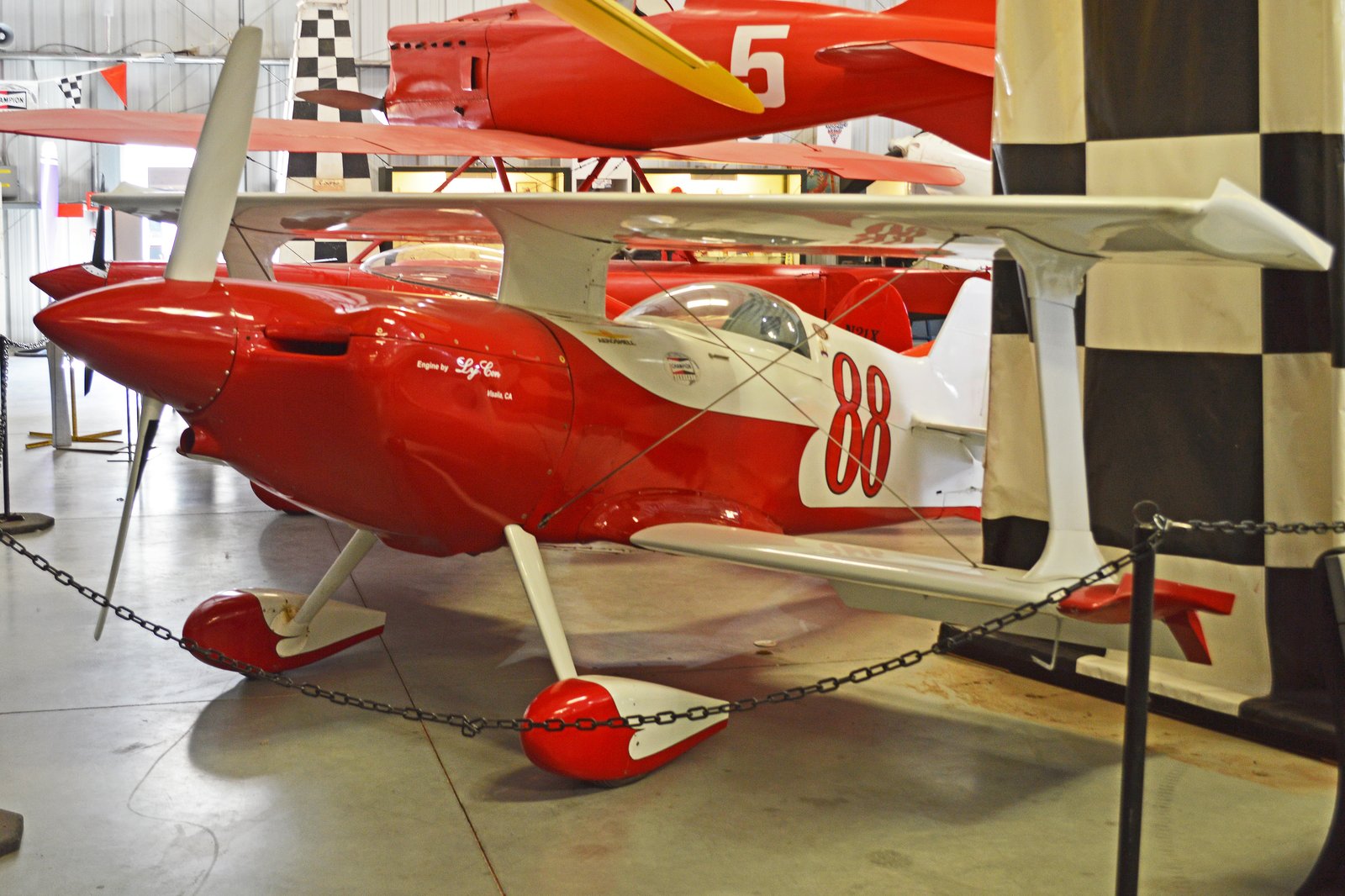
Racing Dominance
The MONG Sport achieved unparalleled success in competitive air racing, establishing one of the most remarkable winning streaks in aviation racing history. When a biplane class was added to the Reno National Championship Air Races in the mid-1960s, the MONG Sport immediately proved its superiority. Bill Boland's victories began in 1965 at 148.6 mph, followed by consecutive wins in 1967 at 151 mph and 1970 at 177 mph. The same airframe, racing under various names including "Mongster" and "Long Gone Mong," continued winning through 1994, with its final victory recorded at 212.81 mph.
Design Innovation
Ralph Mong Jr.'s engineering breakthrough centered on an innovative structural approach that eliminated traditional support wires. The design featured lift struts positioned between the lower fuselage frame and upper wing attachment points, utilizing steel tubing instead of expensive, drag-producing wire bracing. This configuration allowed the compact biplane to extract maximum performance from its modest Continental A65 powerplant, producing results that defied conventional power-to-weight expectations.
The Designer and Development
Ralph Mong Jr. conceived the MS1 Sport as a personal aircraft project in the early 1950s. Following successful test flights, demand for the design led to collaboration with Frank Powell, an aerospace engineer and draftsman working at Aero Commander. Powell's technical expertise proved crucial in developing comprehensive construction plans suitable for homebuilders. The partnership resulted in detailed blueprints that enabled amateur constructors to achieve professional-level performance.
Technical Specifications
The MONG Sport's performance figures demonstrated exceptional efficiency for its era. With an empty weight of 550 pounds and gross weight of 970 pounds, the aircraft achieved a cruise speed of 110 mph and maximum speed of 115 mph. Its service ceiling reached 13,000 feet with a climb rate of 1,000 feet per minute. The 16-gallon fuel capacity provided a range of 400 miles, while the remarkably low stall speed of 50 mph offered forgiving handling characteristics.
Production and Ownership Changes
More than 400 sets of construction plans have been distributed since the design's introduction, making the MONG Sport one of the more popular homebuilt aircraft of its generation. Unlike factory-produced aircraft, each example was constructed by individual builders using the detailed plans. In 1996, Ed Fisher acquired rights to the design, maintaining availability of construction documentation. Mike Stewart subsequently purchased the rights in 2019, currently offering updated plans for MS-2 and MS-3 variants with corrections to original blueprint errors.
Racing Modifications and Records
As air racing technology advanced, MONG Sport variants incorporated increasingly sophisticated modifications while retaining the basic airframe design. The evolution culminated in 2006 when a heavily modified example called "Phantom" achieved 251.958 mph, later pushing the record to 284.454 mph. This aircraft featured carbon fiber wings and extensive aerodynamic refinements, demonstrating the fundamental soundness of Mong's original concept even under extreme performance conditions.
Legacy and Museum Recognition
The MONG Sport's significance extends beyond its racing achievements to its influence on homebuilt aircraft development. Its success proved that amateur constructors could build aircraft capable of outperforming factory-produced designs in specialized applications. The aircraft's importance is recognized at the Planes of Fame Air Museum in Chino, California, where an example is permanently displayed. Contemporary builders continue constructing new examples using current plan sets, ensuring the design's survival into the 21st century.
The MONG Sport represents a unique achievement in aviation history: a homebuilt design that not only succeeded in its intended role but dominated competitive racing for three decades. Its combination of innovative engineering, practical construction methods, and exceptional performance established benchmarks that influenced subsequent homebuilt aircraft development and demonstrated the potential of amateur aviation construction.