
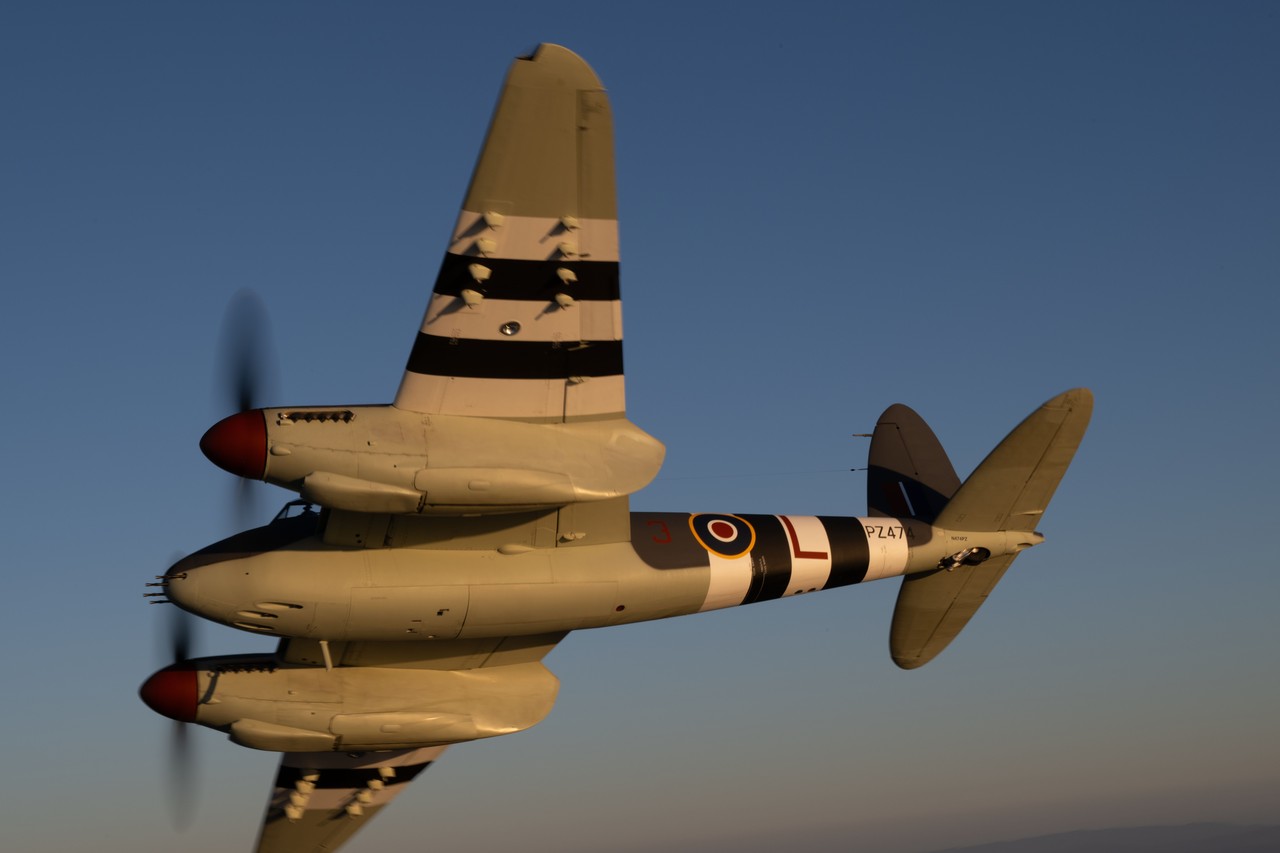
Combat Dominance and Versatility
The Mosquito's exceptional performance made it virtually untouchable by enemy fighters during much of World War II. From its first operational sortie on September 17, 1941—a photo-reconnaissance mission along the France-Spain border—the aircraft demonstrated capabilities that surpassed all expectations. By mid-1941, it had become one of the world's fastest operational aircraft, so swift that it routinely flew unarmed daylight missions over heavily defended German territory with impunity.
The aircraft's versatility proved unmatched in wartime service. Mosquito crews excelled at precision bombing, striking targets like the Gestapo headquarters in Oslo and Amiens prison with surgical accuracy. During the V-1 flying bomb campaign from June 1944 to March 1945, Mosquito nightfighters played a crucial role in Britain's defense, intercepting hundreds of these early cruise missiles. The type's first air-to-air victory came on May 29, 1942, when a crew destroyed a German Dornier 217 bomber.
Revolutionary Design Philosophy
Eric Bishop led the design team that created this remarkable aircraft, moving his core group to the secret facility at Salisbury Hall on October 7, 1939. The Mosquito's wooden construction wasn't merely a wartime expedient—it represented a deliberate design philosophy that prioritized speed and versatility over defensive armament. The aircraft's plywood fuselage with balsa wood core conserved strategic aluminum while achieving structural strength that could withstand high-speed flight and combat stresses.
Geoffrey de Havilland Jr., son of the company founder, piloted the prototype's maiden flight from Hatfield on November 25, 1940. Performance trials revealed that the aircraft exceeded all design expectations, with only minor development problems requiring attention. This success validated Bishop's radical approach of creating an unarmed bomber that could outrun enemy fighters rather than fighting them.
De Havilland Aircraft Company Legacy
The De Havilland Aircraft Company, founded by aviation pioneer Sir Geoffrey de Havilland, established its reputation through innovative designs like the DH.88 Comet racers that dominated the 1934 England-Australia Air Race. This experience with high-speed, long-range aircraft directly influenced the Mosquito's development. The company's main facility at Hatfield became the center of a vast production network that included more than 400 subcontractors throughout Britain.
De Havilland's approach to manufacturing proved as innovative as its design philosophy. The company pioneered distributed production techniques, with components manufactured across Britain, Canada, and Australia before final assembly. This strategy not only increased production capacity but also provided security against bombing attacks on individual facilities.
Powerplant and Performance
Twin Rolls-Royce Merlin inline engines powered the Mosquito to its exceptional performance levels. These liquid-cooled V-12 engines, also used in the Spitfire and Hurricane fighters, provided the power-to-weight ratio necessary for the aircraft's multi-role capabilities. Canadian production utilized Packard-built Merlins, demonstrating the international cooperation that made large-scale Mosquito production possible.
The two-man crew configuration—pilot and navigator—optimized the aircraft for its diverse missions. This arrangement allowed for specialized roles while maintaining the compact design essential to the Mosquito's speed advantage. The navigator could operate bombing equipment, manage reconnaissance cameras, or serve as radar operator in nightfighter variants, depending on the specific mission requirements.
Production Achievement
Between 1941 and 1950, manufacturers completed 7,781 Mosquitoes across all variants, making it one of the most successful British aircraft designs of the war era. Production began in mid-1941 and continued at British facilities until late 1950, with parallel production lines in Canada and Australia contributing significantly to the total output. By January 1942, contracts had already been awarded for 1,378 aircraft of various types, demonstrating military confidence in the design.
The aircraft appeared in numerous specialized variants, including the B.Mk.35 bomber, FB.VI fighter-bomber with four 20mm Hispano cannons and four .303 Browning machine guns, and the FB.Mk.26 ground-attack aircraft. Nightfighter versions like the N.F.XIX carried radar equipment, while photo-reconnaissance variants featured extensive camera installations for intelligence gathering missions.
Enduring Legacy
The RAF never possessed sufficient Mosquitoes to fulfill all the missions that tacticians devised for this extraordinary aircraft throughout the war. Its combination of speed, range, and adaptability made it invaluable for operations that other aircraft simply could not perform effectively. The Mosquito proved that unconventional design approaches could produce superior results, challenging established military aviation doctrine.
Today, the National Air and Space Museum in Washington, D.C., preserves B.Mk.35 serial number TH 998, built at Hatfield in 1945. This aircraft later served with No. 3 Civilian Anti-Aircraft Cooperation Unit at RAF Exeter, which operated Britain's last military Mosquitoes. The "Mossie" remains a testament to innovative engineering and the principle that sometimes the most radical solutions prove the most successful.