
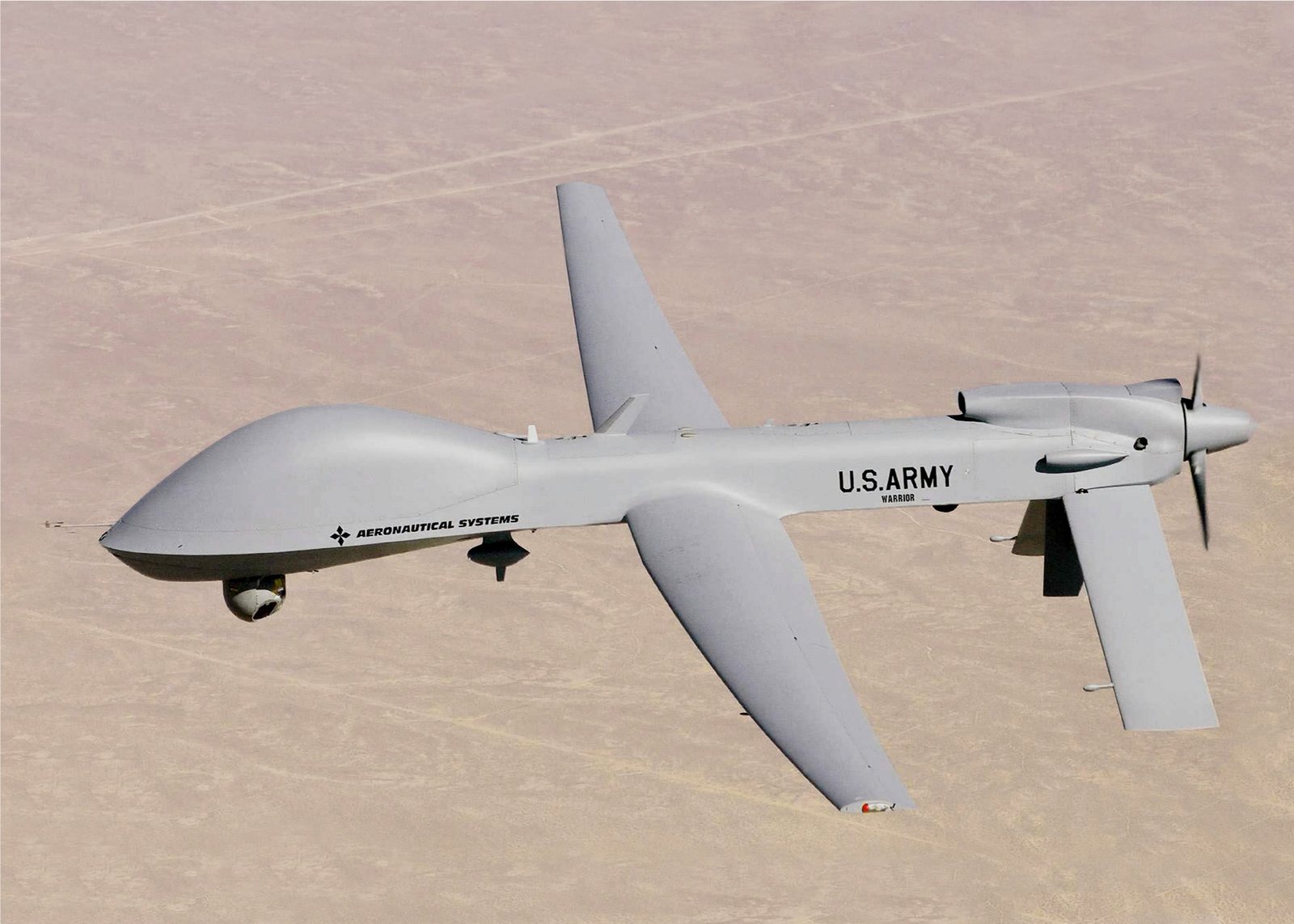
Production and Manufacturer History
The MQ-1C Gray Eagle was designed and developed by General Atomics Aeronautical Systems, Inc. (GA-ASI), a subsidiary of the San Diego-based General Atomics. Manufacturing is conducted at GA-ASI facilities in Southern California, specifically in the San Diego and Poway areas. While a precise production timeline for the baseline model is not publicly documented, the aircraft's first flight occurred in October 2004, and a July 2019 Selected Acquisition Report confirmed the program remained in active production. By October 2013, approximately 75 units had been produced. GA-ASI continues to develop and produce modernized versions, including the Gray Eagle ER and Gray Eagle 25M, well into the 2020s.
Design and Technical Specifications
Derived from the MQ-1 Predator, the Gray Eagle is a MALE UAS optimized for multi-role operations. It features an Automatic Takeoff and Landing System (ATLS), which allows for fully autonomous launch and recovery from austere airfields. The aircraft is powered by a single engine, though specific model and horsepower data are not detailed in available records. Its physical dimensions include a length of 28 feet (8.53 m). Depending on the configuration, the aircraft can carry between 800 lb (360 kg) and 1,075 lb (488 kg) of internal and external payloads, including multi-sensor suites (EO/IR with laser designator and SAR/GMTI) and communications relay equipment.
Performance and Armament
The Gray Eagle is capable of reaching a maximum airspeed of 167 knots (KTAS) and maintains a service ceiling of 29,000 feet. Its cruise speed is approximately 80 knots, and it can achieve a range of 2,500 nautical miles when equipped with external fuel tanks. Endurance varies by variant; the baseline model offers roughly 25 hours of flight time, while the MQ-1C ER variant achieved a test flight of 41.9 hours on August 6, 2017, with some configurations potentially reaching 48 hours. For strike missions, the aircraft can carry up to four AGM-114 Hellfire missiles.
Service History and Legacy
The MQ-1C entered U.S. Army service around 2009 and became a vital asset during Operation New Dawn in Iraq starting in 2010. Its operational roles are extensive, encompassing reconnaissance, surveillance, target acquisition (RSTA), signals intelligence (SIGINT), electronic warfare, and close air support. By December 2019, the fleet had accumulated 494,864 total flight hours, maintaining a 92% combat operational availability in fiscal year 2019. The U.S. Army has organized 15 Gray Eagle companies, each typically fielding 12 aircraft. The platform's legacy is defined by its shift toward Army-controlled ISR and its evolution into a networking node for multi-domain operations. At least one example is preserved at the Valiant Air Command, Inc. Warbird Museum in Florida.