
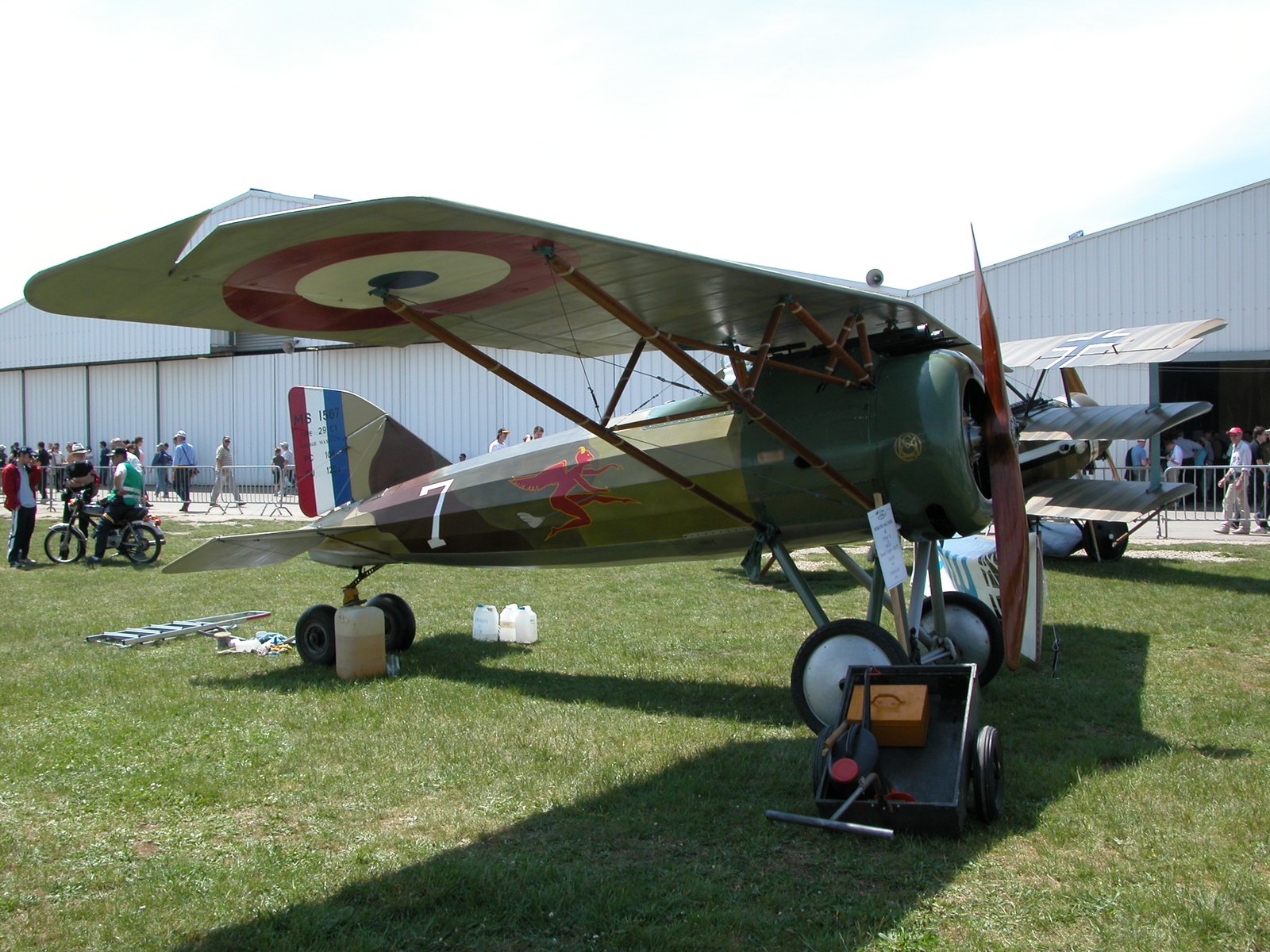
Design and Development
The Morane-Saulnier AI (also designated as the A.I or A-1) was an in-house design developed by Aéroplanes Morane-Saulnier. The project was led by technical designer Raymond Saulnier, with company principals Léon and Robert Morane associated with the effort. Presented to the French military in early 1917, the AI was a single-seat parasol-monoplane, a configuration that provided pilots with superior visibility and maneuverability compared to the biplane fighters common among Allied forces at the time.
Technical Specifications and Powerplant
The aircraft was powered by a single 160 hp Gnome rotary piston engine produced by the French firm Société des Moteurs Gnome. This air-cooled rotary engine, where the entire engine rotates with the propeller, provided a maximum speed of 129 mph (207 km/h). The AI had a wingspan of 27 feet 10 inches and a loaded weight of 1,433 lb (650 kg). While the aircraft was well-regarded for its flight characteristics, it suffered from reliability issues with the Gnome engine and alleged structural failures during operation.
Military and Civil Service
Accepted and produced in large numbers between 1917 and 1918, the AI entered frontline service with the French military during World War I. However, its combat career was remarkably brief, lasting only approximately three months due to the aforementioned structural and engine problems. Following its withdrawal from the front, many airframes were refitted with smaller, more reliable power plants and repurposed as advanced trainers for the remainder of the war and into the post-war period.
Beyond its military utility, the AI gained fame as a high-performance aerobatic platform. French ace Charles Nungesser utilized a personal AI for aerobatic demonstrations after the war. The aircraft's agility was further proven in record-setting attempts: in 1919, Lt. Temple Joyce performed 300 consecutive loops, a record that was later surpassed in 1920 by Alfred Fronval, who completed 1,111 consecutive loops in an AI.
Manufacturer Legacy
Aéroplanes Morane-Saulnier was founded in October 1911. The company evolved through the decades, producing the MS.406 fighter in the late 1930s and the MS.500 Criquet during World War II. The firm was purchased by Potez in 1962 and renamed SEEMS, with its civilian wing eventually becoming SOCATA. SOCATA was later absorbed by Aérospatiale, which is a predecessor to the modern Airbus Group. Today, no original wartime frontline Morane-Saulnier fighters are known to survive in airworthy condition; existing museum examples, such as those at the Old Rhinebeck Aerodrome, are typically replicas or heavily reconstructed.