
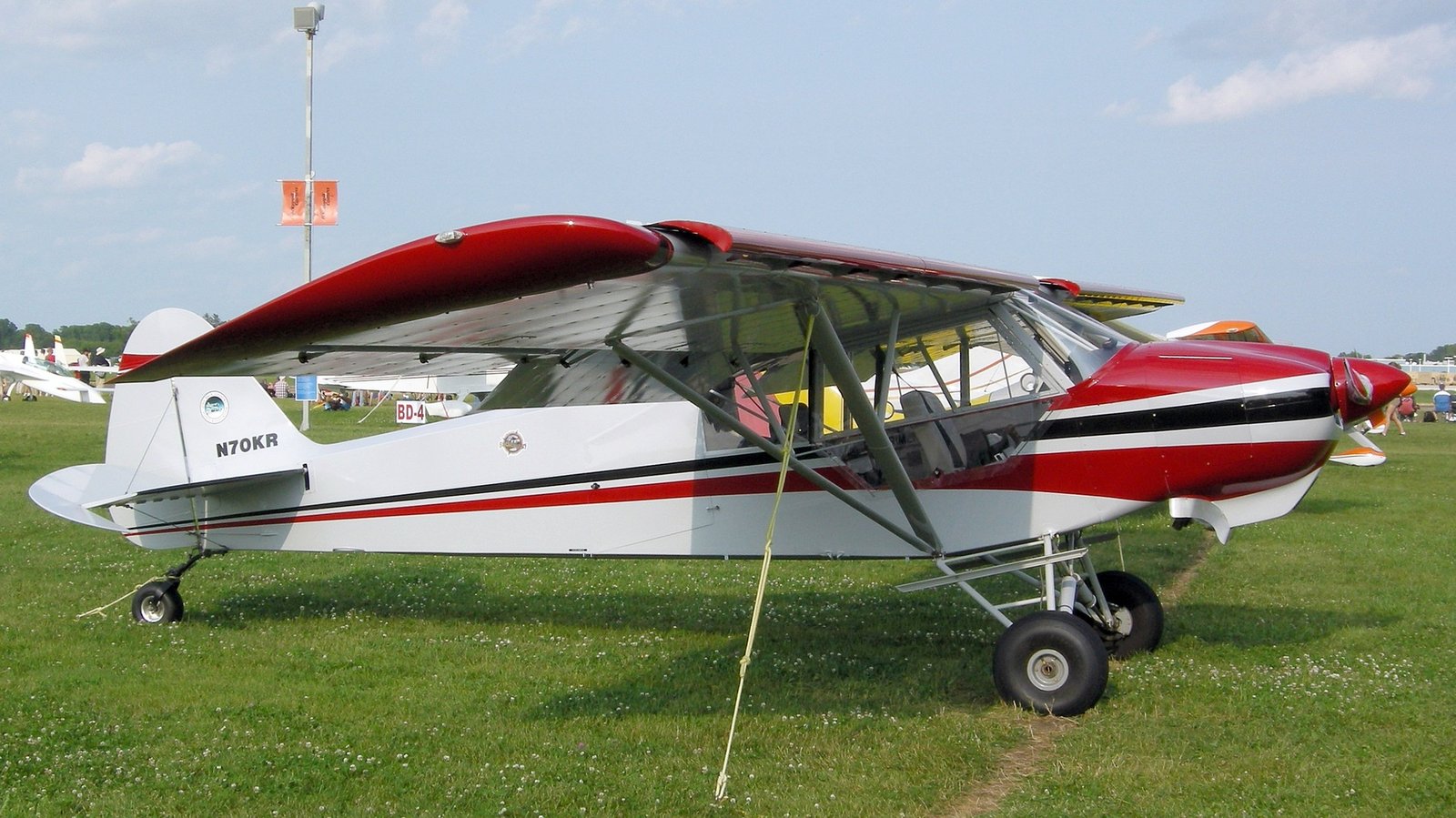
Development and Design Philosophy
Wayne Mackey of Miles City, Montana, conceived the SQ-2 in 2008 after accumulating over 25 years of experience with Piper PA-18 Super Cubs. His vision centered on creating a "next generation" STOL aircraft that would surpass the beloved Super Cub's already impressive backcountry capabilities. Mackey's design objectives addressed specific limitations he had observed in traditional bush aircraft: insufficient cabin space, restricted visibility, and performance constraints in extreme short-field operations.
The SQ-2's most revolutionary feature became its articulating leading-edge slats combined with extended-chord wings. These innovations provided unprecedented stall resistance and spin-proof characteristics, allowing the aircraft to maintain controlled flight at speeds as low as 20 mph. The wider 30-inch tandem cockpit represented a significant improvement over cramped traditional designs, while an enlarged entrance door simplified passenger and cargo access in remote locations.
Manufacturing Evolution
Backcountry Super Cubs LLC emerged from a complex corporate evolution spanning two countries and multiple ownership changes. The lineage began in 1998 when Smith Aviation was founded near London, Ontario, Canada, initially producing Super Cub replica kits. By 1999, the company had established a partnership with Wayne and Sharon Axelson in Southwold, Ontario, for wing production subcontracting.
The company relocated to Wyoming following a January 2006 sale, operating as Turbine Cubs of Wyoming, LLC. During this period, approximately 100 kits were manufactured before turbine engine availability issues forced another strategic pivot. In 2009, the organization rebranded as Backcountry Super Cubs LLC, shifting focus back to piston-powered aircraft while maintaining operations in Douglas, Wyoming.
Backcountry Super Cubs pioneered advanced manufacturing techniques including CNC cutting of 4130 chrome-moly steel tubing and precision-formed 6061-T6 aluminum wing spars. These innovations enabled consistent quality control and reduced assembly time for amateur builders.
Technical Specifications and Performance
The SQ-2's powerplant centers on the proven Lycoming O-360 four-cylinder engine, producing 180 horsepower through a two-bladed constant-speed propeller. Lycoming recommends power ranges between 180-240 horsepower, with some examples utilizing the O-375-C2A variant. The engine family's heritage extends back to the 1950s, with over 35,000 O-360-series engines produced throughout more than seven decades of continuous manufacturing.
With a maximum gross weight of 2,200 pounds and wing area of 170 square feet, the SQ-2 achieves a wing loading of just 12.9 pounds per square foot. This exceptionally low wing loading contributes directly to the aircraft's remarkable short-field performance and gentle handling characteristics. The 48-gallon fuel capacity provides a practical range of 600 miles at cruise speeds of 115 mph.
The aircraft's 36.9-foot wingspan houses the extended-chord wing design that distinguishes it from conventional Super Cub derivatives. Rate of climb reaches 1,000 feet per minute, enabling rapid departure from confined areas surrounded by terrain obstacles.
Production and Service Record
Kit production commenced in 2008, with builder assembly time estimated at 1,200 hours for completion. By December 2011, exactly seven examples had been completed and successfully flown, representing the early adoption phase of this specialized design. The limited production numbers reflect both the aircraft's specialized mission profile and the substantial commitment required for amateur construction.
One documented example, registration N58SQ with manufacturer serial number 2009, accumulated 1,335 airframe hours before sustaining substantial damage in a non-fatal accident on July 27, 2022. The aircraft carried two occupants during the incident, demonstrating the real-world utilization of these machines in demanding backcountry operations.
Legacy and Influence
The Mackey SQ-2's design innovations influenced subsequent Backcountry Super Cubs developments, including the four-seat Backcountry Boss variant that incorporates a 12-inch fuselage extension. The SQ-2's wing technology evolved into the company's Rev II and Rev III series, which feature double-slotted flaps for enhanced STOL performance.
While production numbers remained modest, the SQ-2's engineering solutions advanced the state of amateur-built STOL aircraft design. Its combination of modern manufacturing techniques with innovative aerodynamic features established new benchmarks for short-field performance and safety margins in the experimental aircraft category.
The aircraft serves exclusively in civilian roles, operating from remote airstrips, sandbars, and tundra surfaces throughout North America's wilderness regions. No military applications or commercial airline service have been recorded, consistent with its specialized bush flying mission profile.