
Development and Innovation
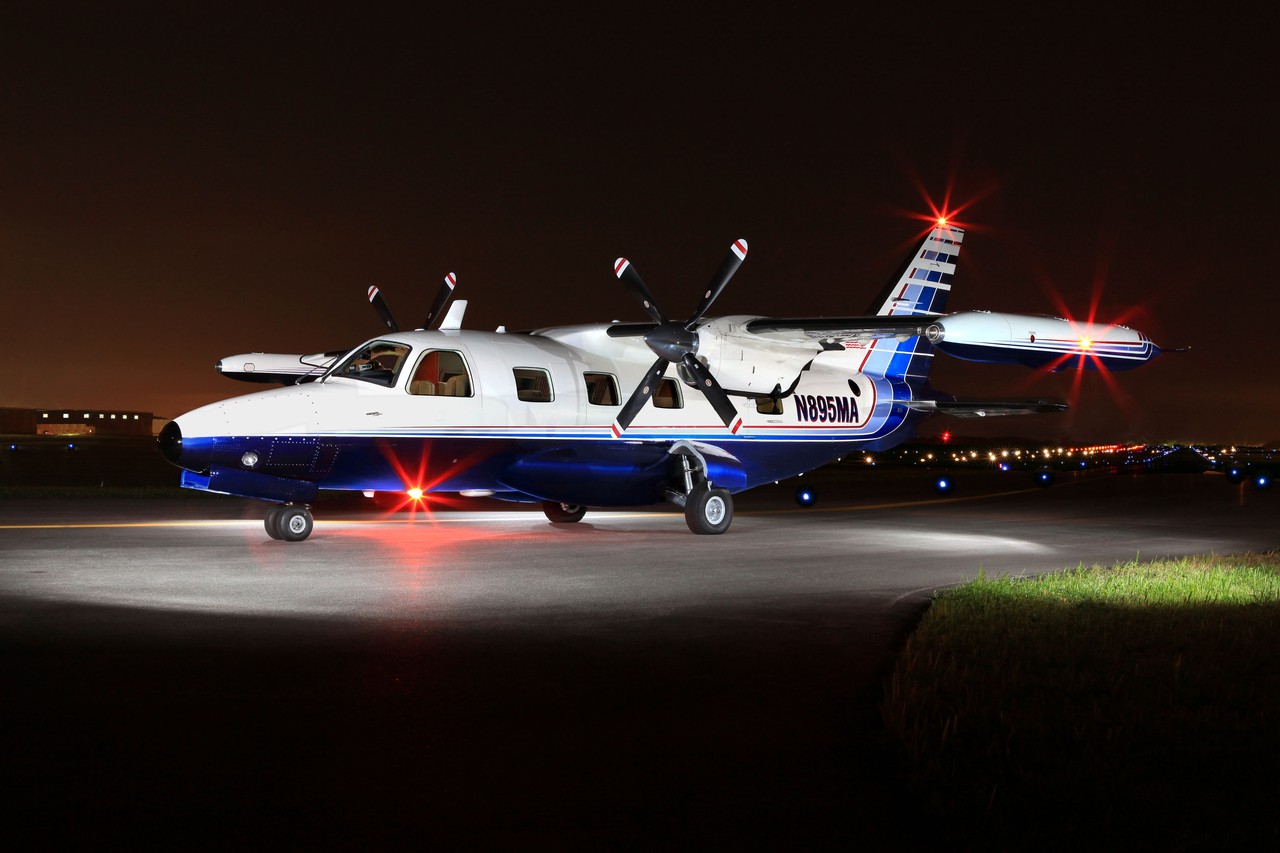
Mitsubishi Heavy Industries began developing the MU-2 in 1956, creating an entirely new turboprop design rather than adapting existing airframes. This approach distinguished the aircraft from competitors who simply mounted turboprop engines on conventional designs. The project represented Japan's ambitious return to aircraft manufacturing after the post-war restrictions were lifted.
The prototype initially flew with Turbomeca Astazou turboprops, but production models designated MU-2B adopted the Garrett TPE331 engine series that would power all subsequent variants. This engine choice proved prescient, as the TPE331 became one of the most reliable turboprop powerplants in aviation.
Production Success
From 1963 to 1986, Mitsubishi produced 704 MU-2 aircraft across 13 different model designations, making it one of postwar Japan's most commercially successful aircraft programs. Production occurred at two facilities: the primary plant in Nagoya, Japan, and a secondary assembly operation in San Angelo, Texas.
In 1963, Mitsubishi granted North American rights to Mooney Aircraft, which established the Texas facility in 1965. The arrangement allowed major components manufactured in Japan to be assembled with American engines, avionics, and interiors. Over 70 percent of total production occurred in the United States, with 703 aircraft built at San Angelo between 1966 and 1986.
When Mooney encountered financial difficulties in 1969, Mitsubishi assumed direct control of the Texas operation, continuing production until 1986. The final Japanese-built aircraft was completed in January 1987.
Aircraft Variants
The MU-2 evolved through numerous variants, divided into short-fuselage and long-fuselage configurations. Short-fuselage models included the initial MU-2B with 34 aircraft built, the MU-2F with 95 units, and the MU-2K with 83 examples. The MU-2P produced 31 aircraft, while the luxury Solitaire variant totaled 57 units.
Long-fuselage variants featured a 1.91-meter fuselage extension to accommodate additional passengers. The MU-2G produced 46 aircraft, the popular MU-2J delivered 108 units, and the MU-2L completed 29 examples. Each variant incorporated progressive improvements in engines, avionics, and systems.
Later models featured significant powerplant upgrades. The MU-2J employed Garrett TPE 331-6-251-M engines producing 840 shaft horsepower but flat-rated to 665 horsepower for reliability. The MU-2N and MU-2P became the first production variants with TPE 331-5-252M slow-turn engines driving four-blade Hartzell propellers, improving efficiency and reducing noise.
Military Service
The Japanese Self-Defense Forces operated 20 MU-2 aircraft, including four unpressurized MU-2C utility transports and 16 MU-2E search and rescue variants. The military versions demonstrated the aircraft's versatility beyond civilian passenger transport, though the type never achieved widespread military adoption.
The Manufacturer
Mitsubishi Heavy Industries first entered aviation in 1921 at facilities adjacent to Nagoya's seaport. By the MU-2's production end in 1986, MHI had manufactured over 30,000 aircraft spanning more than 100 different types. The company continues operating today as a major Japanese industrial conglomerate, maintaining significant aerospace operations including participation in international airliner programs.
Operational Performance
The MU-2B achieved impressive performance specifications for 1965, reaching 300 mph at 20,000 feet with pressurized cabin comfort. Later variants improved upon these figures, with the 1978 MU-2N powered by Honeywell TPE331-5 engines producing 776 equivalent shaft horsepower.
The aircraft's high-wing configuration provided excellent short-field performance and stability, making it suitable for diverse operating environments from corporate transport to utility roles. The constant-speed propellers and turboprop reliability offered advantages over piston-powered competitors in its class.
Legacy and Current Status
Of the 703 aircraft manufactured at San Angelo, approximately 400 remain in active service decades after production ceased. This operational longevity demonstrates the aircraft's robust construction and continued utility in various roles.
However, the MU-2's reputation has been affected by safety concerns, with more than 270 fatalities recorded in accidents involving the type. Despite these challenges, the aircraft represents a significant milestone as Japan's successful re-entry into commercial aviation manufacturing and established Mitsubishi as a credible competitor in the international turboprop market.
The MU-2 proved that Japanese aerospace engineering could compete globally, paving the way for subsequent programs including Mitsubishi's current regional jet initiatives. Its commercial success validated the decision to create an integrated turboprop design rather than adapting existing airframes.