
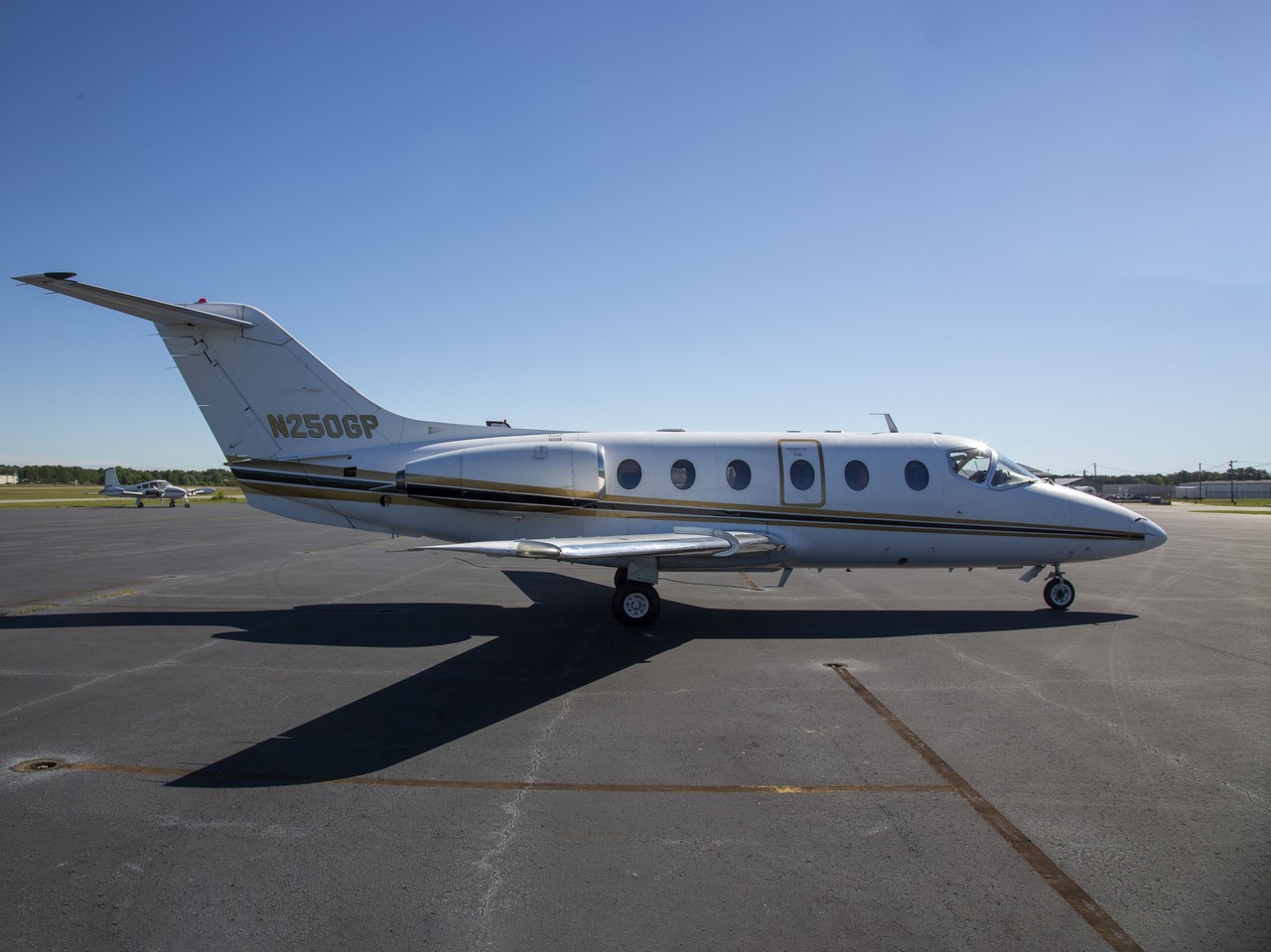
Development and Design Philosophy
Mitsubishi Heavy Industries launched the MU-300 Diamond project in November 1976 following extensive market research begun in 1969. The aircraft was conceived as the flagship of Mitsubishi's corporate aviation lineup, positioned above the successful MU-2 turboprop to compete directly with established American jets like the Cessna Citation and Learjet 25. The name "Diamond" reflected its intended status as the crown jewel of Mitsubishi's aviation offerings.
The engineering team at Mitsubishi designed the MU-300 as a sophisticated twin-turbofan featuring several advanced characteristics for its era. The aircraft employed a cantilever low-wing configuration with nearly full-span Fowler flaps and spoilers, enabling notably low approach and landing speeds that enhanced safety margins at smaller airports. The distinctive T-tail design and rear-fuselage mounted engines in individual pods created a clean aerodynamic profile while reducing cabin noise.
Manufacturing and International Cooperation
Mitsubishi Heavy Industries, whose aircraft division traced its origins to 1928, brought substantial manufacturing expertise to the Diamond program. The company had produced over 18,000 aircraft during World War II, including the famous Zero fighter, before resuming civilian aircraft production in 1962. For the MU-300, Mitsubishi established an innovative international manufacturing approach, producing components in Nagoya, Japan, while final assembly occurred at San Angelo, Texas, through their American subsidiary, Mitsubishi Aircraft International Inc.
This trans-Pacific production strategy aimed to position the Diamond favorably in the crucial American market while leveraging Japanese manufacturing precision. The first prototype achieved its maiden flight on August 29, 1978, beginning a certification program that would prove more challenging than anticipated.
Certification Challenges and Variants
The path to FAA Part 25 certification proved lengthy and costly for Mitsubishi, partly due to regulatory changes implemented after the DC-10 crashes of the late 1970s. These enhanced safety requirements added approximately 600 pounds to the aircraft's certified weight, impacting performance projections. Nevertheless, type certification was granted on November 6, 1981, with initial customer deliveries commencing in July 1982.
Mitsubishi developed three distinct variants during the production run. The initial Diamond I featured Pratt & Whitney JT15D-4 engines producing 2,500 pounds of thrust each. The Diamond IA incorporated uprated JT15D-4D engines flat-rated to 25°C for improved high-altitude and hot-weather performance, along with an early Electronic Flight Information System (EFIS) cockpit. The final Diamond II variant employed JT15D-5 engines generating 2,900 pounds of thrust and included thrust reversers plus additional fuel capacity.
Production Numbers and Transfer to Beechcraft
Mitsubishi manufactured exactly 97 MU-300 aircraft between 1982 and 1985, including two prototypes. Production comprised 89 Diamond I aircraft, 27 Diamond IA variants, and 11 Diamond II models. Despite achieving technical success and positive reception from operators, the Diamond program faced intense competition in the crowded light jet market and struggled to achieve the sales volumes necessary for profitability.
In December 1985, Mitsubishi made the strategic decision to exit the business jet market, selling all production rights, tooling, unfinished airframes for 64 additional aircraft, and inventory to Beechcraft. This transfer marked the end of Japan's first indigenous business jet program but provided Beechcraft with a proven design that would become highly successful.
Evolution into the Beechjet Legacy
Under Beechcraft ownership, the MU-300 design evolved into the Beechjet 400 series, manufactured in Wichita, Kansas. Beechcraft had received 113 orders for the Model 400A by 1991, and the type later became the Hawker 400 under subsequent ownership changes. The U.S. Air Force selected a derivative as the T-1A Jayhawk for tanker and transport crew training, ordering 211 aircraft with 180 delivered between 1992 and 1997.
Current Status and Legacy
As of 2014, 56 Diamond I aircraft remained in active service, testament to the type's robust design and construction quality. The MU-300's significance extends beyond its modest production numbers, representing Mitsubishi's successful transition from turboprop to jet aircraft and establishing design foundations that would prove enduring in American hands. The aircraft demonstrated that Japanese manufacturers could compete in sophisticated aviation markets, paving the way for future programs like the Mitsubishi Regional Jet.
The Diamond's legacy lives on through its Beechcraft and Hawker descendants, which have served reliably in corporate aviation and military training roles for decades, validating the soundness of Mitsubishi's original engineering vision.