
Design Genesis and Development
The MY-103 Mistral emerged from a multi-generational design evolution spanning three decades. Hermann Mylius initiated the lineage in the late 1970s with his single-seat MY-102 Tornado aerobatic trainer. His son Albert Mylius, who founded Mylius Flugzeugwerk in 1996, transformed the concept into a two-seat configuration designed to surpass the comfort limitations of the earlier Bölkow Bo 209 Monsun.
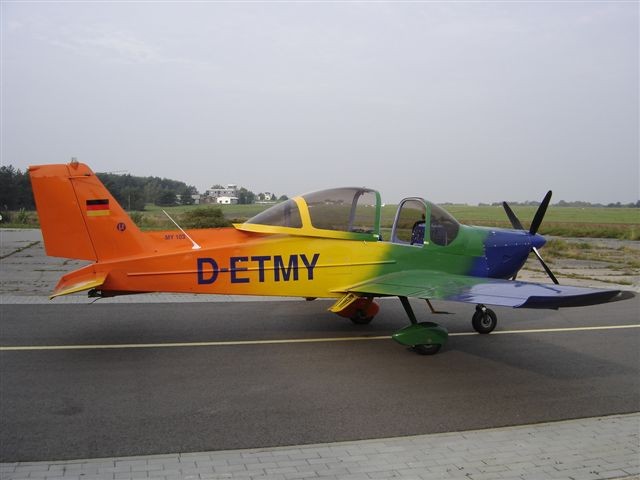
The development process proved challenging from the outset. The initial prototype D-ETMY, which first flew on May 23, 1998, encountered a critical certification obstacle when crash deceleration testing revealed that the cockpit's positioning directly above the wing box created an unacceptably high deformation zone. This fundamental design flaw prevented certification under existing safety standards.
Albert Mylius and his engineering team responded by implementing substantial modifications. They relocated the cockpit forward of the wing box, widened the fuselage by two inches, and redesigned the entire forward section. The revised MY-103 version 2 first flew in July 2001, representing nearly three years of intensive redesign work.
Technical Innovation and Specifications
The Mistral incorporates several design features optimized for aerobatic training. Its all-metal construction utilizes a low-wing configuration with fixed tricycle landing gear, prioritizing structural integrity over speed. The side-by-side seating arrangement with dual controls provides optimal instructor-student interaction, while the rear-sliding bubble canopy offers exceptional visibility during aerobatic maneuvers.
Powered by a Lycoming AEIO-360 four-cylinder engine producing 200 horsepower, the aircraft drives a three-bladed MTV constant-speed propeller. The fuel-injected engine's inverted-flight capability supports the aircraft's +6/-4.5 g operational limits, enabling full aerobatic training sequences including sustained inverted flight.
Performance specifications reflect the aircraft's training mission priorities. With an empty weight of 1,367 pounds and maximum takeoff weight of 2,094 pounds, the Mistral achieves a maximum speed of 173 mph at 8,000 feet. More importantly for training operations, it maintains a relatively gentle stall speed of 70 mph with flaps deployed and demonstrates a climb rate of 1,180 feet per minute.
Production Challenges and Limited Success
Despite achieving approximately 95 percent certification completion, Mylius Flugzeugwerk faced financial difficulties that prevented final certification. The company produced only four examples of the MY-103/200 basic trainer variant before suspending German production in 2018. Currently, just two aircraft remain active in Germany, registered as D-ETMY and D-ENMY.
Recognizing potential in the design, Colombian aerospace company INDAER partnered with Aero Integration & Manufacturing S.A.S. (AIMING) in July 2013 to establish South American production. INDAER, employing 100 engineers and technicians primarily supporting ATR and Beechcraft aircraft, invested approximately 5,000 engineering hours redeveloping the design using Siemens Solid Edge software.
The Colombian prototype HK-4995G (construction number S002) successfully completed its maiden flight on July 16, 2014, validating the design's fundamental airworthiness. However, insufficient customer interest and certification funding ultimately forced suspension of the Colombian initiative as well.
Market Position and Legacy
The MY-103 Mistral occupies a highly specialized niche within the aerobatic trainer market. Unlike mass-produced training aircraft, it targets flight schools and operators requiring dedicated aerobatic capability rather than basic flight instruction. This narrow market focus, while technically logical, limited commercial viability.
The aircraft's design philosophy continues the German tradition of robust, purpose-built trainers exemplified by aircraft like the Bücker Jungmann and the Bo 209 Monsun. However, modern flight training increasingly emphasizes cost efficiency over specialized capability, favoring multi-purpose aircraft that can perform both basic and advanced training roles.
Mylius also proposed a four-seat variant designated MY-104, which never progressed beyond conceptual design. This expansion attempt reflected recognition that the two-seat trainer market alone could not sustain production volumes necessary for commercial success.
Current Status and Future Prospects
Today, the Mylius MY-103 Mistral represents more of a technological achievement than a commercial success. The handful of flying examples demonstrate the validity of the design approach while highlighting the challenges facing specialized aircraft manufacturers in the modern aviation market.
The suspension of both German and Colombian production initiatives effectively ended hopes for widespread adoption. However, the two active German aircraft continue serving as testaments to the engineering excellence that Hermann and Albert Mylius pursued across their multi-decade development effort. For aviation enthusiasts and aerobatic pilots, the Mistral remains a rare example of purpose-built training aircraft optimized for serious aerobatic instruction rather than compromise solutions.