
Service History
The N-262 entered commercial service with Air Inter of France in July 1964, when the airline took delivery of its first production N-262B on July 24, 1964. Air Inter inaugurated scheduled passenger service with the type on the Paris-Quimper route that same day, making it the launch customer with an order for six aircraft. The type's introduction marked a significant milestone as France's first pressurized regional turboprop to enter airline service.
Across the Atlantic, Lake Central Airlines became the primary American operator, ordering 12 aircraft that entered service in May 1965. The N-262's penetration into the competitive US market represented a rare success for French aviation exports during this period. Later, Allegheny Airlines operated three specially modified Mohawk 298 conversions, which featured Pratt & Whitney Canada PT6A-45 engines instead of the standard Turbomeca powerplants.
The Manufacturer
The aircraft's development represents a complex corporate evolution in French aviation. The design originated with Max Holste, who developed the MH.250 Super Broussard (first flight May 20, 1959) and subsequently the MH.260 prototype (first flight July 29, 1960). However, Max Holste's financial difficulties forced the company to sell the project to the state-owned Nord Aviation in 1961.
Nord Aviation, established in the late 1950s, took over the design and extensively redesigned it for pressurization and US airworthiness certification. The company's engineers developed a circular fuselage cross-section and added a distinctive dorsal fin for improved stability. On January 1, 1970, Nord Aviation merged with Sud Aviation to form Aérospatiale, which continued N-262 production until 1976. Aérospatiale later became part of the Airbus consortium, meaning the N-262's lineage continues within today's European aerospace giant.
Engine & Technical Details
The production N-262 was powered by two Turbomeca Bastan turboprop engines, with variants including the Bastan VIC producing 1,080 horsepower in early models and the more powerful Bastan VIIC in later variants like the N-262C Frégate. These French-built engines proved reliable for regional operations, though their production was limited to the 1960s era.
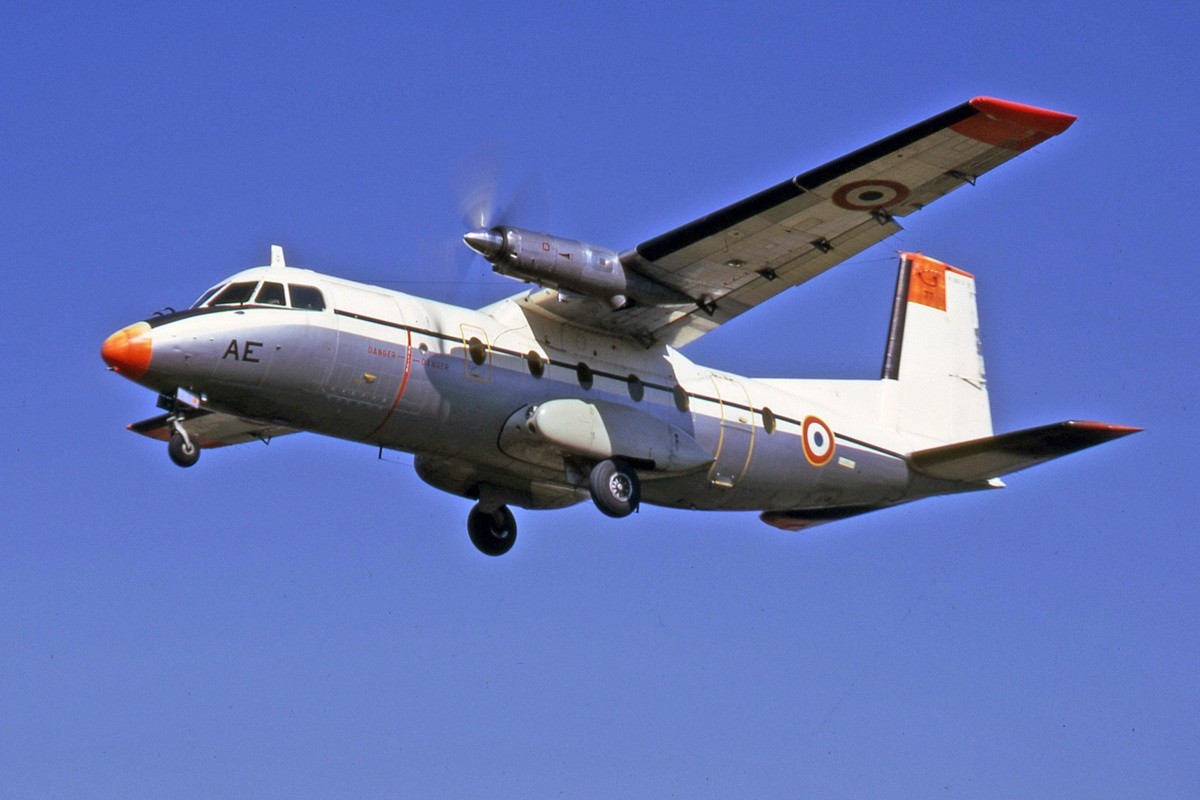
The aircraft featured an all-metal, high-wing monoplane configuration with retractable tricycle landing gear. The pressurized cabin could accommodate 26 passengers in standard configuration or up to 29 in high-density seating. Military variants designated N-262C and N-262D Frégate incorporated the more powerful Bastan VIIC engines and featured increased wingspan for improved performance.
Performance & Pilot Perspective
The N-262 delivered respectable performance for its era, with a maximum speed of 239 mph and a more economical cruising speed of 220 mph. Its service ceiling reached 24,000 feet with a rate of climb of 1,250 feet per minute. The aircraft's range of 690 miles made it well-suited for regional routes, while its stall speed of just 80 mph provided good short-field performance characteristics valued by regional operators.
The type's handling qualities reflected its evolution from the earlier Max Holste designs, which were known for their rugged bush-flying capabilities. The pressurized cabin represented a significant comfort advantage over unpressurized competitors, allowing operations at higher altitudes with greater passenger comfort.
Production Variants & Military Service
Production encompassed several distinct variants across the 110 aircraft built. Early models included the N-262A and N-262B with Bastan VIC engines, of which only four were completed in 1964. The military N-262C and N-262D Frégate variants served with the French Air Force and French Navy as transport aircraft, featuring the upgraded Bastan VIIC powerplant.
The most unusual variant was the Mohawk 298, which first flew on January 7, 1975. These three aircraft were converted for Allegheny Airlines with Pratt & Whitney Canada PT6A-45 engines, representing an attempt to modernize the design with more readily available North American powerplants.
Legacy
Despite its technical innovations and early promise, the N-262 faced intense competition from larger aircraft like the Fokker F27 and later regional jets. Production ceased in 1976 after 14 years, with the relatively small production run of 110 aircraft reflecting the challenges facing European manufacturers in the regional airliner market.
The N-262's significance lies in its role as France's entry into the pressurized turboprop regional market and its successful, if limited, penetration of American airline service. As a bridge between the piston-engine era and modern regional aviation, it demonstrated French technical capabilities while highlighting the difficulties smaller manufacturers faced competing against established players like Fokker and de Havilland. Today, nearly 50 years after production ended, no examples are known to remain in active service, though the aircraft has appeared in several films and represents an important chapter in French aviation history.