
Service History
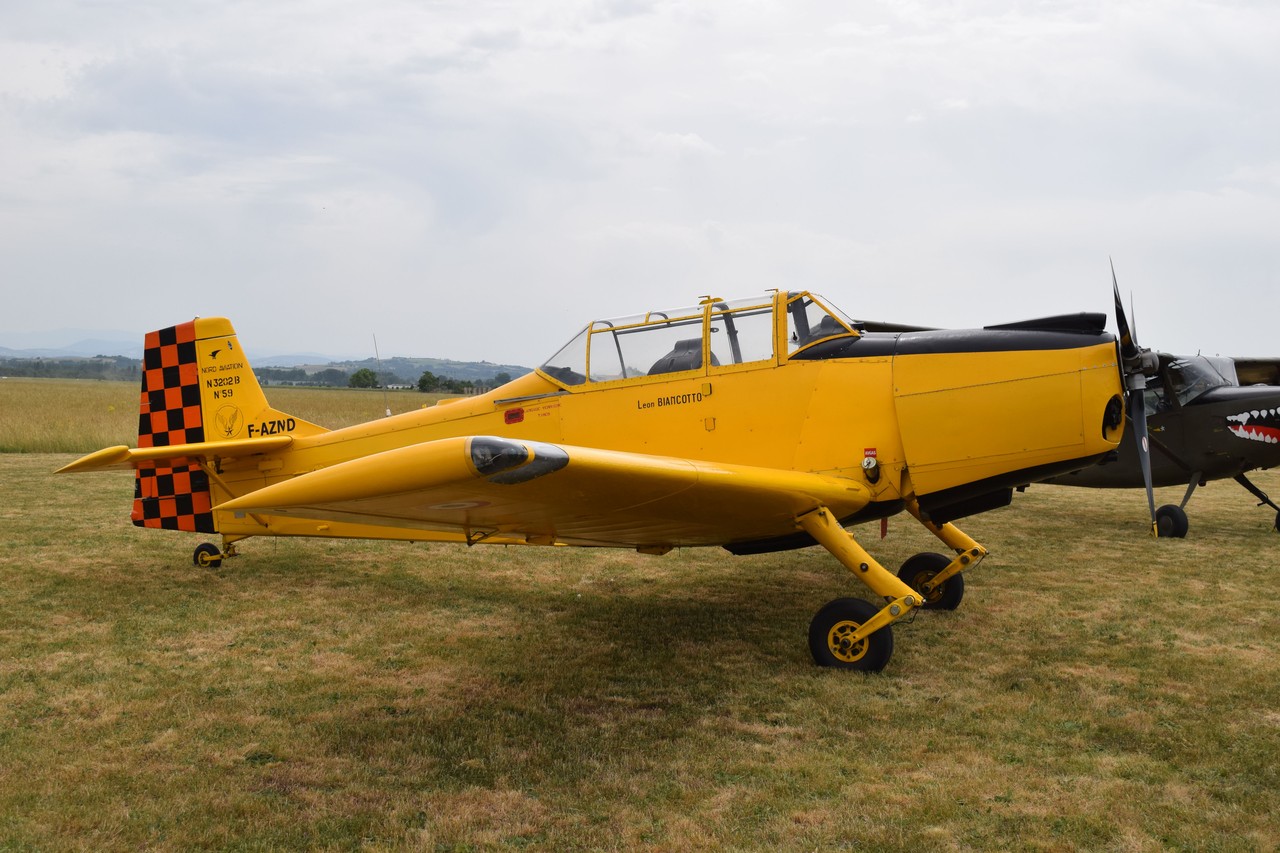
The Nord 3202 filled a crucial role in French Air Force pilot training during the post-World War II expansion of military aviation. All 50 production aircraft were delivered exclusively to the Armée de l'Air, where they served alongside other Nord Aviation trainers in the comprehensive flight training curriculum of the late 1950s. The aircraft provided fundamental flight instruction for student pilots transitioning from basic ground school to operational aircraft, with its two-seat configuration allowing direct supervision by flight instructors.
The Manufacturer
Nord Aviation emerged as a significant force in French aerospace through the merger of SFECMAS and SNCAN on October 1, 1954. The state-owned manufacturer operated from multiple facilities, with the Nord 3202 production centered at Bourges airport in central France. During its 16-year existence, Nord Aviation achieved notable success with the Nord Noratlas transport, producing 228 aircraft for France and 187 for West Germany beginning in 1956.
The company's influence extended beyond aircraft manufacturing into missile development, creating the Exocet anti-ship missile that entered service in 1979. Nord Aviation's corporate journey concluded on March 1, 1970, when it merged with Sud Aviation and SEREB to form Société nationale d'industrie aérospatiale, later renamed Aérospatiale. This lineage continued through subsequent mergers, eventually becoming part of EADS in 2000 and ultimately the modern Airbus Group.
Engine & Technical Details
The Nord 3202's powerplant consisted of a single Potez inline piston engine, available in two variants: the 4D-32 producing 179 kilowatts (240 horsepower) or the more powerful 4D-34 generating 194 kilowatts (260 horsepower). These nose-mounted engines provided reliable performance suited to the demanding requirements of flight training operations. Potez, the engine manufacturer, maintained a respected position in French aviation powerplant development throughout the post-war period.
The aircraft featured a cantilever low-wing monoplane design that offered superior performance characteristics compared to high-wing trainers while maintaining manageable handling qualities for student pilots. The fixed tailwheel landing gear configuration simplified maintenance requirements and reduced operational costs, critical factors for training aircraft that accumulated high flight hours. The enclosed cockpit provided weather protection while maintaining excellent visibility for both instructor and student.
Training Operations
French Air Force training protocols utilized the Nord 3202 for primary flight instruction, where students mastered fundamental aviation skills including basic flight maneuvers, navigation, and emergency procedures. The aircraft's docile handling characteristics made it suitable for pilots with minimal flight experience, while its performance envelope allowed progression to more advanced training exercises. The two-seat arrangement enabled real-time instruction and immediate correction of student errors, essential for effective pilot development.
The Nord 3202 represented one element in a comprehensive training system that prepared pilots for transition to operational fighters, bombers, and transport aircraft. Its role complemented other Nord Aviation training aircraft, including the Nord 3212, creating a family of trainers that standardized French pilot instruction throughout the 1950s.
Production Legacy
The limited production run of exactly 50 aircraft reflected the specific requirements of French Air Force training programs rather than broader market demand. This focused production approach characterized many military trainers of the era, where aircraft were designed for particular institutional needs rather than export potential. The Nord 3202's development occurred during a period of rapid aviation advancement, when training aircraft needed to prepare pilots for increasingly sophisticated operational aircraft.
As a product of the 1950s with limited production numbers, surviving Nord 3202 aircraft are extremely rare today. The demanding service life of training aircraft, combined with the passage of nearly seven decades, has likely eliminated most examples from active flying status. Unlike larger production aircraft that achieved civilian preservation through surplus sales, the Nord 3202's exclusive military service and small production quantity severely limited opportunities for post-service survival.
The aircraft's historical significance lies primarily in its contribution to French military aviation training rather than technological innovation or operational achievement. It represents the methodical approach to pilot development that characterized post-war European air forces, emphasizing systematic progression through carefully designed training stages using purpose-built aircraft.