
Production Legacy
The Navion's manufacturing history spans three decades across four different companies, demonstrating both its enduring appeal and the challenges of post-war aviation. North American Aviation launched production in 1946, building approximately 1,109 units through 1947 before selling the design rights to Ryan Aeronautical in 1948. Ryan produced over 1,200 additional aircraft through 1951, creating the Model A with the 205-horsepower Continental E-185 engine and the Model B featuring the more powerful 260-horsepower Lycoming GO-435-C2.
When Ryan ceased production, the Tubular Steel Corporation (TUSCO) of Texas acquired the rights, manufacturing the improved D, E, and F models in the mid-1950s, followed by the five-seat Rangemaster G and H variants from 1958 to 1961. TUSCO's operations ended abruptly when Hurricane Carla destroyed their factory on September 10, 1961, after producing approximately 50 Rangemaster G models. The final chapter came through Navion Aircraft Company, which built the last H models until 1976, bringing total production to approximately 2,700 aircraft.
Military Service
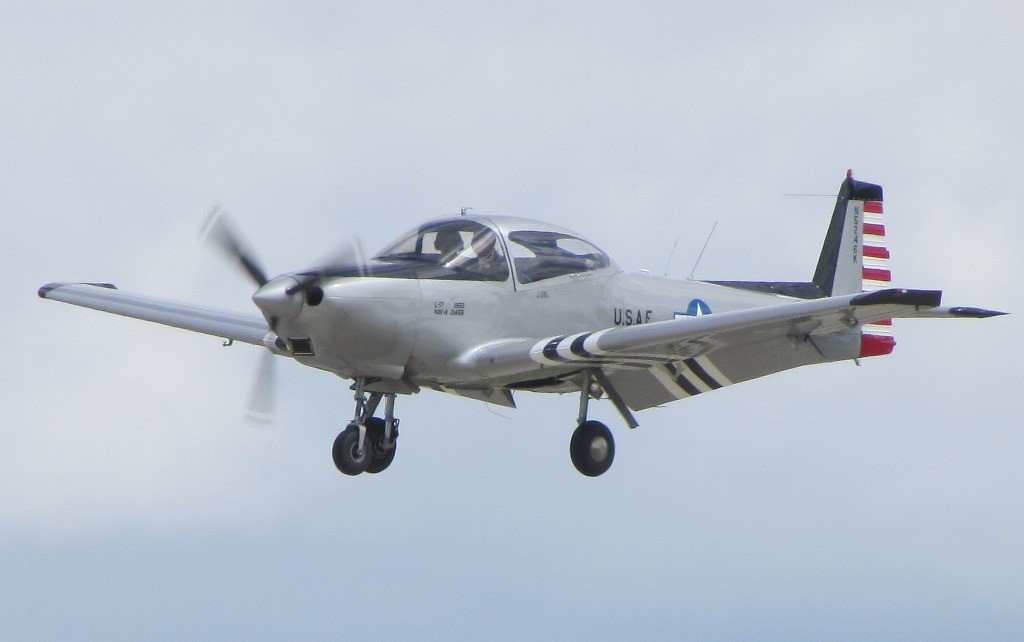
The U.S. military adopted the Navion as the L-17 for observation, liaison, and training duties, with 223 L-17A aircraft delivered beginning in 1948. The 176th Infantry Regiment of the Virginia Army National Guard received their L-17 on February 18, 1949, which was later transferred to U.S. Army Field Forces in January 1951. During the Korean War, L-17s served in forward air control roles, demonstrating the type's versatility in military operations.
The U.S. Navy also operated Navions, including operations aboard the USS Leyte (CV-32) in 1950. The Air Force evaluated a prototype Model 72 for their trainer competition but ultimately selected the Beechcraft T-34. Beyond combat roles, L-17s served in prisoner transport and police duties, with detailed maintenance records showing aircraft like L-17 48-11078 undergoing repairs as late as May 5, 1953.
The Manufacturers
North American Aviation, renowned for creating the P-51 Mustang, designed the Navion as part of their post-war strategy to capture the civilian market with returning military pilots. Founded in 1929, North American operated until its 1967 merger into Rockwell International, eventually becoming part of Collins Aerospace under RTX Corporation. The company intentionally incorporated P-51 design elements into the Navion, creating a rugged, high-performance civilian aircraft.
Ryan Aeronautical brought significant aviation heritage to Navion production, having been founded by T. Claude Ryan, who built Charles Lindbergh's Spirit of St. Louis in 1927. Operating from 1931, Ryan was eventually acquired by News Corp in 1999, later becoming part of Boeing in 2009. Today, Sierra Hotel Aero of South St. Paul, Minnesota, holds the type certificate, data, molds, and tooling, preserving the possibility of resumed production.
Engine Technology
The Navion's powerplant evolution reflected advancing aircraft engine technology of the late 1940s and 1950s. Initial models used the Continental E-185-3 and E-185-9 engines, producing 185 to 205 horsepower for takeoff. Later variants upgraded to the Continental E-225 (225 hp), Continental IO-470 with fuel injection, or the Lycoming GO-435-C2 geared engine producing 260 horsepower.
Continental's O-470 engine family, which powered many Navion variants, became one of aviation's most successful designs with over 50,000 units built during its production run from 1947 through the 1970s. The Lycoming GO-435, used in Ryan B models, featured reduction gearing for improved propeller efficiency and climb performance, though fewer than 1,000 of these engines were manufactured during their brief post-war production period.
Flight Characteristics
Pilots appreciated the Navion's spacious cabin, which offered more room than competitors like the Cessna 170 but couldn't match the Beechcraft Bonanza's speed advantage. Stock Navions achieved maximum speeds around 140 mph, though modern modifications can boost performance to match Bonanza speeds of 175 mph or higher. The aircraft's service ceiling reached approximately 20,000 feet in Rangemaster configuration, with range extended significantly by the distinctive tip tanks that became a Navion trademark.
The transition from the original sliding canopy to conventional doors in later models improved passenger access while maintaining the sleek profile inspired by military fighter design. The Rangemaster variants expanded seating to five passengers, making the Navion competitive with larger cabin-class aircraft while retaining single-engine operating economics.
Current Status
Dozens of Navions remain airworthy today through dedicated owner modifications and preservation efforts coordinated by Sierra Hotel Aero. The MAPS Air Museum in Northeast Ohio displays L-17B 48-1078, the former 176th Infantry Regiment aircraft delivered in 1949. This preservation ensures the Navion's legacy as a significant bridge between World War II fighter technology and post-war personal aviation, representing an era when military-inspired design could successfully transition to civilian markets.