
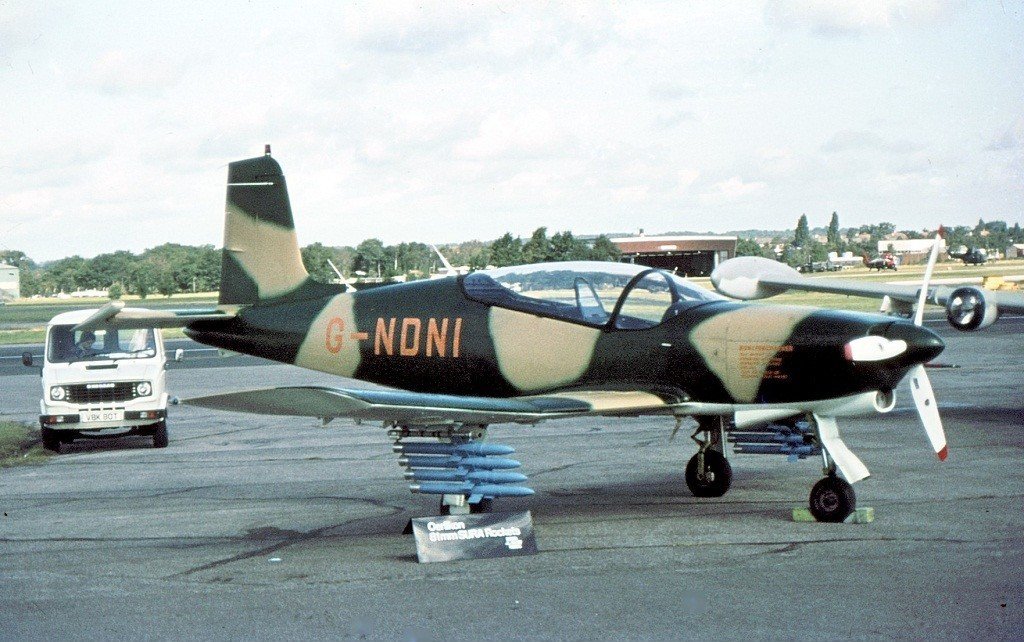
Development and Design Philosophy
The NDN-1T emerged from the vision of Nigel Desmond Norman, co-founder of the successful Britten-Norman company and founder of NDN Aircraft in 1976. Norman conceived the Firecracker family as a cost-effective solution for developing nations seeking to establish indigenous military pilot training capabilities. The design philosophy centered on creating an aircraft that could deliver jet-like handling characteristics while maintaining the operational economics of a turboprop trainer.
The program began with the piston-powered NDN-1 prototype, which first took to the skies on 26 May 1977 from Goodwood, Chichester, with Desmond Norman at the controls. This initial variant validated the basic design concept, featuring an innovative low aspect ratio wing of 5.28:1 and a NACA 23012 airfoil section specifically chosen to replicate the handling qualities of contemporary fighter aircraft.
Technical Innovation
The NDN-1T represented a significant evolution from its piston-engine predecessor, incorporating a Pratt & Whitney Canada PT6A-25 turboprop engine delivering 533 kW (715 equivalent shaft horsepower). This powerplant drove either a three-blade Hartzell HC-B3TN-3/T10173K-1 or Hoffmann constant-speed propeller measuring 2.13 meters in diameter. The substantial power increase transformed the aircraft's performance envelope while maintaining the design's core philosophy of affordable, jet-like training.
Key design features included tandem seating for instructor and student, retractable tricycle landing gear, and an integrated airbrake system. The aircraft's empty weight of 1,117 kg and maximum takeoff weight of 1,633 kg provided a useful load capacity suitable for training missions, with fuel capacity of 405 liters ensuring adequate endurance for typical training sorties.
First Flight and Testing
Desmond Norman piloted the first NDN-1T on its maiden flight on 1 September 1983, accompanied by co-pilot John Davy. The test program validated the aircraft's design objectives, confirming its ability to provide military pilots with realistic preparation for transition to high-performance jets while operating at significantly lower hourly costs than pure jet trainers.
The RAF Competition
The NDN-1T's most significant opportunity came in 1984 when it competed for the Royal Air Force's requirement to replace the aging BAC Jet Provost basic trainer. The competition represented a crucial moment for the British aviation industry, with the NDN-1T facing formidable international competition from the Pilatus PC-9, Embraer Tucano, and AAC A20 Wamira.
For the RAF bid, NDN proposed a militarized variant featuring enhanced engine power and ejection seats, with production planned through Hunting Group. Despite the aircraft's British origins and innovative design approach, the Royal Air Force ultimately selected the Shorts-built version of the Embraer Tucano, effectively ending the NDN-1T's prospects for large-scale production.
Commercial Operations
All three NDN-1T aircraft were delivered to Specialist Flying Training Ltd. (SFT) of Hamble, Hampshire, beginning in September 1982. SFT operated these aircraft for contract training of foreign military students, demonstrating the type's capabilities in its intended role. The first aircraft, registered G-SFTR, served as the primary demonstrator and test bed for the type's operational validation.
NDN Aircraft Company
The NDN-1T's manufacturer reflected the entrepreneurial spirit of British aviation in the 1970s and 1980s. NDN Aircraft, founded by Desmond Norman after his departure from Britten-Norman, focused specifically on developing simple, robust aircraft designs suitable for licensed production in developing countries. This business model aimed to bootstrap local aviation industries while providing affordable military training solutions.
The company operated from 1976 until renaming itself Norman Aircraft Company in 1985. Financial difficulties led to receivership in 1988, effectively ending production of the Firecracker family and eliminating prospects for the type's revival during the peak years of military trainer procurement.
Legacy and Survival
Despite its limited production run, the NDN-1T achieved complete survival of its tiny fleet. All three aircraft eventually found their way to the United States, where they remain today: serial number 005 operates at a flight test facility, number 006 continues flying under private ownership, and number 007 exists in unassembled condition. This perfect preservation rate stands as testimony to the aircraft's robust construction and the dedication of its operators.
The broader Firecracker family totaled just four aircraft: the single piston-engine NDN-1 prototype and the three turboprop NDN-1T variants. Recent developments suggest potential revival of the design, with type certificates, tooling, and manufacturing rights offered for sale in 2023 as interest in affordable military trainers continues in global markets.
The NDN-1T represents a fascinating chapter in British aviation history, embodying the innovative spirit and market-focused design philosophy that characterized the nation's aerospace industry during the 1980s. While commercial success eluded the type, its technical achievements and complete survival ensure its place in aviation history as a unique solution to military training requirements.