
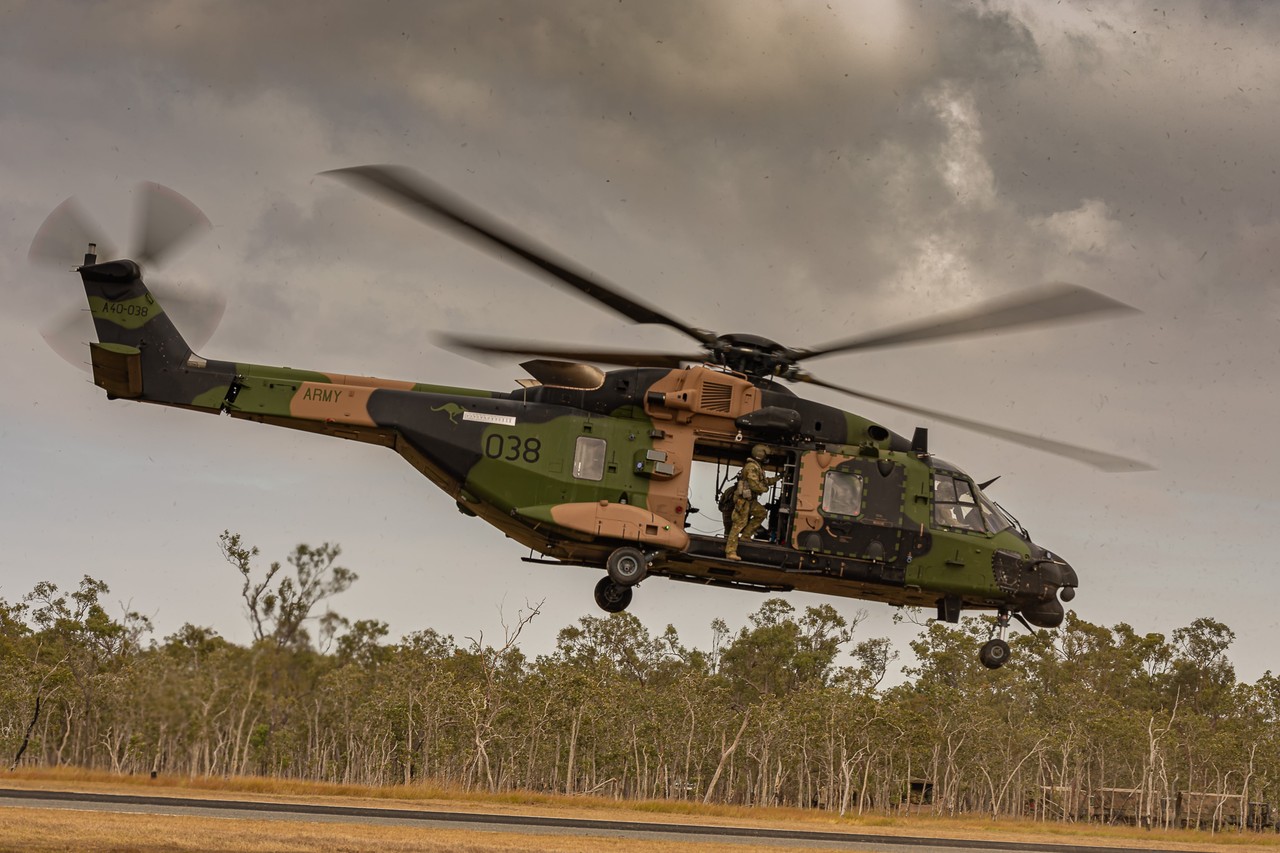
Development and Design
The NH-90 emerged from a pivotal design-and-development contract signed on September 1, 1992, between NHIndustries and NAHEMA (NATO Helicopter Management Agency), representing France, Germany, Italy, and the Netherlands. Portugal joined this multinational effort in June 2001, expanding the program's European reach. Design objectives centered on creating a medium-sized, twin-engine, multi-role military helicopter capable of battlefield transport, anti-ship warfare, and anti-submarine operations to replace aging 1980s-era designs.
NHIndustries, established specifically for this program on September 1, 1992, brought together Europe's leading helicopter manufacturers. The partnership initially included Eurocopter (now Airbus Helicopters) from France and Germany, Agusta (now Leonardo) from Italy, and Stork Fokker Aerospace (now GKN Fokker) from the Netherlands, with ownership shares of 31.25 percent each for the Eurocopter entities and 5.50 percent for Stork Fokker.
Design work commenced in 1993, focusing on revolutionary flight control technology. The NH-90 became the first production helicopter to incorporate fully fly-by-wire flight controls, marking a significant advancement in rotorcraft technology. The third prototype, PT3 (F-ZWTJ), achieved a historic milestone on December 12, 2002, when it flew exclusively on fly-by-wire controls after engineers removed all mechanical backup systems.
Flight Testing and Prototypes
The NH-90's flight test program began with prototype PT1 (F-ZWTH) taking to the skies on December 18, 1995, from Marignane, France. Four additional prototypes followed in systematic succession: PT2 (F-ZWTI) flew on March 19, 1997, PT3 (F-ZWTJ) on November 27, 1998, the German-built PT4 (98+90) on May 31, 1999, and the Italian PT5 (MMX-613) on December 22, 1999. This comprehensive test program validated the aircraft's innovative design across multiple nations and operational scenarios.
Production and Manufacturing
Major production commenced following a significant industrialization contract signed on June 30, 2000, covering 298 units (later adjusted to 243 firm orders plus 55 options) among the four founding nations. By April 2013, worldwide orders had reached 529 NH-90s of all variants, demonstrating strong international confidence in the platform.
Production efficiency improved dramatically over the program's lifespan, with manufacturing lead times decreasing from 18 months to just 7.5 months between 2004 and 2016. Peak production occurred in 2014 when manufacturers delivered 53 helicopters worldwide. Manufacturing takes place at multiple final assembly lines across Europe and beyond: Cascina Costa in Italy for Leonardo, Marignane in France and Donauwörth in Germany for Airbus Helicopters, Albacete in Spain, Patria in Finland for Nordic countries, and Brisbane in Australia. The Marignane facility maintains capacity for up to 22 aircraft annually.
Military Service and Operations
The NH-90 entered operational service in 2007 with the German Army, marking the beginning of its active military career. The Royal Netherlands Navy received its first NH-90 NFH (navalized anti-submarine warfare variant) in April 2010, expanding the type's operational envelope to maritime missions.
Two primary variants serve distinct military roles: the TTH (Tactical Transport Helicopter) handles battlefield transport and utility missions, while the NFH (NATO Frigate Helicopter) specializes in anti-submarine and anti-ship warfare from naval vessels. Armed forces from thirteen nations operate the NH-90, including France, Germany, Italy, the Netherlands, Norway, Finland, Australia, Spain, and Portugal.
Technical Innovation
Beyond its groundbreaking fly-by-wire system, the NH-90 incorporates a simplified baseline airframe philosophy that allows extensive customization for specific customer requirements. This approach enables operators to configure their aircraft for particular mission sets while maintaining commonality in basic systems and training.
The twin-engine configuration provides redundancy crucial for military operations, though specific engine details remain proprietary to the manufacturers. The medium-sized airframe strikes an optimal balance between payload capacity and operational flexibility.
Operational Legacy
By January 2017, NH-90s across all variants had accumulated 127,000 flight hours in service with thirteen nations, demonstrating the type's operational reliability and mission effectiveness. Production continued as of 2021, twenty-five years after the maiden flight, indicating sustained demand and relevance in modern military aviation.
The NH-90 represents more than technological achievement; it exemplifies successful European defense cooperation and industrial collaboration. As the first production helicopter with fly-by-wire controls, it established new standards for rotorcraft design and paved the way for future advanced helicopter systems. The program's multinational structure and distributed manufacturing model created a template for subsequent international aerospace ventures.