
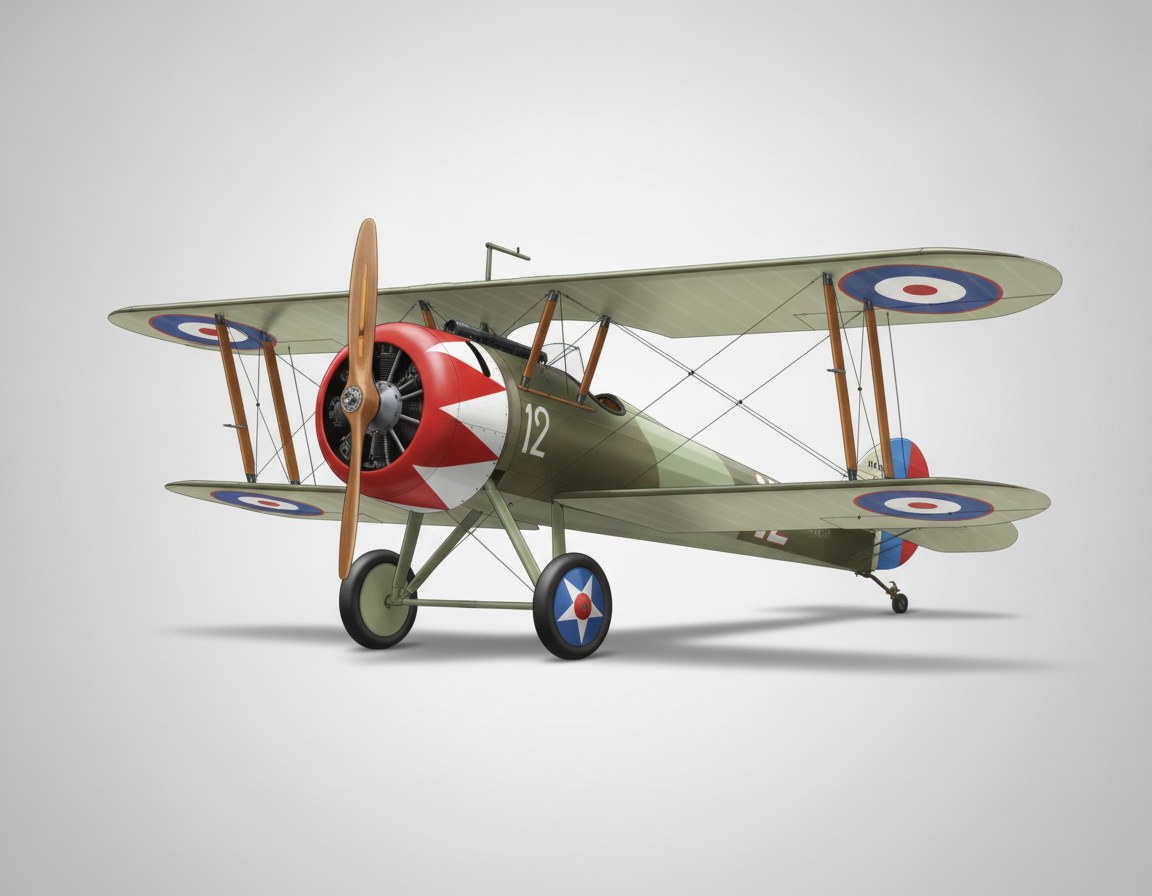
American Combat Service
The Nieuport 28 earned its place in aviation history not through French acceptance, but through American necessity. When the United States entered World War I, the Army Air Service desperately needed fighter aircraft for its squadrons deploying to France. French manufacturers had already shifted production to the superior SPAD XIII, leaving nearly 300 completed Nieuport 28s available for export. American forces acquired these aircraft despite their known limitations, marking the beginning of U.S. fighter aviation.
The 94th and 95th Aero Squadrons received their first Nieuport 28s in mid-February 1918, though initial deliveries arrived without armament due to machine gun shortages. Early combat patrols in March sometimes flew with only one Vickers gun instead of the standard twin-gun configuration. Despite these handicaps, American pilots achieved their first aerial victories in the type on April 14, 1918, when Douglas Campbell and Alan Winslow each shot down German aircraft over their home airfield.
Campbell later became America's first World War I ace while flying the Nieuport 28, demonstrating that pilot skill could overcome the aircraft's technical deficiencies. The 1st Pursuit Group's 27th, 97th, and 147th Aero Squadrons also operated the type throughout 1918, accumulating combat experience until SPAD XIIIs became available in sufficient numbers.
Technical Specifications and Performance
The Nieuport 28's 160-horsepower Gnome Monosoupape 9N rotary engine represented both the aircraft's strength and weakness. The nine-cylinder air-cooled powerplant, displacing 15.892 liters and weighing 330 pounds, provided adequate performance for 1918 standards. The engine drove a two-bladed wooden propeller measuring 8 feet, 2.4 inches in diameter, enabling a maximum speed of 123 miles per hour at 6,500 feet.
With a service ceiling of 17,388 feet and a range of 180 miles, the Nieuport 28 possessed respectable performance figures for its era. The aircraft's 1,200-pound weight and compact dimensions made it reasonably maneuverable, though structural concerns about wing flutter at high speeds limited aggressive diving maneuvers. Armament consisted of two synchronized .303-caliber Vickers machine guns mounted above the engine.
Manufacturing and Design Heritage
Société Anonyme des Établissements Nieuport developed the Model 28 as their ultimate biplane design, building upon experience gained with earlier successful fighters like the Nieuport 17. Production began in 1917 and continued through 1918, with final assembly taking place at the company's factory near Paris. The manufacturer completed between 297 and 300 aircraft before terminating the program.
French military authorities rejected the design in favor of the SPAD XIII, citing engine production priorities and performance concerns. This decision proved fortuitous for American forces, as it made the entire Nieuport 28 production run available for export. The aircraft represented the end of Nieuport's biplane fighter development, as the company subsequently focused on monoplane designs.
Tragedy and Transition
The Nieuport 28's service record included both triumph and tragedy. Quentin Roosevelt, son of former President Theodore Roosevelt, died flying a Nieuport 28 in July 1918 when German fighters shot him down behind enemy lines. His death occurred just weeks before American squadrons began receiving SPAD XIIIs, which offered superior performance and structural integrity.
By late 1918, most American pursuit squadrons had transitioned to French SPAD aircraft, relegating the Nieuport 28 to training duties. Approximately 50 examples were shipped to the United States after the armistice to equip the peacetime Army Air Service, serving briefly in the early 1920s before retirement.
Hollywood Fame and Preservation
The Nieuport 28 gained unexpected fame in Hollywood during the 1930s, appearing in major aviation films including "Hell's Angels" (1930) and "The Dawn Patrol" (1930 and 1938). Aviation movie specialists Paul Mantz and Frank Tallman acquired several examples for their aerial cinematography business, keeping the type flying into the 1960s.
At the famous Tallmantz auction in May 1968, racing car builder Jim Hall purchased one Nieuport 28 for $14,500, demonstrating the aircraft's value as a warbird collectible. Today, several museums preserve examples of America's first combat fighter, including the National Air and Space Museum, American Heritage Museum in Massachusetts, and the National Naval Aviation Museum in Pensacola, Florida.
The American Heritage Museum's example retains its original 1918 Gnome engine and period metal components, representing one of the most authentic surviving examples of this historically significant aircraft.