
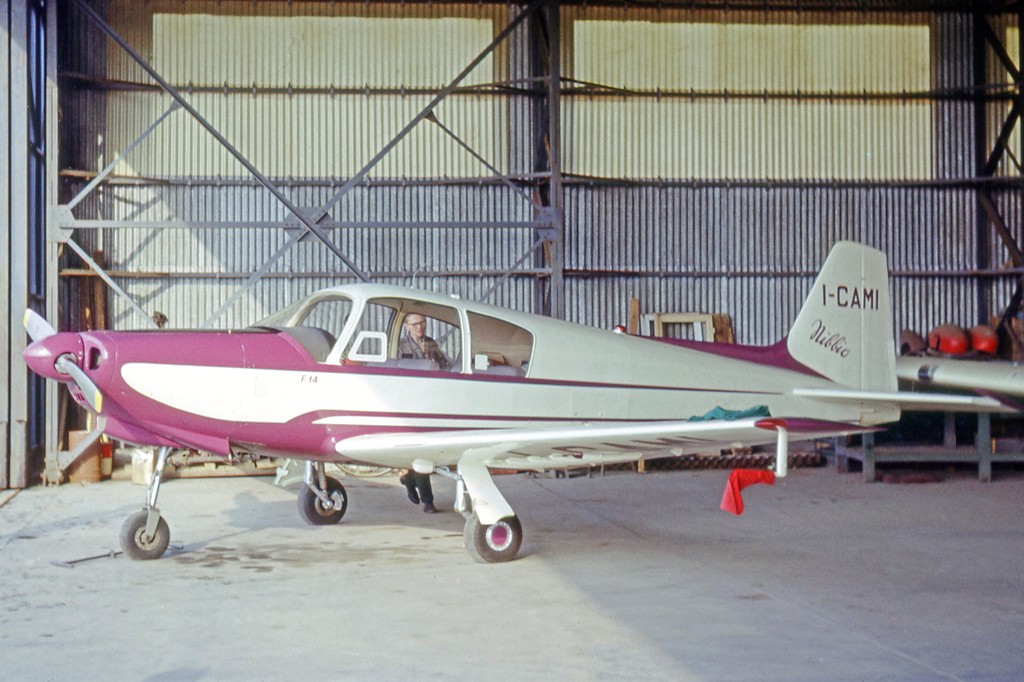
Design Origins and Development
The F-14 Nibbio emerged from Stelio Frati's systematic approach to aircraft design, building upon the proven aerodynamics of his earlier F.8L Falco. Frati retained the same wing sections, structural loading parameters, and power-to-weight ratios that had made the Falco successful, but scaled the entire design upward to accommodate four occupants rather than two. This methodical evolution represented a calculated risk to expand the market appeal of Frati's designs while preserving their flying characteristics.
The prototype's maiden flight on January 16, 1958, validated Frati's design philosophy. The aircraft featured all-wood construction throughout, maintaining traditional building techniques even as the aviation industry increasingly embraced metal fabrication. A single door on the starboard side provided cabin access, while the enlarged fuselage offered significantly more interior volume than the compact Falco.
Limited Production Run
Aviamilano Costruzioni Aeronautiche committed to a small production batch following the prototype's successful testing. The company assigned construction numbers 202 through 211 to ten production aircraft, which began reaching customers in 1959. This conservative production approach reflected both the specialized nature of the touring aircraft market and the financial constraints facing smaller Italian manufacturers during the late 1950s.
The brief two-year production span from 1958 to 1959 positioned the Nibbio as a transitional design in Frati's portfolio. While the aircraft demonstrated sound engineering principles, market conditions and competitive pressures limited its commercial success. Each of the ten production aircraft represented a significant investment for private owners, as four-seat touring planes remained luxury items in the European general aviation market.
Performance and Technical Characteristics
The 180-horsepower Lycoming O-360-A1A engine provided the Nibbio with respectable performance for its era. The four-cylinder, horizontally-opposed powerplant delivered a maximum speed of 204 mph and a cruise speed of 185 mph, placing the aircraft competitively within its class. These figures demonstrated that Frati's scaling methodology preserved the Falco's favorable power-to-weight characteristics while accommodating the additional structural weight and cabin volume.
The all-wood construction required specialized maintenance skills but offered several advantages including excellent vibration damping and relatively straightforward field repairs. European craftsmen possessed extensive experience with wooden aircraft structures, making maintenance support more readily available than might be assumed from a modern perspective.
International Operations
Despite limited production numbers, F-14 Nibbios found homes across multiple European countries. Aircraft operated under Italian, British, and Swiss registrations, with some examples changing nationality during their service lives. Construction number 208, for instance, carried both Italian registration I-SERE and Swiss registration HB-EVZ at different periods, illustrating the international movement typical of European general aviation aircraft.
At least one Nibbio remained operational as late as 1973, demonstrating the type's structural durability and the dedication of private owners to maintaining these rare aircraft. The scattered international registrations suggest that knowledgeable pilots appreciated the aircraft's flying qualities despite its limited availability.
Aviamilano's Legacy
Aviamilano Costruzioni Aeronautiche represented one of several Italian companies attempting to establish themselves in the post-war general aviation market. Based in Milan, the company produced multiple Frati designs including variants of the F.8 Falco series alongside the F-14 Nibbio. However, the company's limited production runs and relatively short operational period reflected the challenging economics facing smaller aircraft manufacturers during this era.
The Nibbio's most significant contribution proved to be its role as a developmental link in Frati's design evolution. Lessons learned from scaling up the Falco design directly influenced the subsequent F.15 Picchio, produced by Procaer. More importantly, this developmental lineage contributed to the creation of the SIAI Marchetti SF.260, which became one of the most successful military and civilian training aircraft of its generation, with hundreds of examples produced over several decades.
Enduring Influence
While only ten F-14 Nibbios were built, their significance extends beyond their limited numbers. The aircraft validated Frati's design methodology and demonstrated the viability of scaling successful aerodynamic configurations to different market segments. This approach influenced subsequent Italian aircraft development and contributed to the country's reputation for producing elegant, high-performance general aviation aircraft.
The Nibbio's rarity has made surviving examples particularly valued among vintage aircraft enthusiasts. Each remaining airframe represents a tangible link to the creative period of Italian aviation design during the 1950s, when innovative engineers like Stelio Frati were establishing the technical foundations for decades of successful aircraft production.