
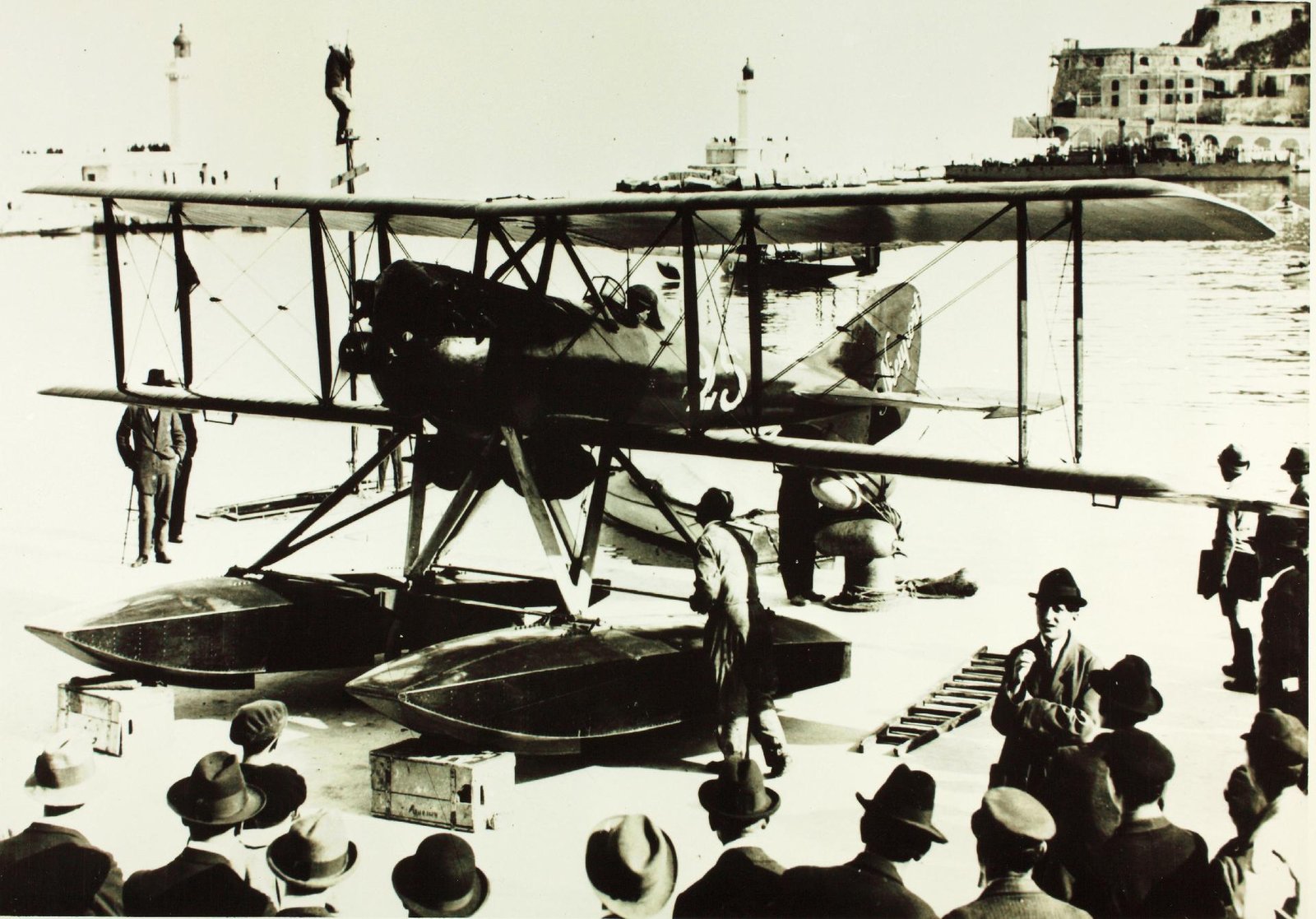
Designed by Gustave Delage in 1918, the Nieuport-Delage NiD 29 was a single-seat, single-engine biplane fighter. Although developed during World War I, it entered service too late to participate in the conflict. The aircraft first flew on August 21, 1918, and was eventually selected as the standard fighter for France in 1920, with deliveries to operational units beginning in 1922. Production took place at the Nieuport-Delage works in Issy-les-Moulineaux, with series production running from approximately 1920 through the late 1920s.
The standard NiD-29 C.1 was powered by a 300 CV (approximately 296 hp) Hispano-Suiza 8Fb liquid-cooled V-8 piston engine. This configuration allowed the fighter to reach a maximum speed of 213 km/h at an altitude of 4,000 meters, with a service ceiling of 7,700 meters and a range of 580 km. For armament, the aircraft typically carried two synchronized forward-firing machine guns. Beyond the standard fighter, various specialized versions were developed, including the NiD 29B.1 light bomber and the NiD 29 E.1 combat pilot trainer, the latter of which used a 180 hp Hispano-Suiza engine.
Production of the NiD 29 was extensive, with at least 700 units built in France and a total estimated production of 1,200 to 1,500 aircraft including license-built examples. Japan was the largest single operator, producing 608 aircraft as the Nakajima Ko-4. Other license production occurred in Italy via Macchi (95 airframes) and Belgium via SABCA (87 airframes), with further production in Siam.
In military service, the NiD 29 operated in front-line French units until 1928 and in training roles until 1931. It saw combat in North Morocco during the Rif War, where some aircraft were modified with Michelin No. 4 bomb racks to carry six 10-kg bombs for counter-guerilla operations. Other international operators included Spain, Sweden (where it was designated the J 2), Argentina, and China.
The aircraft also achieved significant success in civil aviation through racing variants. The NiD 29V, featuring a reduced wingspan and a 320 hp Hispano-Suiza engine, was flown by Joseph Sadi-Lecointe. This variant became the first aircraft to exceed 300 km/h and won the 1920 Gordon Bennett and Deutsch de la Meurthe Cup races, establishing the NiD 29 family as one of the fastest aircraft in the world during the early 1920s.