
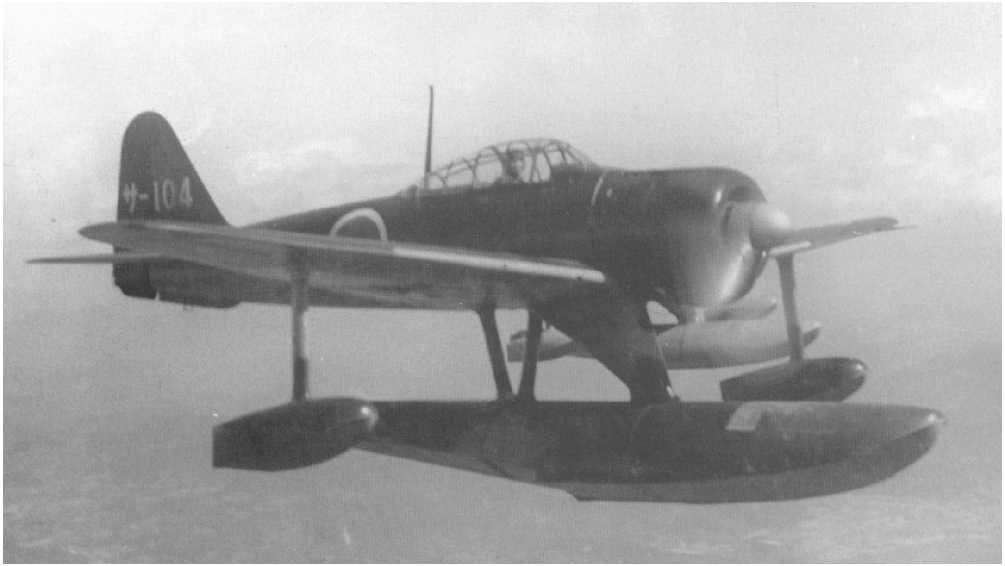
The Nakajima A6M2-N, designated by the Imperial Japanese Navy as the Navy Type 2 Floatplane Fighter Model 11 and known by the Allied reporting name “Rufe,” was a dedicated floatplane fighter developed during World War II. The aircraft was conceived to fill a tactical gap, as existing reconnaissance floatplanes like the Nakajima E8N and Mitsubishi F1M were insufficient for the fighter role during amphibious operations. In February 1941, Nakajima engineers Niitake and Tajima initiated the project under the designation AS-1. The resulting design utilized the A6M2 Model 11 Zero fuselage but incorporated a revised tail, structural reinforcements, and a float configuration consisting of one large central float and two wingtip stabilizing floats.
The prototype first flew on December 8, 1941, piloted by Captain Nishihata. Production officially began in April 1942, with Nakajima Hikōki manufacturing a total of 327 aircraft, including the prototype, by September 1943. During late 1942, production rates were approximately twelve aircraft per month. The A6M2-N was powered by a Nakajima NK1C “Sakae 12” 14-cylinder air-cooled radial engine, which produced 700 kW (940 hp) for takeoff and a maximum altitude power of 950 hp at 4,200 meters. This engine drove a three-bladed constant-speed metal propeller.
Operationally, the A6M2-N served the Imperial Japanese Navy in the Pacific War. Early production aircraft were split between the Solomon Islands and the Aleutian Islands, where they operated from August 1942 through April 1943 due to the absence of land-based airfields. In the Solomons, units were deployed to Tulagi to contest airspace over Guadalcanal, conducting patrols and raids on Henderson Field. Between September 4 and November 7, 1942, the type flew 360 sorties, claiming 14 Allied aircraft while losing nine. The aircraft was also operated by various Kōkutai, including the 5th, 14th, 36th, 452nd, 801st, 902nd, and 934th, as well as the Kamikawa Maru Suisentai, which operated from a seaplane tender.
Technically, the A6M2-N maintained the Zero's armament of two 7.7 mm Type 97 machine guns in the nose and two 20 mm Type 99 Model 1 cannons in the wings, with the ability to carry two 60 kg bombs. It reached a maximum speed of 435 km/h at 5,000 meters and had a service ceiling of 10,000 meters. While its range of 1,148 km was shorter than the land-based Zero due to float drag, it remained a high-performance asset for remote island defense. Following the end of production in 1943, the type transitioned to training and second-line roles, though some served as home island interceptors. Notably, a rare example was captured by the French Aéronavale in Indochina between 1945 and 1947.