
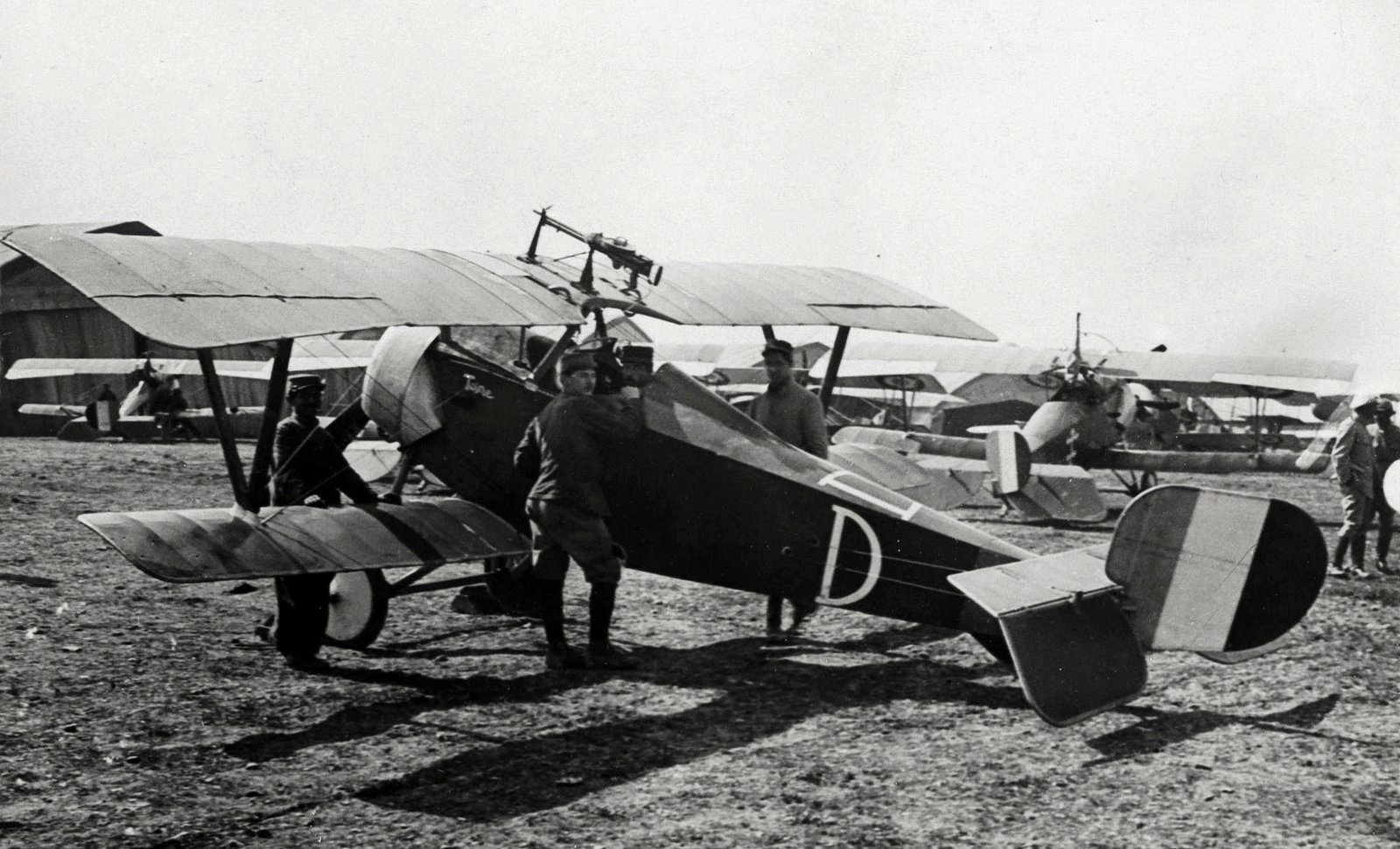
The Nieuport 16 C.1 was a French single-seat sesquiplane fighter developed during World War I. Designed by Gustave Delage, the aircraft served as a more powerful successor to the Nieuport 11. It maintained the compact sesquiplane layout characteristic of the Nieuport line, which provided a balance of agility and climb performance. The aircraft entered service in 1916 and was manufactured at the Nieuport factory located in Issy-les-Moulineaux, France, by the Société Anonyme des Établissements Nieuport.
Technically, the Nieuport 16 was essentially a Nieuport 11 airframe updated with a more potent powerplant. It was equipped with a Le Rhône rotary engine rated at 110 hp. In terms of performance, the fighter reached a maximum speed of 165 km/h (103 mph) at sea level, which decreased to 156 km/h (97 mph) at an altitude of 2,000 meters. The aircraft had an operational endurance of two hours and was designed to carry a single pilot.
For armament, the Nieuport 16 was equipped with either a .303 in (7.7 mm) Lewis machine gun or a .303 in (7.7 mm) Vickers machine gun. Most notably, the aircraft became closely associated with the use of Le Prieur rockets, which could be mounted in groups of eight for specialized attacks against ground targets and observation balloons. This capability made the Nieuport 16 more prominent in rocket-based aerial warfare than almost any other aircraft of its era.
During its service life, the aircraft was utilized by several Allied nations. In France, it was operated by the Aéronautique Militaire, including Escadrille N.12, as well as the Aéronautique Navale; specifically, the Escadrille de chasse terrestre du CAM de Dunkerque operated one unit (N1354) from June 1916 to July 1917. The Aviation Militaire Belge also employed the type, including the 1ère Escadrille de Chasse. Additionally, the British Royal Flying Corps operated 25 aircraft, which were delivered between 16 April and 6 August 1916. The aircraft's operational history coincided with major conflicts such as the Battle of the Somme and the Battle of Verdun.