
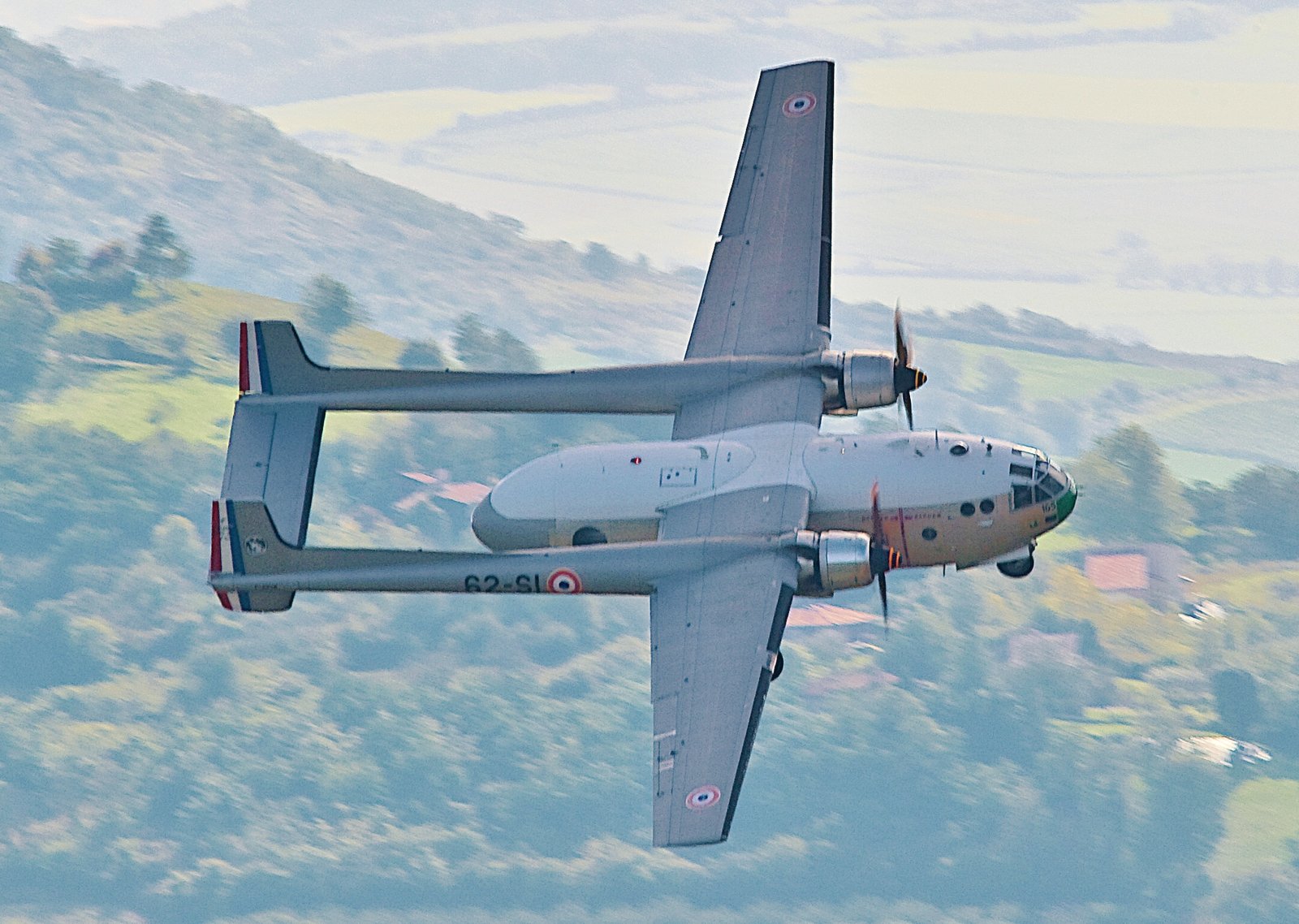
Designed to satisfy a 1947 requirement from the Direction Technique et Industrielle (DTI), the Nord Noratlas was developed as a mid-sized military transport capable of hauling freight, passengers, or paratroopers. The aircraft, produced by the state-owned Société nationale de constructions aéronautiques Nord (Nord Aviation), was selected over competing designs submitted by Sud-Ouest and Bréguet. It first took to the skies on 10 September 1949, introducing a distinctive twin-boom layout and rear-opening clamshell doors that facilitated efficient cargo loading and paratroop deployment, making it ideal for rough-strip and short-field operations.
Production ran from 1949 to 1961, with a total of 425 aircraft built. Manufacturing was distributed across France and West Germany; French production occurred at Bourges, Les Mureaux, and Issy-les-Moulineaux, while Flugzeugbau-Nord handled production in Bremen, Germany. The aircraft was powered by two Bristol Hercules 738 air-cooled sleeve-valve radial piston engines, installed under SNECMA association, providing a total output of 2,089 hp.
In 1952, the French Air Force adopted the Noratlas as its standard military transport, officially entering service on 6 December 1953. The aircraft saw extensive operational use during the Algerian War and the 1956 Suez Crisis, where it was used to deploy paratroopers south of Port Fouad and Port Said. It even participated in long-range strike missions into Egypt known as Operation Drought. Beyond France, the Noratlas served in the militaries of West Germany, Belgium, Greece, Israel, Morocco, Niger, Nigeria, and Portugal. While primarily used for cargo and paratroop transport, eight aircraft were converted into the Nord Gabriel electronic warfare variant, serving until 1989.
Technically, the Noratlas could be crewed by 4 to 5 personnel and had a versatile capacity, accommodating 45 soldiers, 36 paratroopers, or 18 patients with medics, with a maximum cargo load of approximately 18,647 lb. It reached a maximum speed of 270 mph (252 mph when fully loaded) and a cruise speed of 201 mph, with a range of 1,600 mi and a service ceiling of 24,600 ft. Although marketed for civilian use, commercial success was limited, with only 10 French aircraft ever fitted for passenger operations. The French military finally withdrew the type from service in 1989. Today, the Noratlas is rare, though a small number survive, including one active aircraft on the French warbird circuit.