
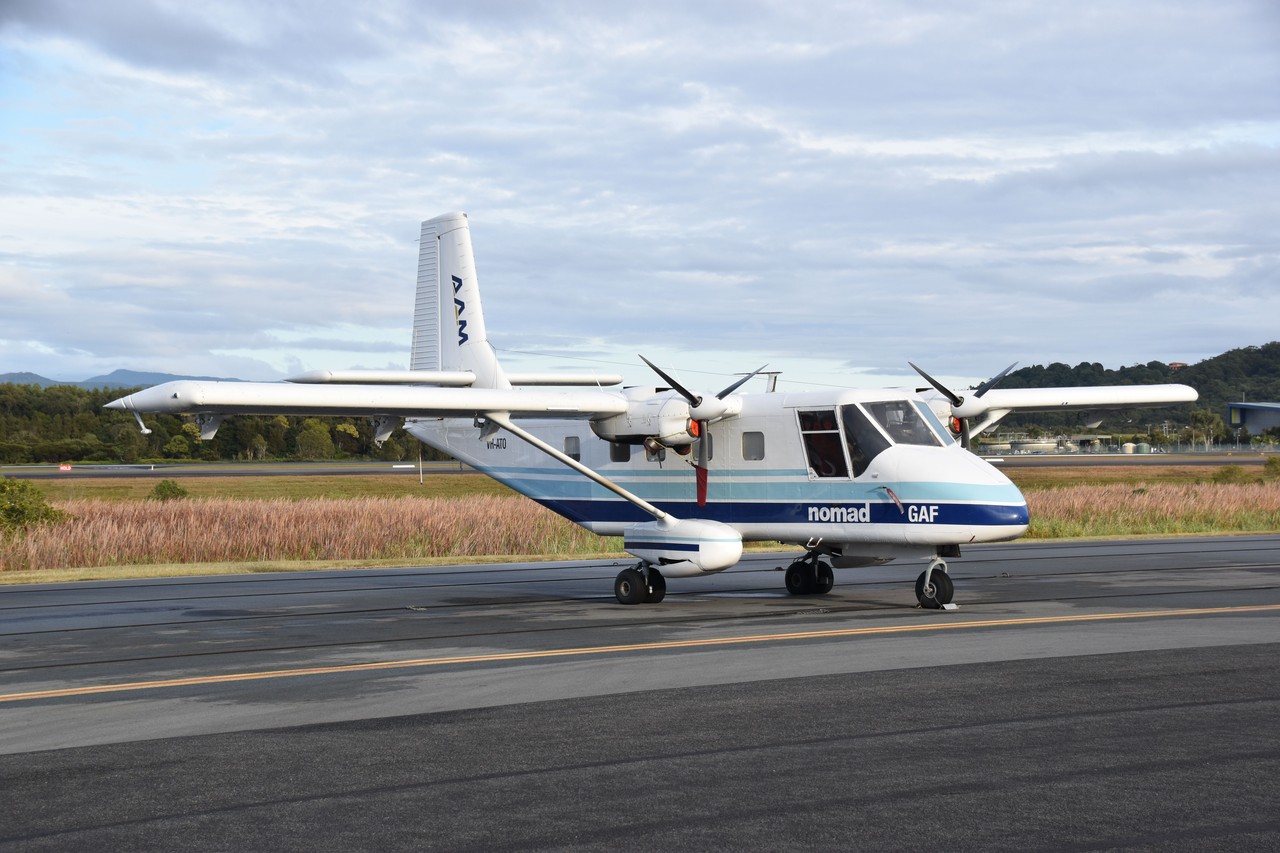
Service History
The Nomad carved out a specialized niche in Australia's aviation landscape, serving operators who demanded reliable STOL performance in remote locations. The Royal Flying Doctors Service adopted the type for medical evacuation missions across Australia's vast interior, where its ability to operate from short, unprepared strips proved invaluable. Commercial operators like Skywest utilized early examples for passenger services in northern Australia, though initial operations revealed maintenance challenges with the Allison powerplants that required mandatory post-overhaul test procedures to prevent power loss incidents.
The Australian Army received 11 N22 Missionmaster variants from the initial production batch, employing them for surveillance, transport, and medical evacuation duties. The Royal Australian Air Force acquired one N22B variant in 1977, later transferring it to Army service in 1987. International military operators included Thailand and the Philippines, along with several Pacific nations, though detailed service records remain limited.
The Manufacturer
Government Aircraft Factories emerged in the early 20th century as Australia's primary military aircraft manufacturer, achieving prominence through licensed production of Dassault Mirage III fighters until approximately 1970. Facing the end of Mirage production and seeking to maintain manufacturing capabilities, GAF management initiated the Nomad project in 1965 as a successor program to sustain operations and workforce.
The Australian government provided crucial support with A$3.2 million in development funding approved in January 1970, followed by A$13 million for the initial 20-unit production run authorized in May 1972. Despite inter-service disputes between the RAAF and Army that delayed procurement decisions, production continued until 1985. GAF itself underwent significant transformation, incorporating into Aerospace Technologies of Australia in 1986, later acquired by Rockwell in 1996, and eventually becoming part of Boeing Australia. The original GAF entity no longer exists as an independent manufacturer.
Engine & Technical Innovation
Powering the Nomad were two Allison 250-B17C turboprop engines, each delivering 420 shaft horsepower. The Allison 250 series, manufactured by what is now Rolls-Royce, represented proven technology with nearly 30,000 units built since the 1960s and approximately 16,000 remaining in service. These engines provided the Nomad with a power-to-weight ratio exceeding 2 horsepower per pound, enabling strong single-engine performance at altitude—a critical safety feature for operations over inhospitable terrain.
The design team at GAF incorporated several innovative features to meet the demanding specifications. The high-wing configuration maximized ground clearance while providing inherent stability, while retractable landing gear reduced drag without compromising the aircraft's utility role. Construction emphasized simplicity to minimize operating costs, reflecting the economic realities of serving remote routes with limited maintenance infrastructure.
Variants and Capabilities
GAF developed multiple variants to address diverse operational requirements. The baseline N22 accommodated 12 passengers with military variants designated N22 Missionmaster. The N22B stretched capacity to 13 passengers while serving both civilian and military operators. The N22C cargo variant increased maximum takeoff weight to 4,050 kilograms, optimizing payload over passenger accommodation.
The most significant development was the N24A, featuring a lengthened fuselage measuring 14.34 meters (47 feet 1 inch) and seating for 17 passengers. GAF produced 40 examples of this stretched variant, targeting commuter airline operations. Specialized variants included the Searchmaster for maritime surveillance missions and dedicated photographic platforms for mapping operations.
Production Challenges and Legacy
Despite achieving its technical objectives, the Nomad struggled commercially against established competitors. GAF projected a break-even requirement of 200 aircraft at a unit cost of A$991,000 in 1981 values, but production peaked at 172 total examples including prototypes. The program suffered an early setback when the second prototype (A18-002) was damaged during a forced road landing on October 3, 1973, though this incident did not significantly impact development schedules.
Production authorization came in phases, with the initial 20 units approved in May 1972 followed by an additional 55 aircraft authorized in 1980. However, international sales remained limited despite the aircraft's proven capabilities, reflecting the challenging economics of specialized utility aircraft production.
Current Status
The Nomad's story continued beyond GAF's closure, with GippsAero acquiring the type certificate in 2008 as part of broader efforts to revive Australian aircraft production. These revival efforts ultimately stalled by 2020, though related programs including the GA8 Airvan resumed production in June 2025 under new ownership. Factory support for existing Nomads continues, though no new production is anticipated.
The GAF Nomad represents a significant achievement in Australian aviation, demonstrating the nation's capability to design and manufacture indigenous aircraft tailored to unique operational requirements. While commercial success remained elusive, the program sustained critical manufacturing skills and infrastructure during a transitional period in Australia's aerospace industry.