
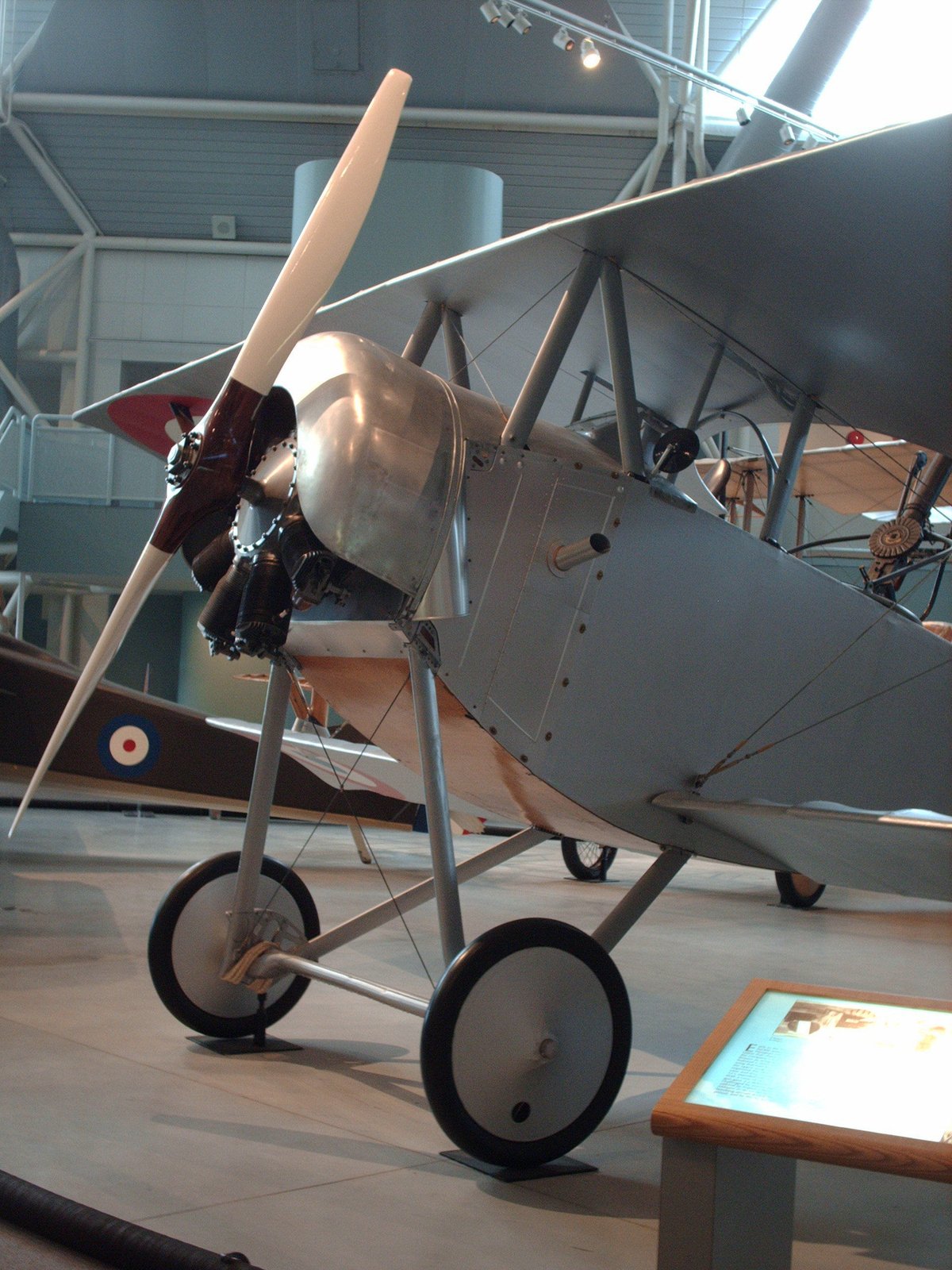
The Nieuport 12 was a French two-seat reconnaissance and fighter aircraft introduced in 1915. Designed as a sesquiplane, the aircraft featured a lower wing with a significantly smaller chord than the upper wing, though both were of comparable span. A notable design characteristic was the placement of ailerons exclusively on the upper wing. The fuselage was characterized by flat sides and a unique tail assembly; it lacked a fixed vertical fin ahead of the rudder, and the rudder itself was aerodynamically balanced, with a large portion of its area situated ahead of the hinge line.
Production occurred primarily in France through Société Anonyme des Établissements Nieuport between 1915 and 1916. While exact production totals for the Nieuport 12 alone are not documented, records indicate that more than 1,000 aircraft were built across the Nieuport 10, 12, and 12bis variants combined. Some aircraft were also produced under license in the United Kingdom by William Beardmore & Co. for the Royal Naval Air Service, including serial number 9233.
Technical specifications varied by model. The standard Nieuport 12 was powered by a 110 hp Clerget 9B (or 9Z) nine-cylinder air-cooled rotary engine. An improved version, the Nieuport 12bis, appeared in 1916 and utilized a 130 hp Clerget 9B engine along with revised side fairings and a circular cowling. Performance data for the 110 hp variant lists a maximum speed of 146 km/h (91 mph), a service ceiling of 4,000 meters, and a rate of climb of 1,000 meters in 5 minutes and 40 seconds. The aircraft had a wingspan of approximately 29 feet 6 inches and a gross weight of 1,874 lb.
During World War I, the Nieuport 12 served in various roles for the French Aéronautique Militaire, the British Royal Flying Corps (RFC), the Royal Naval Air Service (RNAS), and the air services of Italy and Russia. It was utilized for observation, reconnaissance, and as an escort fighter for bombers, typically armed with one flexible Lewis gun for the observer. One notable achievement associated with the type was by Flight Sub-Lieutenant Arthur Ince, who used a Nieuport 12 to become the first Canadian to shoot down an enemy aircraft during the conflict. By spring 1917, the type was largely withdrawn from frontline combat due to obsolescence and crew dissatisfaction, though many were converted into trainers and remained in service until 1918.
Today, the legacy of the Nieuport 12 is preserved through rare surviving examples and replicas. The Canada Aviation and Space Museum in Ottawa houses an original 1915 aircraft, which was gifted by the French government and exhibited across North America as a war trophy starting in February 1917.