
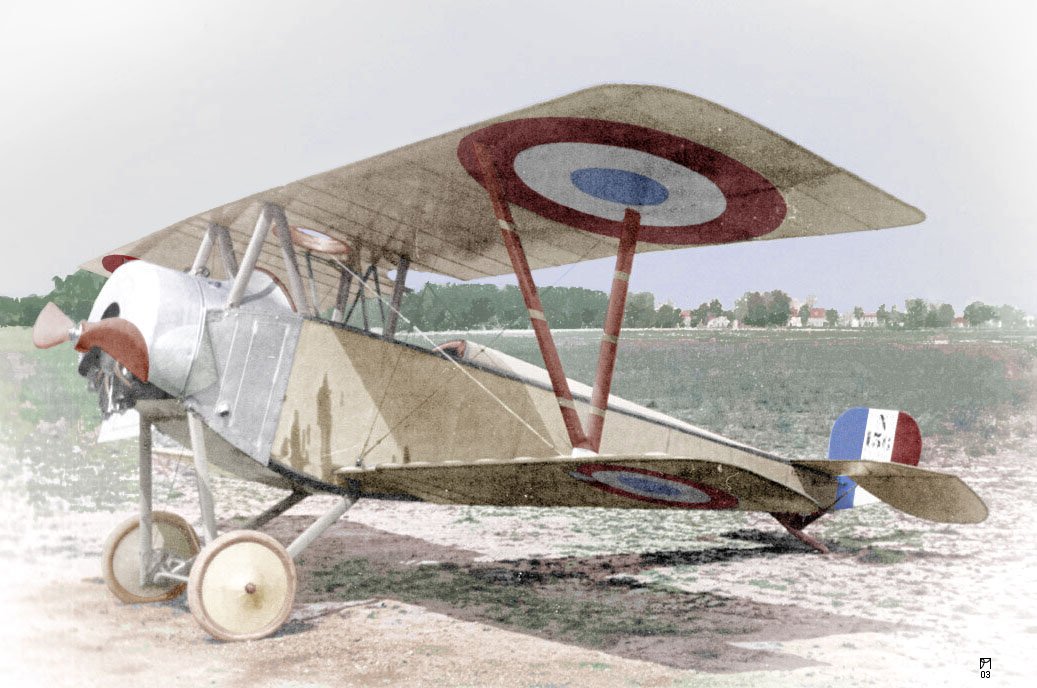
Design and Development
The Nieuport 10 was developed by Gustave Delage, the chief designer for Société Anonyme des Établissements Nieuport. The aircraft originated from the Nieuport X, a racer intended for the 1914 Gordon-Bennett Trophy. Following the cancellation of the race due to the outbreak of World War I, the design was adapted for military use. The resulting aircraft was a sesquiplane, characterized by a full-sized upper wing and a significantly smaller lower wing supported by V-shaped interplane struts. This configuration reduced drag and improved upward visibility, establishing a design lineage that would influence subsequent French fighter aircraft.
Production and Manufacturing
Production began in late 1914 or early 1915, with the aircraft entering service during the summer of 1915. While exact production totals are not fully documented, it is estimated that approximately 700 aircraft were built across the Nieuport 9 and 10 series. A significant portion of production occurred under license in Italy, where Macchi manufactured 240 units. Russian factories also produced the type under license, though specific quantities and plant locations remain undocumented. The original manufacturer, Nieuport, operated as a private firm until the French aircraft industry was nationalized in 1936, at which point its assets were absorbed into state-owned groups such as Loire-Nieuport.
Technical Specifications and Performance
The Nieuport 10 was powered by a single-row rotary piston engine, typically an 80 hp Gnome or Le Rhône. In a single-seat fighter configuration, the aircraft had a wingspan of 25 ft 11 in, a length of 22 ft 11.5 in, and a height of 8 ft 10.25 in. It featured an empty weight of 904 lb and a maximum take-off weight of 1,455 lb. Performance figures for the single-seat variant include a maximum speed of 91 mph at sea level and a climb rate capable of reaching 6,560 ft in 16 minutes and 30 seconds.
Military Service
Originally intended as a two-seat reconnaissance aircraft, the Nieuport 10 existed in two primary configurations: the 10AV, with the observer in the front, and the 10AR, with the observer in the rear. However, the 80 hp engine proved underpowered for two occupants, leading many operators to convert the aircraft into single-seat fighters by covering one cockpit and mounting a machine gun on the upper wing to fire over the propeller.
France deployed the aircraft on the Western Front and in Macedonia, where unit MF 388 operated machines marked with a Cross of Lorraine. The British Royal Naval Air Service (RNAS) placed the first order for 24 aircraft, delivered between May and August 1915, and operated them in the Aegean via No. 2 Wing (Mudros) and No. 3 Wing (Tenedos). The Royal Flying Corps (RFC) also utilized the type, specifically No. 45 Squadron on the Western Front in early 1917. Other operators included Belgium, where No. 4 Squadron flew the type from Houtem aerodrome in 1915, as well as Russia and the United States.
Legacy
As a front-line type, the Nieuport 10 was eventually superseded by the more powerful Nieuport 12 and relegated to training duties. Its primary historical significance lies in its role as the prototype for the Nieuport 11 and the broader family of successful Allied fighters. Regarding surviving examples, the National Air and Space Museum acquired an aircraft in 1951, which was later traded to the Old Rhinebeck Aerodrome in 1986 and flown between 1987 and 1990.