
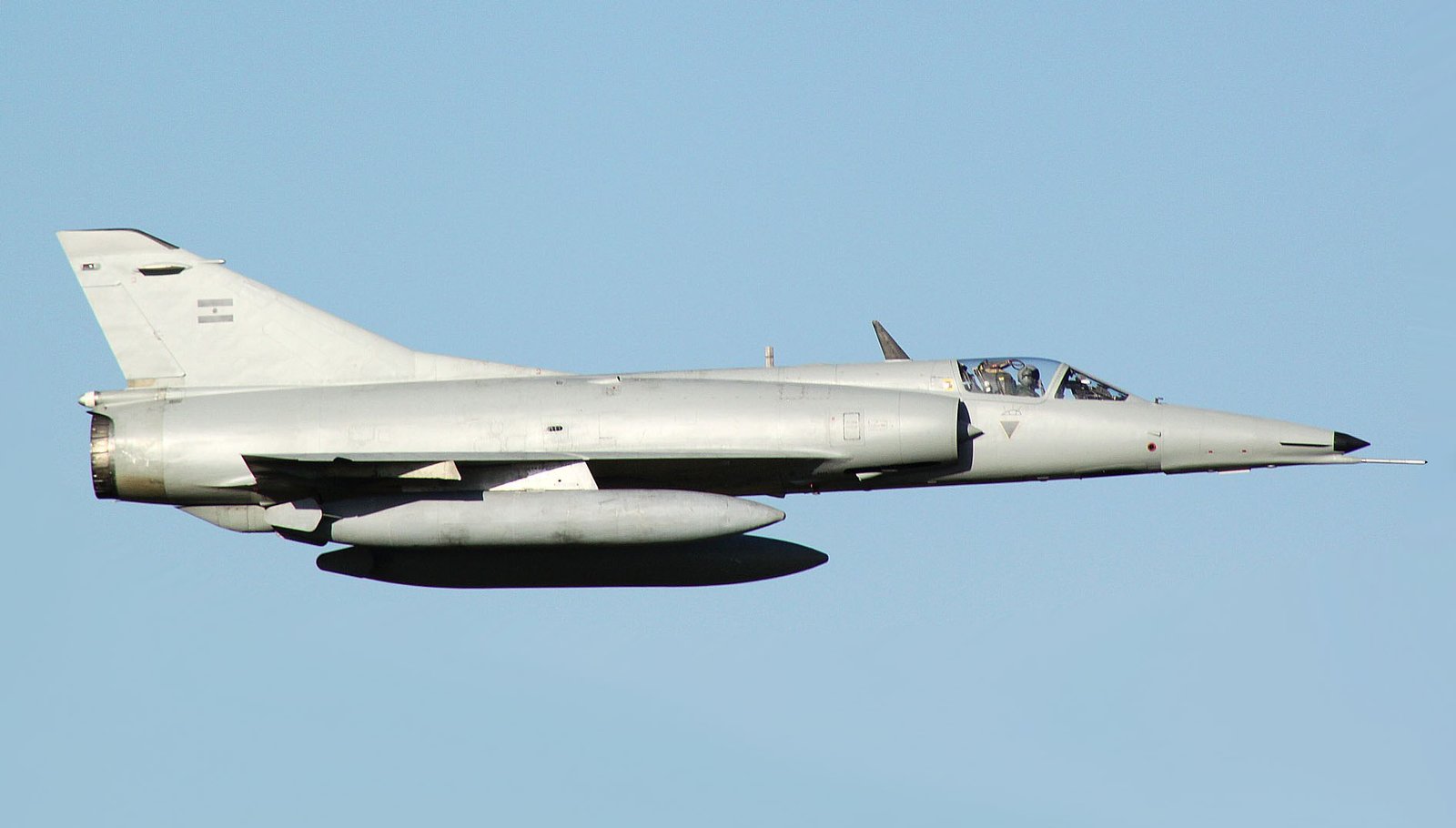
The IAI Nesher was developed by Israel Aircraft Industries (now Israel Aerospace Industries) as a local production of the French Dassault Mirage 5. The program began around 1968, driven by a French arms embargo that prevented the delivery of ordered Mirage 5s. Utilizing Mirage 5 blueprints, tools, and jigs, IAI produced the aircraft at their Ben Gurion Airport facilities. While reports on the first prototype flight vary between September 1969 and September 1971, the first production aircraft for the Israeli Air Force (IAF) took to the air on March 21, 1971. Production deliveries spanned from May 1971 to February 1974, resulting in a total of 61 aircraft: 51 single-seat fighters (Nesher A/S) and 10 two-seat trainers (Nesher B/T).
Technically, the Nesher is a supersonic multirole strike fighter powered by a single SNECMA Atar 9C afterburning turbojet, capable of producing 4,280 kgf of dry thrust and 6,200 kgf with afterburner. This powerplant allowed the aircraft to reach a maximum speed of Mach 2.1 at approximately 39,370 feet. The airframe features a wingspan of 8.22 meters and a length of 15.55 meters, with a maximum takeoff weight of 13,500 kg. For armament, it is equipped with two 30 mm DEFA cannons and seven hardpoints capable of carrying up to 4,200 kg of ordnance, including Shafrir 2 or AIM-9 Sidewinder missiles and various bombs and rockets.
In military service, the Nesher equipped four IAF squadrons: the "First Fighter," "First Jet," "Hornet," and "Guardians of the Arava." It saw extensive combat during the 1973 Yom Kippur War, where it achieved dozens of aerial victories. Notably, the "First Fighter" squadron recorded 59 kills against only four losses, and individual aircraft such as Nesher 510 and 561 were credited with 13 and 12 kills, respectively. The IAF retired the type between 1978 and 1981 in favor of the IAI Kfir.
Following Israeli service, 39 aircraft (35 single-seat and 4 two-seat) were exported to the Argentine Air Force under the name "Dagger." These aircraft played a significant role in the 1982 Falklands War, conducting low-level strike missions against British naval forces at San Carlos. Some Argentine examples were later upgraded to the "Finger" standard. While IAI corporate history claims five aircraft remained in operation with the South African Air Force, the specific identity of these airframes is not fully documented in the available records.