
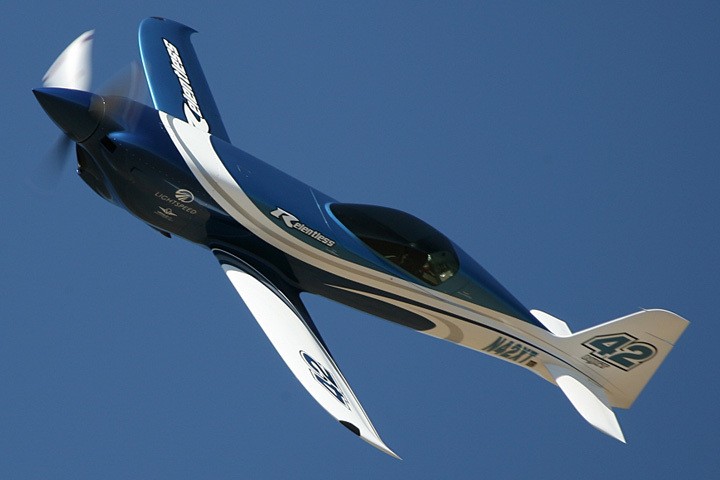
Racing Dominance
The Nemesis NXT established unprecedented dominance in Sport Class air racing, with Jon Sharp piloting the prototype aircraft N333XT to four consecutive national championships beginning in 2006. The aircraft's most celebrated achievement came during the 2009 Reno Air Races, where it delivered what became known as a "record a day and two on Sunday" performance, capturing five speed records and the national title. On September 19, 2009, the NXT reached 406.051 mph average race speed, making aviation history as the first homebuilt aircraft to break the 400 mph barrier on the Reno course.
This performance placed the NXT ahead of half the Unlimited Class competitors that year, including legendary World War II fighters like P-51 Mustangs, Hawker Sea Furys, and Curtiss P-40 Warhawks. The aircraft's racing career concluded triumphantly in 2015 when Sharp set five FAI world records for piston aircraft at Moriarty, New Mexico, including a 100-kilometer closed course record at 397 mph that remained current as of 2022.
Design Innovation
Jon Sharp brought cutting-edge aerospace engineering to kit aircraft design, leveraging his experience at Lockheed's legendary Skunk Works facility. The NXT became the first kit-built airplane designed entirely through digital simulation, utilizing computational fluid dynamics, NASA-derived airfoils, and wind tunnel testing at Lockheed facilities. Sharp and his team could "fly" the aircraft virtually before physical construction began, representing a revolutionary approach to homebuilt aircraft development.
Patricia Sharp played a crucial role in the project, creating 44 carbon fiber molds and laying up the carbon fiber components for the prototype and initial five production kits. The sophisticated design process resulted in an aircraft with exceptional aerodynamic efficiency, featuring a laminar flow wing and carefully optimized airframe that maximized the potential of its powerplant.
Manufacturing and Production
Nemesis Air Racing produced the NXT as a kit aircraft to comply with emerging Sport Air Racing regulations. Jon Sharp initially created five complete kits, with Patricia Sharp handling the complex carbon fiber work. Air racer Kevin Eldredge subsequently built kit numbers 6 through 10, bringing total known production to at least 10 aircraft. By October 2023, the prototype had completed over 100 successful test flights, with the first production model assembled that same month.
The German company Air-C-Race became the official builder of remote control models in 2011, extending the aircraft's influence beyond full-scale aviation. This arrangement demonstrated the design's scalability and appeal across different segments of the aviation community.
Technical Excellence
The NXT's performance stemmed from its optimized integration of advanced materials and proven powerplant technology. The single Lycoming TIO-540-NXT Thunderbolt six-cylinder twin-turbocharged engine produced 350 horsepower, driving the 1,600-pound empty weight aircraft to extraordinary speeds. With a maximum takeoff weight of 2,600 pounds and 90-gallon fuel capacity, the aircraft balanced performance with practical racing requirements.
The carbon fiber construction provided exceptional strength-to-weight ratios while the retractable landing gear minimized drag. The cockpit accommodated two occupants, allowing for passenger flights and training operations beyond pure racing applications. This versatility contributed to the aircraft's appeal among kit builders seeking high-performance capabilities.
Electric Evolution
The NXT's advanced design proved adaptable to emerging propulsion technologies. Electroflight and Rolls-Royce developed an electric variant called "Spirit of Innovation" (G-NXTE), featuring three electric motors driving a single MT propeller and carrying a 1,500-pound battery pack. The electric version nearly doubled existing electric aircraft speed records, achieving 388 mph and setting multiple closed-course and time-to-climb records.
The original NXT's fuel system design, featuring a single large tank between cockpit and engine rather than wing tanks, proved particularly suitable for electric conversion by providing optimal battery pack placement. This adaptability demonstrated the fundamental soundness of Sharp's original design approach.
Museum Recognition
The National Air and Space Museum acquired the record-setting Nemesis NXT prototype around 2018, recognizing its significance as the first homebuilt aircraft to exceed 400 mph and the first kit aircraft designed using digital simulation. The acquisition placed the NXT alongside its predecessor, the original Nemesis, which had earned display at the Steven Udvar-Hazy Center and headlines the "Nation of Speed" exhibit in Washington, D.C.
The original Nemesis had captured 45 of 48 races between 1991 and 1998, becoming the winningest airplane in air racing history. The NXT's museum placement confirmed the continued legacy of Jon Sharp's innovative approach to high-performance aircraft design, bridging the gap between professional aerospace engineering and homebuilt aviation achievement.