
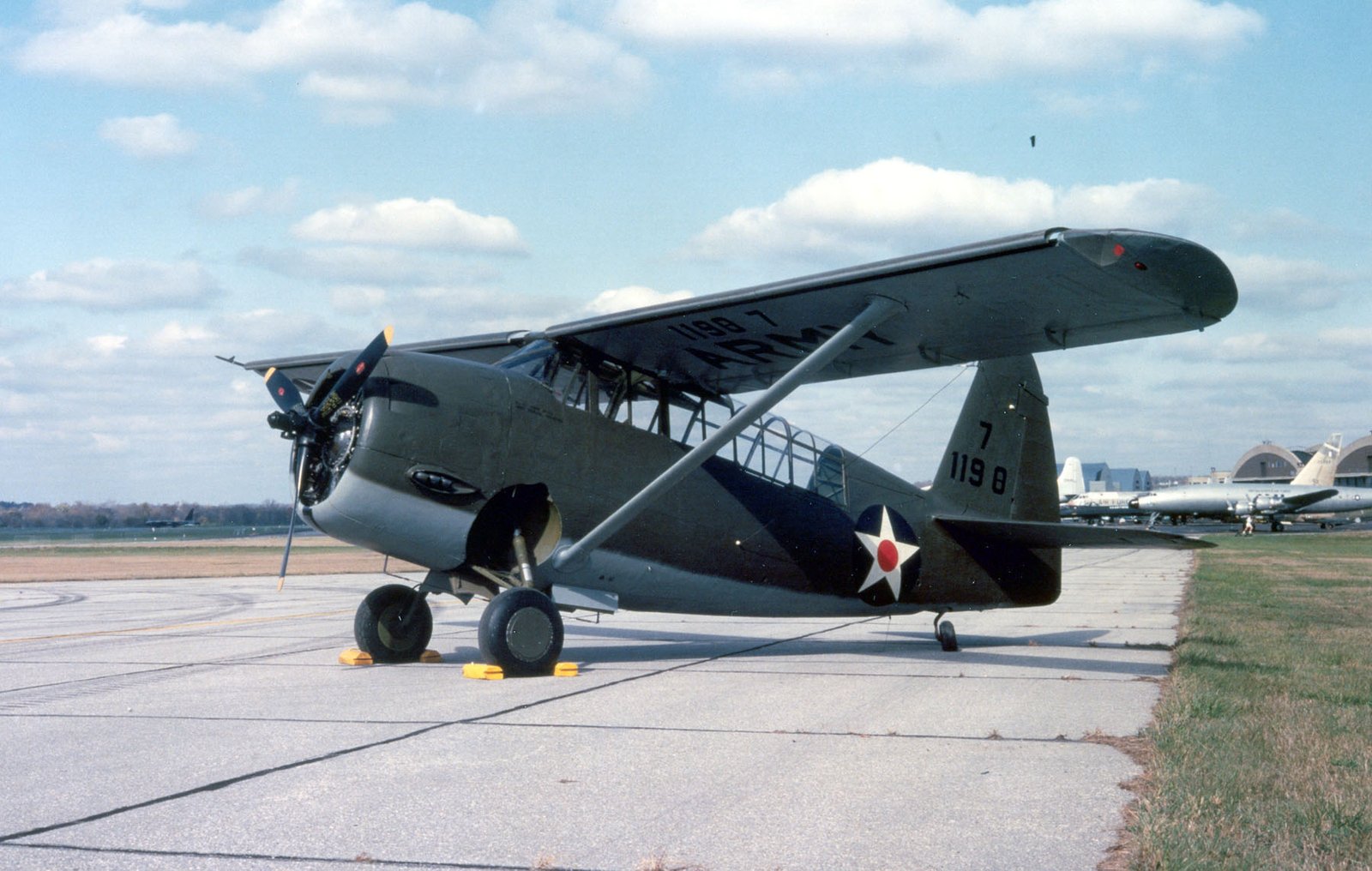
Production and Manufacturer History
The Curtiss-Wright O-52 Owl was developed by the Curtiss-Wright Airplane Company, a firm created in 1929 through the merger of the Curtiss Aeroplane and Motor Company and Wright interests. The O-52, designated as Curtiss Model 85, was ordered and produced between approximately 1940 and 1942, with a total of 203 aircraft built. While Curtiss-Wright was a dominant force in aviation during the interwar period, the company eventually transitioned away from airframe manufacturing in the late 1940s. Today, Curtiss-Wright Corporation continues to operate as a diversified aerospace and defense technology company.
Design and Technical Specifications
Designed as a "heavy observation" aircraft, the O-52 first flew in February 1941. The aircraft featured a rotund, all-metal fuselage with a high-wing layout and extensive glazing to facilitate observation. A signature design element was its retractable landing gear. The O-52 was powered by a Pratt & Whitney R-1340 nine-cylinder, air-cooled radial piston engine. In terms of performance, the aircraft reached a top speed of 220 mph and possessed a range of 700 miles, with a gross weight of 5,364 lb and a wingspan of 40 ft 9 in. For defense and utility, it was equipped with one fixed forward-firing .30-caliber machine gun and one flexible .30-caliber machine gun for the observer.
Military Service
Procured by the U.S. Army for artillery spotting and observation, the O-52 was quickly deemed unsatisfactory for modern combat due to its vulnerability. Consequently, many units remained in the United States as utility aircraft and trainers. However, some were deployed to the Philippines, where they faced superior Japanese air power and saw brief, unsuccessful combat.
Under the Lend-Lease program, 30 O-52s were allocated to the Soviet Union, with 26 dispatched via Arctic convoys starting in November 1941. After initial training at the 22nd ZAP in Ivanovo, the aircraft were deployed to various Independent Fire Correction Aviation Squadrons (OKAE), including the 50th OKAE under Major N. A. Sokolov, as well as the 12th, 13th, 42nd, and 118th OKAE. In Soviet service, the O-52 performed artillery spotting, photography, and clandestine operator insertion. Despite its general vulnerability, one Soviet O-52 famously shot down a Messerschmitt Bf 109, earning the nickname "Messerschmitt Killer."
Civil Service and Legacy
Following the war, at least two O-52s were transferred to Soviet civil registration for geological survey and mapping missions. The O-52 represents a pivotal shift in military doctrine; its rapid obsolescence led the U.S. Army to abandon heavy observation aircraft in favor of lighter liaison types like the Stinson L-5 and Piper L-4. Today, a rare preserved example of the O-52 Owl is held in the collection of the Yanks Air Museum in Chino, California.