
Design and Development
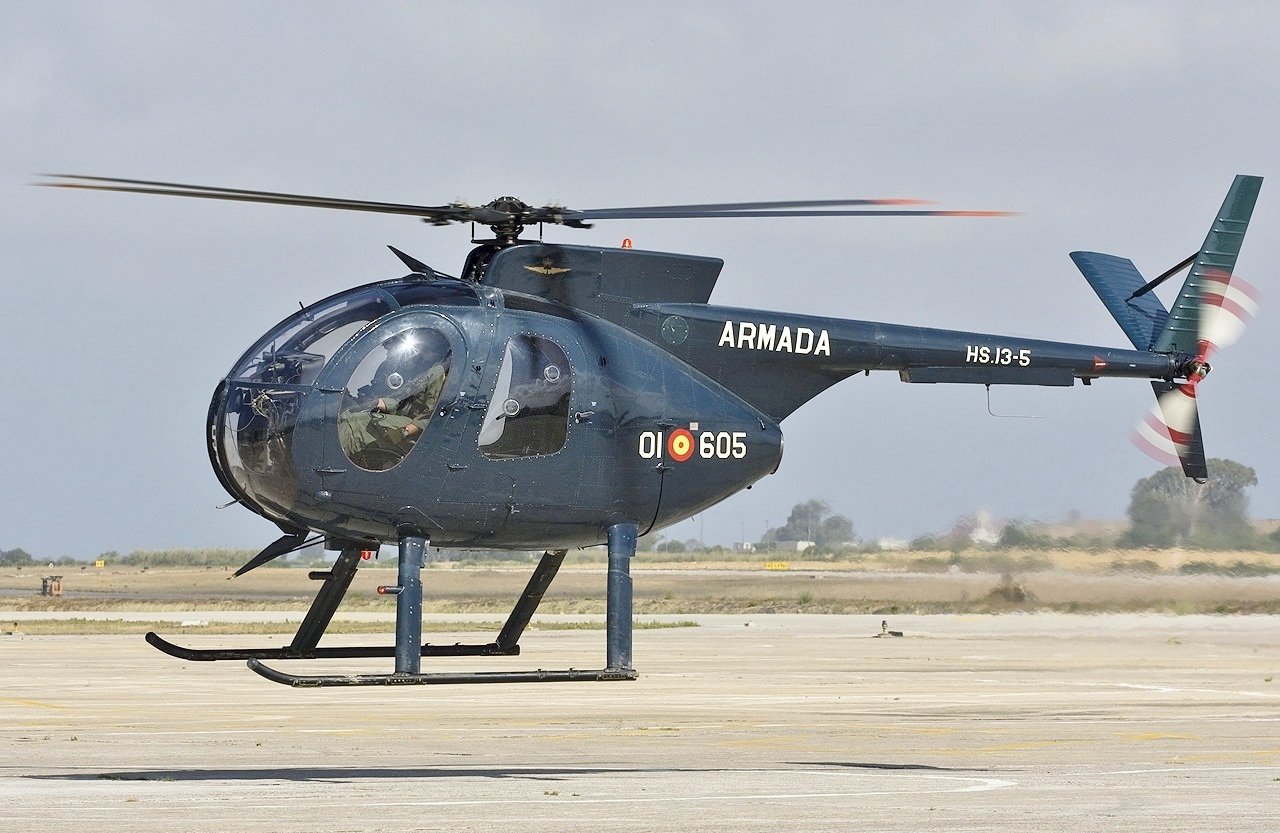
The Hughes OH-6 Cayuse, internally designated as the Model 369, was developed to meet United States Army Technical Specification 153 issued in 1960. The Army sought a Light Observation Helicopter (LOH) to replace the Bell H-13 Sioux, capable of performing reconnaissance, personnel transport, casualty evacuation, and light attack roles. The resulting aircraft featured a compact, ovoid "egg-shaped" fuselage with extensive canopy glazing to provide pilots with superior exterior visibility. Its agility was driven by a four-bladed fully articulated main rotor. The prototype, designated the YOH-6A, completed its maiden flight on February 27, 1963.
Production and Technical Specifications
Hughes Helicopters received the production contract in May 1965. Primary U.S. production of the OH-6A continued until August 1970. Production totals for the U.S. Army vary by source, with estimates ranging from 1,419 to 1,434 units; a conservative estimate suggests around 1,400+ aircraft were built. Beyond the United States, Kawasaki Heavy Industries produced 387 OH-6D units under license in Japan. The aircraft is powered by a single turboshaft engine producing 317 horsepower, enabling a maximum cruise speed of 130 knots and a travel range of 330 nautical miles.
Military Service and Legacy
Entering U.S. Army service in 1966, the OH-6 arrived in South Vietnam around December 1967. Pilots nicknamed the aircraft the "Loach" (a phonetic derivation of LOH). It was famously utilized in "hunter-killer" or "Pink Teams," where the OH-6 acted as the scout to locate enemy forces and mark targets for the Bell AH-1G Cobra attack helicopter. This high-risk role led to significant losses; sources estimate between 842 and 964 OH-6As were destroyed in Vietnam.
Beyond conventional combat, modified OH-6As were used by the CIA via Air America for a covert wire-tapping mission in December 1972 near Vinh, North Vietnam. The design's versatility led to the development of the AH-6 "Little Bird" and MH-6 special operations variants, as well as a successful civilian lineage through the Hughes 500 and MD 500 series used in law enforcement and emergency medical services.