
Development and Design Philosophy
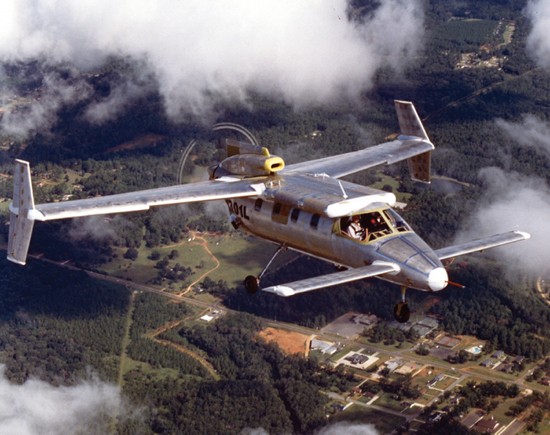
The Laser 300 emerged from OMAC's singular focus on creating a revolutionary single-turboprop pusher design that challenged conventional aircraft configurations of the early 1980s. The California-based Old Man's Aircraft Company committed entirely to this single aircraft concept, betting their future on an unconventional approach that placed a fixed canard in the nose and mounted the engine in a pusher configuration behind the main wing.
The aircraft's most distinctive features included high-mounted wings with end-plate-style fins positioned at the wingtips, creating an unmistakable silhouette that set it apart from traditional general aviation designs. This canard configuration was particularly unusual for its era, representing a bold departure from proven designs in favor of theoretical aerodynamic advantages.
Technical Specifications and Performance
Powered by a single Pratt & Whitney Canada PT6A-3R turboprop engine producing 680 horsepower, the Laser 300 achieved impressive performance figures on paper. The aircraft reached a maximum takeoff weight of 6,400 pounds while maintaining a cruise speed of 250 knots. With a maximum range of 1,881 nautical miles, the design promised to compete effectively in the very light turboprop market segment.
The PT6A engine choice proved sound, as this powerplant had already established reliability in aircraft like the Cessna Caravan. However, the Laser 300's innovative fuel system presented unique engineering challenges, utilizing strake tanks that ran down the fuselage sides rather than conventional wing-mounted fuel storage.
Development Challenges and Testing
Wind tunnel testing at NASA's Langley Research Center revealed critical flaws in the aircraft's longitudinal stability, exposing fundamental design problems that required extensive modification. Flight operations chief Edwin Chaplin later acknowledged that the Laser initially suffered from very poor longitudinal stability, though improvements were achieved by the sixtieth test flight.
These stability issues highlighted the risks inherent in OMAC's unconventional design approach. While canard configurations offered theoretical benefits, the practical implementation proved far more challenging than anticipated, requiring extensive flight testing and modification to achieve acceptable handling characteristics.
Production Ambitions and Financial Reality
By January 1989, OMAC had developed optimistic production forecasts, projecting construction of eight aircraft per month by the end of 1991. These ambitious plans required significant capital investment, with the company estimating over $20 million needed just to initiate certification and production processes.
The total program cost eventually exceeded $300 million, a staggering sum for a small general aviation manufacturer. Despite years of development work and substantial financial investment, market interest remained insufficient to justify the massive capital requirements for certification and production startup.
The End of OMAC
Political unrest in Brazil prevented crucial new investments from materializing, effectively ending OMAC's hopes for bringing the Laser 300 to market. The combination of poor company finances, limited market interest, and ongoing technical challenges proved insurmountable obstacles.
With only three prototypes ever constructed, OMAC ceased operations without achieving commercial success. The company's single-minded focus on one revolutionary design, while admirable in its ambition, left no fallback options when the Laser 300 failed to attract sufficient backing.
Legacy and Historical Significance
The Laser 300 serves as a cautionary tale about innovation in general aviation, demonstrating how technical ambition can exceed practical and financial limitations. Despite receiving an ICAO type designator (OMLA), this designation saw no practical use due to the absence of production aircraft.
The aircraft remains notable for its bold design choices and represents the kind of innovative thinking that occasionally emerges in general aviation. However, it also illustrates the enormous challenges facing small manufacturers attempting to introduce unconventional designs in a conservative market segment.
Today, the Laser 300 exists primarily as a historical footnote, studied by aviation enthusiasts and industry analysts as an example of ambitious engineering constrained by market realities. The prototype's advanced configuration concepts would later influence other canard designs, though none would directly trace their lineage to OMAC's pioneering but ultimately unsuccessful effort.
The aircraft's failure highlighted the substantial risks involved in departing from proven configurations, particularly for undercapitalized manufacturers lacking the resources to overcome inevitable development challenges. While innovation drives aviation progress, the Laser 300's story demonstrates that revolutionary designs require not only technical excellence but also sufficient financial backing and market acceptance to achieve commercial viability.