
Service History
The Partenavia Oscar carved out a significant niche in the European general aviation market, particularly among flying clubs seeking reliable training and touring aircraft. The versatile design spawned multiple variants to serve different market segments, from the lightweight P.66B Oscar 100 two-seater to the fully aerobatic four-seat P.66C Charlie. Twenty-one aircraft found their way to South Africa, where AFIC (Pty) Limited assembled and marketed them as the AFIC RSA 200 Falcon, demonstrating the design's international appeal.
The P.66C Charlie variant proved especially popular with aerobatic enthusiasts, with 96 aircraft built primarily for Italy's Aero Club d'Italia after its maiden flight in January 1976. This four-seat version showcased the Oscar's structural integrity and handling characteristics that made it suitable for demanding flight training and competition aerobatics.
The Manufacturer
Partenavia Costruzioni Aeronautiche SpA emerged from the ambitious vision of Professor Luigi Pascale and his brother Giovanni during Italy's postwar aviation renaissance. Founded in the 1950s and incorporated as a limited company in 1959, Partenavia operated as an independent manufacturer until 1981, when the Italian state-owned aerospace giant Aeritalia acquired the Naples-based firm. The Pascale brothers, who had honed their aeronautical skills as enthusiastic model aircraft builders, established Partenavia as a dedicated civil aircraft manufacturer focused on practical light aircraft designs.
At its peak in the 1980s, Partenavia employed approximately 150 workers and concentrated production on the P.66 and P.68 aircraft families. The company's 41-year run from 1957 to 1998 represented a significant chapter in Italian aviation manufacturing, producing aircraft that served operators across Europe, Africa, and beyond.
Engine & Technical Details
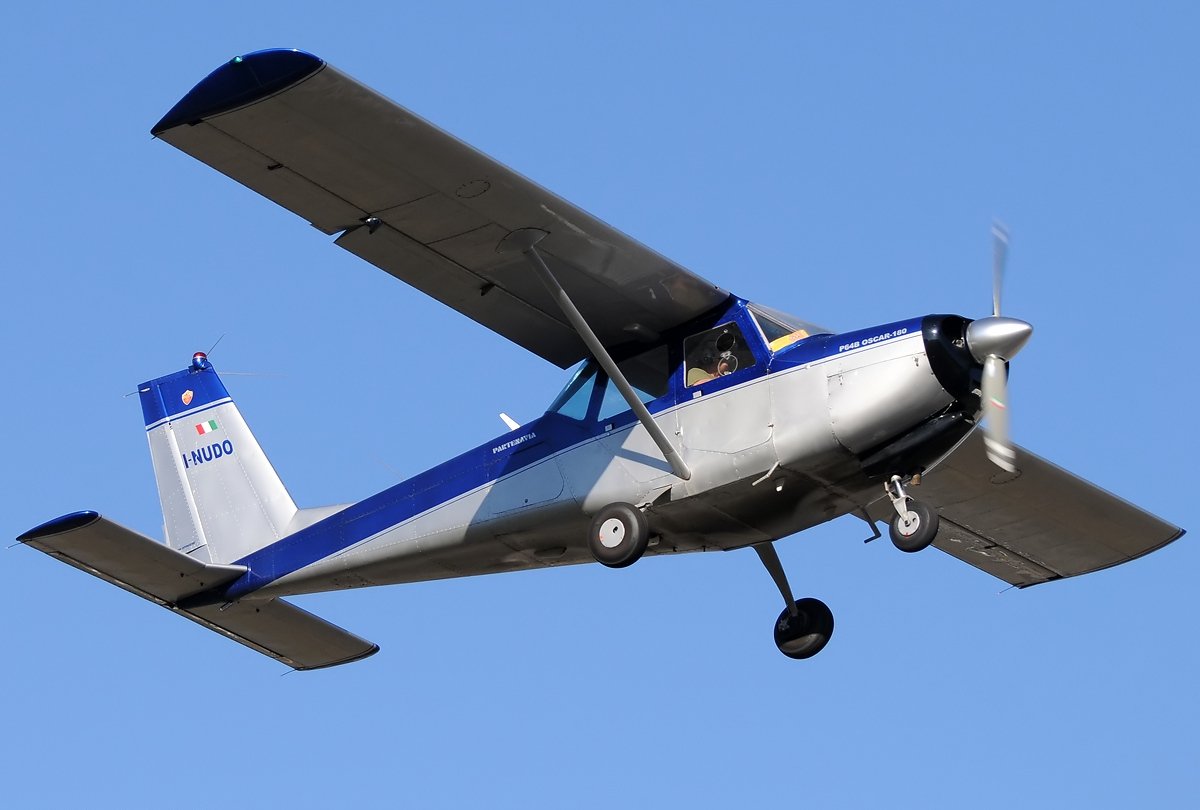
The Oscar family relied exclusively on proven Lycoming horizontally-opposed, air-cooled engines to power its various configurations. The P.64B Oscar 180 utilized the reliable Lycoming O-360-A1A producing 180 horsepower, while the more powerful Oscar 200 variant employed the O-360-A1B generating 200 horsepower. Economy-minded operators could choose the P.66B Oscar 100 with its 100-horsepower Lycoming O-320, or opt for the 150-horsepower O-320 in the three-seat Oscar 150 configuration.
The aerobatic P.66C Charlie featured a Lycoming O-320-H2AD engine producing 160 horsepower, specifically chosen for its reliability under aerobatic stress loads. All variants incorporated a fuel capacity of 162 liters, providing adequate range for the touring and training missions the aircraft was designed to fulfill. The high-wing configuration offered excellent stability and ground handling characteristics, while the fixed tailwheel landing gear simplified maintenance requirements.
Design Evolution
Luigi "Gino" Pascale and Giovanni "Nino" Pascale developed the Oscar as an all-metal evolution of their earlier P.57 Fachiro design. The prototype P.64 Fachiro III first flew on April 2, 1965, but significant refinements transformed it into the production P.64B Oscar B. Key improvements included a cut-down rear fuselage and panoramic rear window that enhanced visibility and gave the aircraft its distinctive appearance.
This design philosophy emphasized practical utility over cutting-edge performance, resulting in an aircraft that flying clubs and private operators found both affordable to operate and forgiving to fly. The Oscar's conventional configuration made it an ideal platform for pilot training while offering sufficient performance for cross-country touring.
Production & Legacy
Partenavia's methodical approach to variant development resulted in a comprehensive aircraft family spanning nearly a decade of production. The breakdown included one prototype, 64 P.64B Oscar B aircraft, nine Oscar 200 variants, 80 P.66B Oscar 100 aircraft, 50 P.66B Oscar 150 aircraft, and 96 P.66C Charlie aircraft, plus two experimental variants that explored potential improvements.
The Oscar's legacy extends into the 21st century through Vulcanair's V.10, which maintains the original airframe design while incorporating modern avionics centered around a Garmin G500 glass cockpit. This contemporary revival demonstrates the fundamental soundness of the Pascale brothers' 1960s design, proving that well-executed aircraft can transcend their original era through thoughtful modernization.
Today, surviving Oscars continue serving in various roles across Europe and beyond, testament to the robust construction and practical design that made them successful during their original production run. The aircraft represents an important milestone in Italian general aviation manufacturing, bridging the gap between postwar reconstruction and the modern era of light aircraft development.