
Development and Design
Italian engineer Giovanni Casiraghi conceived the P-149 as an enlarged derivative of Piaggio's successful P-148 two-seat trainer. Within months of the P-148's 1950 debut, market demand clearly indicated the viability of a four-seat variant combining training, touring, and liaison capabilities. Casiraghi's design featured advanced characteristics for its era, including all-metal construction, a low-wing cantilever configuration, and fully retractable tricycle landing gear—sophisticated features that distinguished it from many contemporary trainers still employing fixed conventional gear.
The prototype's maiden flight on June 19, 1953, demonstrated the soundness of Casiraghi's approach. The aircraft incorporated NACA 230-series airfoils at the wing root transitioning to NACA 4412 sections at the tips, creating a wing with 202.5 square feet of area and an aspect ratio of 6.6. This aerodynamic refinement contributed to the P-149's impressive performance envelope and docile handling characteristics.
Production and International Collaboration
Piaggio's Genova facility, which had survived post-war economic challenges through diversification into products like the iconic Vespa scooter, produced 88 P-149s between 1953 and the early 1960s. However, the aircraft's production story took an unusual turn when Focke-Wulf GmbH of Bremen acquired manufacturing rights. The German company relocated the entire production line to Bremen and manufactured 190 additional aircraft designated FWP.149D, bringing total production to 280 units.
This Italian-German collaboration proved highly successful, with Piaggio delivering 76 of its 88 aircraft to Germany—72 as unassembled kits for final assembly at Bremen. The arrangement allowed Focke-Wulf to establish a significant presence in the post-war training aircraft market while providing Piaggio with substantial export revenue.
Military Adoption and Service
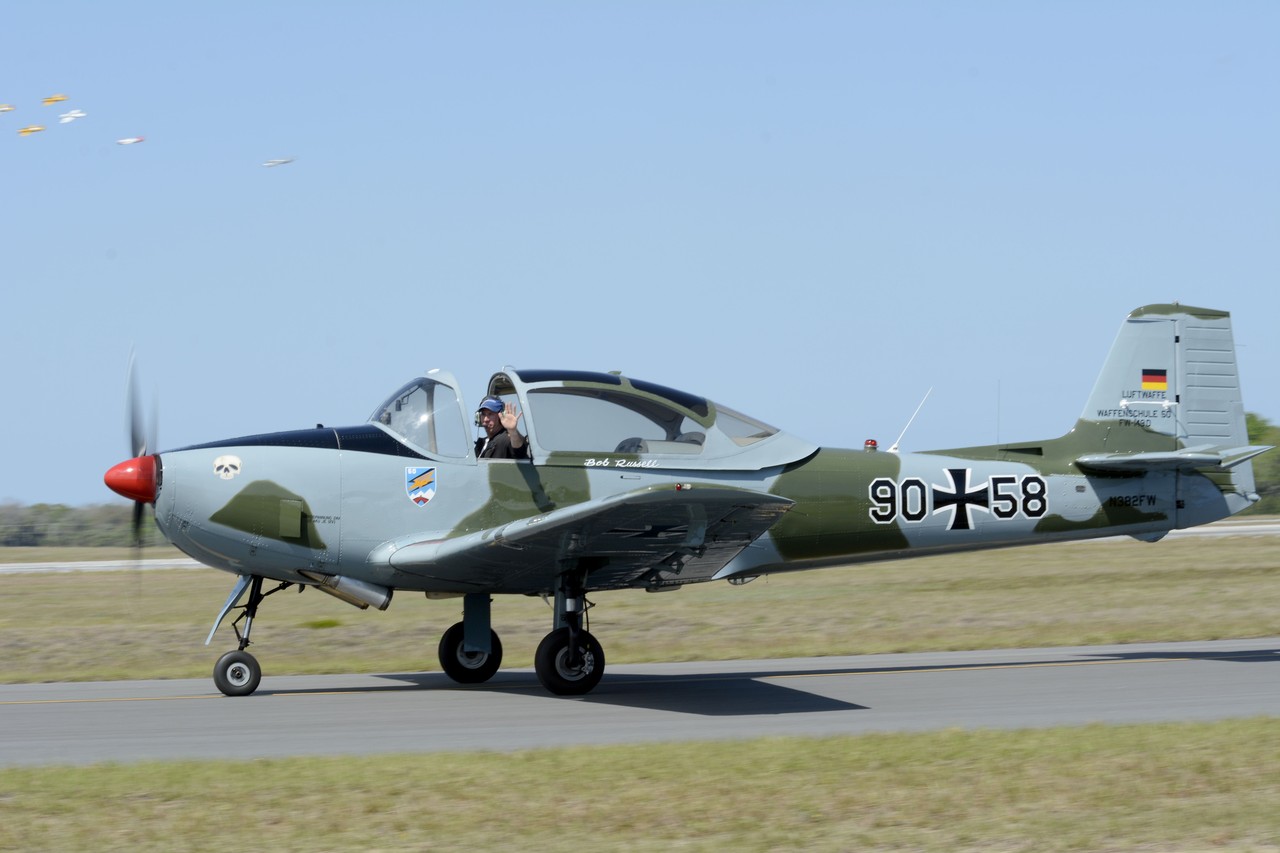
The German Air Force's selection of the P-149 over competing designs from Beechcraft (T-34 Mentor) and Saab (91 Safir) validated the aircraft's design excellence. The Luftwaffe's choice hinged particularly on the P-149's spacious cabin, which accommodated both primary flight training and liaison missions more effectively than its competitors. German military examples served from 1957 until March 31, 1990, when the final P-149D was retired at Fürstenfeldbruck Air Base in Bavaria—a remarkable 33-year service life.
WaffenSchule 49 at Fürstenfeldbruck became the primary operator, training generations of German military pilots on the type. The aircraft's robust construction and reliable systems made it ideally suited for the demanding flight training environment, where aircraft typically accumulate high flight hours under challenging conditions.
Internationally, the P-149 found additional military customers. The Italian Air Force operated two aircraft from 1953 to 1955, with MM559 being the sole Piaggio-built example in Italian military service. The Nigerian Air Force acquired 12 P-149Ds in 1967, while Uganda received several P-149U variants for their air force.
Powerplant and Performance
The Lycoming GO-480-B1A6 flat-six engine provided 270 horsepower through a horizontally-opposed, air-cooled configuration that became the P-149's mechanical heart. This reliable powerplant, also license-manufactured by BMW in Bavaria for German-built aircraft, delivered excellent performance characteristics. The engine enabled a maximum cruise speed of 165 mph, service ceiling of 19,850 feet, and range of 680 miles—impressive figures for a 1950s trainer.
The aircraft's empty weight of 2,557 pounds and gross weight of 3,704 pounds provided a useful load of 1,147 pounds, accommodating pilot, passengers, and fuel for extended training missions. The tricycle landing gear configuration simplified ground handling and reduced the likelihood of ground accidents compared to conventional tailwheel trainers.
Civil Operations and Training Schools
Swissair Flying School recognized the P-149's training potential, purchasing five P-149E variants for their flight academy operations at Bern-Belp airfield. These aircraft provided primary instruction to Swissair's trainee airline pilots, demonstrating the type's effectiveness in commercial pilot training programs. The airline's selection of the P-149 over other available trainers reflected its superior cabin comfort and advanced systems, which better prepared students for transition to larger commercial aircraft.
Legacy and Preservation
Approximately 30 P-149 aircraft remain airworthy worldwide, representing cherished examples of 1950s aviation technology. Captain Gusso's restored MM559, the former Italian Air Force example, has achieved particular recognition through appearances at prestigious events including the Italian Air Force 100th Anniversary Air Show at Pratica di Mare in June 2023 and the Royal International Air Tattoo.
The P-149's significance extends beyond its operational history to represent successful post-war European aviation collaboration. The Italian-German partnership that produced these aircraft demonstrated how former adversaries could cooperate in developing practical solutions for military and civilian aviation needs. Today's surviving examples continue flying as testament to Giovanni Casiraghi's sound design principles and the craftsmanship of both Piaggio and Focke-Wulf manufacturing teams.