
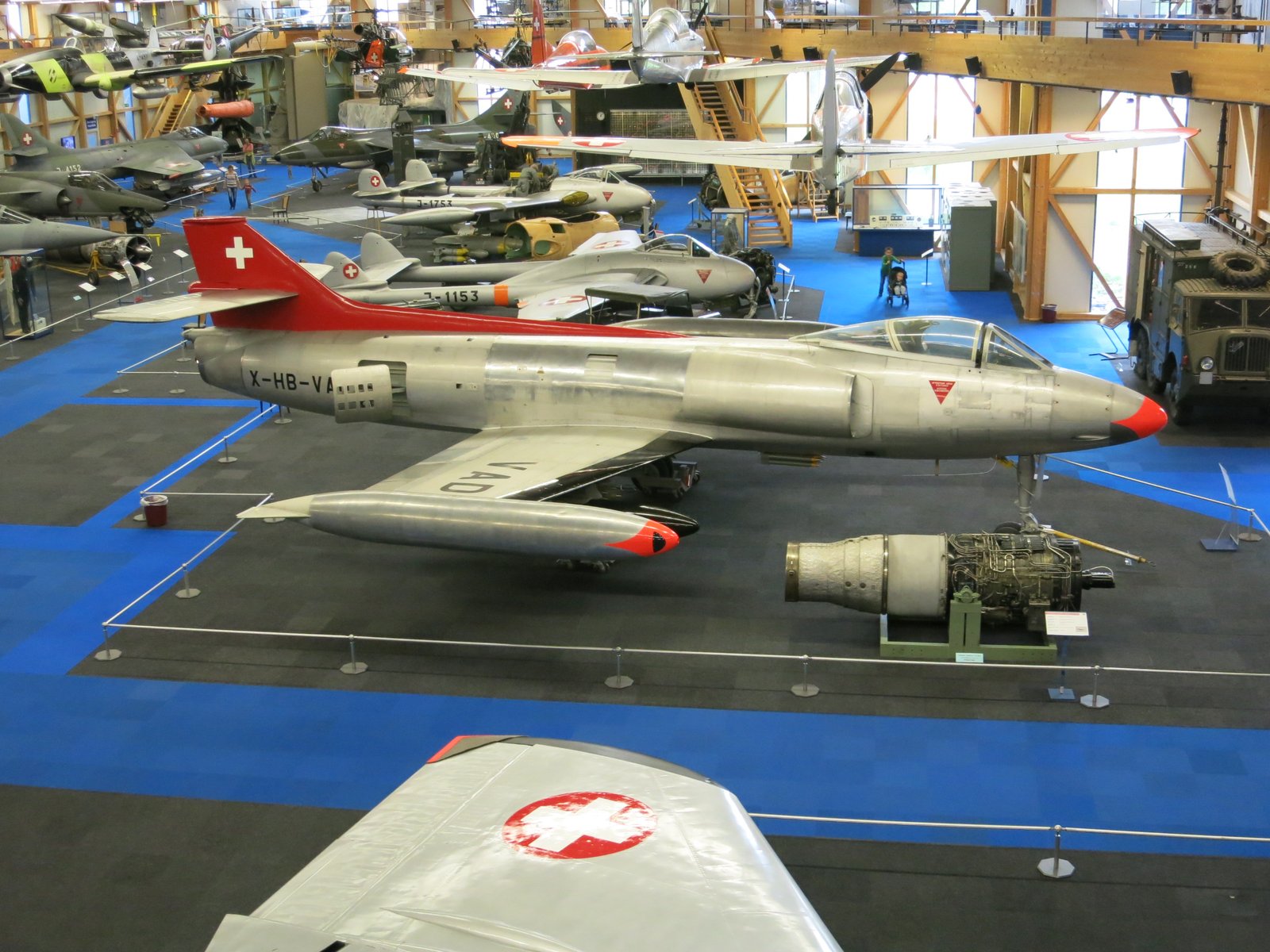
The FFA P-16 was a Swiss-designed single-engine jet fighter and ground-attack aircraft developed by Flug- und Fahrzeugwerke Altenrhein (FFA) in Altenrhein, St. Gallen. Conceived in the late 1940s, the aircraft was intended to serve the Swiss Air Force as a close air support (CAS) platform capable of operating from the short, semi-prepared, or unprepared airfields typical of Switzerland's dispersed alpine defensive strategy. To achieve this, the P-16 was equipped with a robust undercarriage featuring twin main-gear wheels and a brake parachute to minimize landing distances.
The first prototype, P-16-01 (J-3001), made its maiden flight on 25 April 1955. The aircraft's performance was promising; on 15 August 1956, the second prototype successfully broke the sound barrier in a dive. The P-16 was powered by British Armstrong Siddeley Sapphire turbojets. The Mk I prototypes utilized the Sapphire ASSa.6 producing 7,900 lbf of thrust, while the Mk II and Mk III variants used the more powerful Sapphire ASSa.7, which provided 11,000 lbf of thrust. In this latter configuration, the aircraft reached a maximum speed of 695 mph at sea level, a service ceiling of 46,000 ft, and a rate of climb of 12,800 ft/min.
Designed for high firepower, the P-16 featured two 30 mm Hispano-Suiza HS.825 (or Oerlikon KCA) cannons in the nose, each with 120 rounds. A distinctive feature was its retractable ventral Matra launcher capable of firing 44 68 mm SNEB rockets. Additionally, it possessed four under-wing hardpoints for up to 5,700 lb of external ordnance, including conventional and napalm bombs. The Mk III prototypes further integrated AIM-9B Sidewinder missiles.
Despite its capabilities, the programme was plagued by accidents. The first prototype crashed into Lake Constance on 31 August 1955 due to engine failure. In 1958, the Swiss government ordered 100 production aircraft, but the programme was abruptly cancelled after the first pre-production aircraft (J-3003) crashed into Lake Constance on 25 March 1958. Consequently, the Swiss Air Force procured the British Hawker Hunter instead. Only five airframes were ever completed: two Mk I prototypes, one Mk II pre-production aircraft, and two Mk III prototypes built as a private venture. One Mk III flew under the civil registration X-HB-VAD on 24 March 1960.
The P-16 left a lasting legacy beyond its military failure. Bill Lear studied the aircraft's high-speed aerodynamics and wing design, incorporating elements into the development of the Learjet 23. Today, a single composite airframe, assembled from parts of two prototypes, is preserved at the Swiss Air Force Museum at Dübendorf Air Base.