
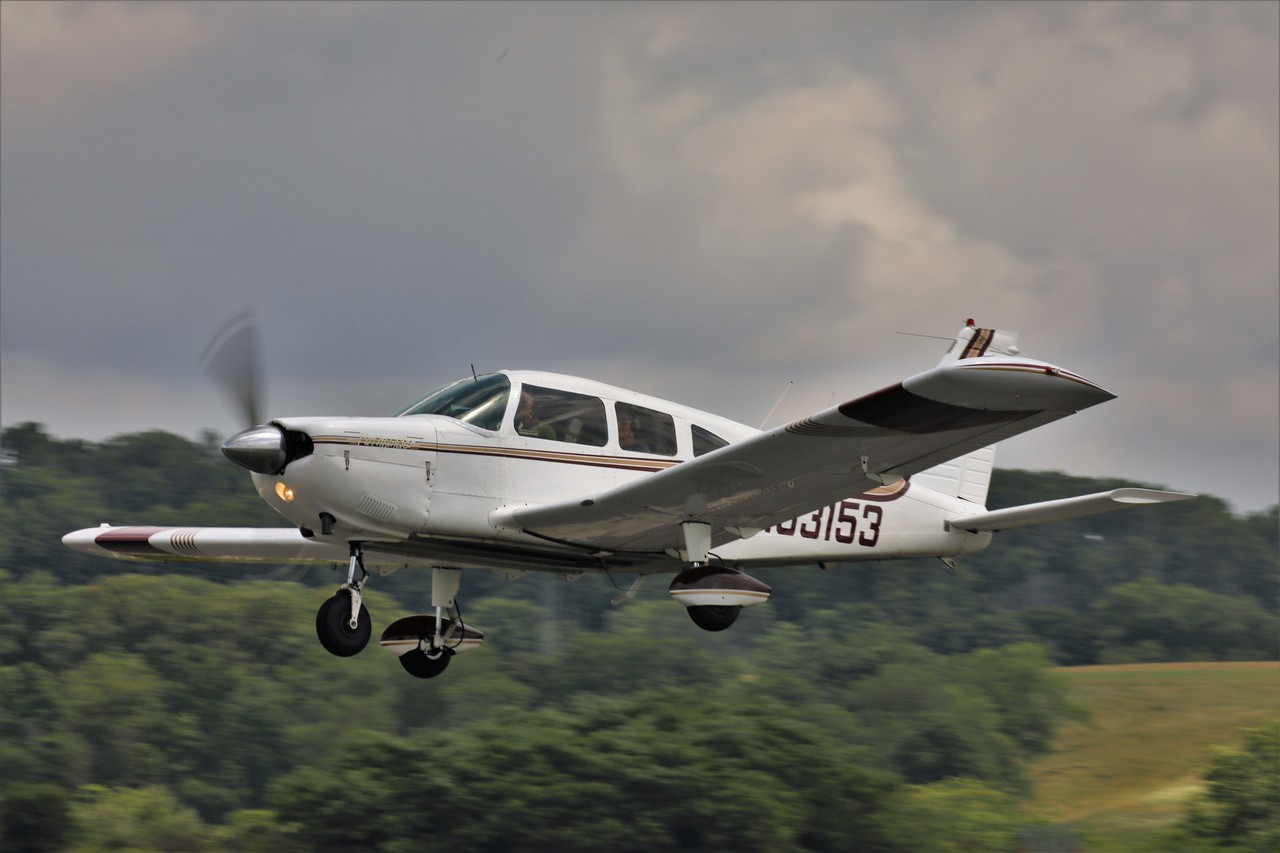
Service History
The PA-28-235 carved out a dominant position in general aviation by offering load-carrying capability that nearly matched its empty weight in useful payload. During the late 1960s peak production years, when Piper was manufacturing approximately 7,000 PA-28 series aircraft annually, the 235-horsepower variant became the go-to choice for pilots requiring maximum utility from a fixed-gear single. The aircraft's ability to haul substantial loads while maintaining competitive operating costs made it a staple of flight training schools, charter operators, and private owners throughout North America and internationally.
The Manufacturer
Piper Aircraft traces its origins to 1927 when William T. Piper and George H. Taylor established Taylor Brothers Aircraft Manufacturing Company in Bradford, Pennsylvania. After acquiring Taylor's interest in 1930, Piper renamed the company and relocated operations following a factory fire in 1937. The company's golden era coincided with the PA-28 series launch in 1960, when Piper mastered the art of creating multiple variants from a single basic design. This strategy allowed them to compete across virtually every segment of the single-engine market, from the 140-horsepower Cherokee trainer to the turbocharged Arrow retractable.
Financial turbulence struck Piper during the 1980s liability crisis that devastated general aviation manufacturing. The company declared bankruptcy in 1991 before being acquired by Newco (later renamed Piper Aircraft Inc.) in 1995. Despite ownership changes and production interruptions, Piper survived where many competitors failed and continues operating from Vero Beach, Florida, producing modern variants of the PA-28 design.
Engine & Technical Innovation
The heart of the PA-28-235's success was its powerplant: the Lycoming O-540 six-cylinder, horizontally-opposed engine. Manufactured by Lycoming Engines (a division of Textron), this air-cooled, carbureted engine was deliberately derated from its maximum potential output to enhance reliability and longevity. Early variants used the O-540-B2B5 with a 1,200-hour time between overhaul, later extended to 2,000 hours by 1968 through design refinements.
Piper's engineering team, led by John E. Higgins and Karl R. Hanson, incorporated several innovative features into the design. The original "Hershey Bar" rectangular wing provided simple, efficient aerodynamics while simplifying manufacturing. A five-inch fuselage stretch introduced in 1973 improved cabin comfort, while the addition of a third side window in 1969 enhanced visibility. The 1966 introduction of an optional constant-speed propeller significantly improved performance, particularly at altitude.
The most significant design evolution came in 1979 with the Dakota variant, which featured a tapered wing that improved both appearance and performance characteristics. This final iteration incorporated decades of refinement while maintaining the basic structural integrity that made the PA-28 series so successful.
Pilot Perspective
Pilots consistently praised the PA-28-235 for its straightforward handling characteristics and exceptional load-carrying capability. The aircraft's high useful load – often approaching 1,400 pounds in optimal configurations – meant pilots could fill all four seats and still carry significant baggage or cargo. Cruise performance typically achieved 155 knots true airspeed, making it competitive with the Cessna 182 while offering similar or superior payload capacity.
The fixed landing gear configuration simplified operations and reduced maintenance costs compared to retractable-gear competitors. Ground handling was predictable thanks to the wide-set main gear, and the low wing design provided excellent fuel capacity with the optional tip tanks extending total fuel to 84 gallons.
Production Evolution
Production began in 1963 with the original Cherokee 235, continuing through several distinct variants. The Charger, certified on June 9, 1972, and introduced for the 1973 model year, featured the fuselage stretch and improved interior. The Pathfinder variant (1974-1977) refined the design further, while the final Dakota iteration (certified June 1, 1978) incorporated the tapered wing and represented the pinnacle of PA-28-235 development.
Domestic production continued until 1994, when liability concerns and market conditions forced Piper to cease single-engine manufacturing temporarily. International production supplemented U.S.-built aircraft, with Chincul SACAIFI in Argentina producing 960 PA-28 variants between 1972 and 1995, while Chile's ENAER assembled 20 PA-28-236 Dakotas by 1982.
Legacy
The PA-28-235 variants contributed significantly to the PA-28 series becoming the fourth most-produced aircraft design in history, with total series production exceeding 32,000 units. While exact production numbers for the 235-horsepower variants remain unspecified, their impact on general aviation was substantial. The design's fundamental soundness is evidenced by Piper's return to PA-28 production in the 2010s, with modern Archer variants incorporating advanced avionics while maintaining the basic airframe that proved so successful decades earlier.
Today, thousands of PA-28-235 aircraft remain active in the general aviation fleet worldwide, testament to the robust design and reliable Lycoming powerplant combination that made these aircraft the workhorses of their era.