
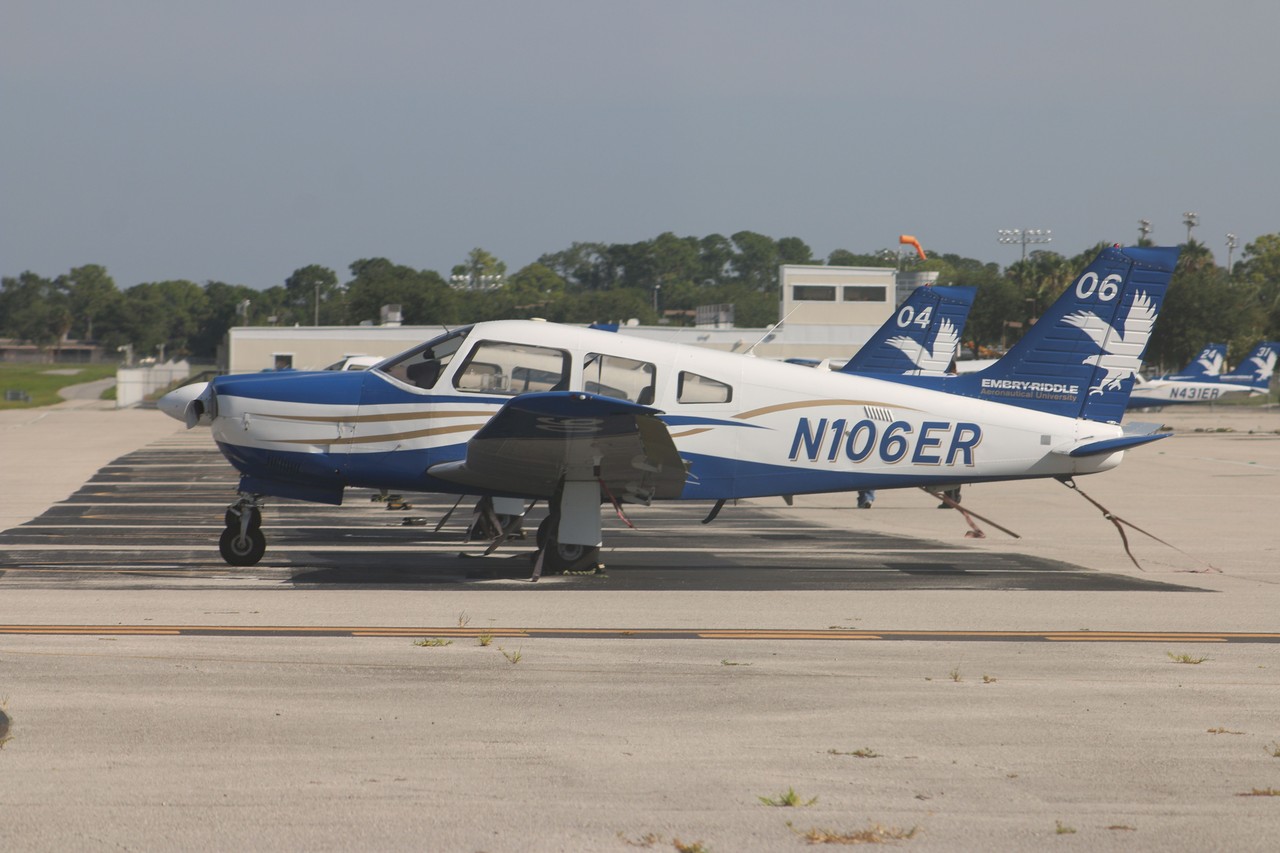
Market Impact and Service History
The Cherokee Arrow filled a crucial niche in the general aviation market, offering pilots an affordable entry into retractable-gear aircraft. Over 1,100 units of the original PA-28R-180 were delivered in just its first two years of production from 1967 to 1968, demonstrating strong market demand for this configuration. The aircraft democratized access to complex aircraft training and ownership, previously dominated by more expensive competitors like Mooney aircraft.
Flight schools and private owners embraced the Arrow for its forgiving handling characteristics combined with the performance benefits of retractable landing gear. The aircraft served as a logical stepping stone for pilots transitioning from basic trainers to higher-performance singles, offering the complexity needed for commercial pilot training without the intimidation factor of more demanding aircraft.
The Manufacturer
Piper Aircraft Company was founded in 1927 by William T. Piper and George A. Page in Rochester, New York. By the time the Arrow entered production, Piper had established itself as a major force in general aviation manufacturing. The company was acquired by Chris-Craft Industries in 1969, just two years after the Arrow's introduction, followed by Bangor Punta in 1970.
Piper faced significant financial challenges in the 1990s, filing for Chapter 11 bankruptcy in 1991. The company emerged under new ownership and continues operations today as Piper Aircraft, Inc., headquartered in Vero Beach, Florida. Current production includes evolved variants of the PA-28 family, maintaining the Cherokee lineage that began with the original fixed-gear models in the early 1960s.
Design and Development
The PA-28R-180 was designed by John Thorp, whose all-metal homebuilt designs influenced the original PA-28 Cherokee platform. Piper's engineering team adapted Thorp's concepts to create a retractable-gear variant that could compete directly with Cessna's fixed-gear singles while offering superior speed and efficiency.
The design philosophy centered on taking the proven Cherokee airframe and adding complexity only where it provided clear benefits. The retractable tricycle landing gear folded cleanly into the wings and fuselage, reducing drag without compromising the aircraft's excellent short-field capabilities. This approach allowed Piper to target the light four-place market with an aircraft that offered both performance and practicality.
First flight and FAA type certification occurred on June 8, 1967, with production beginning immediately afterward. The aircraft incorporated a constant-speed propeller system, adding another layer of complexity that enhanced performance while providing valuable training opportunities for aspiring commercial pilots.
Engine and Technical Specifications
The PA-28R-180 was powered by the Lycoming IO-360-B1E, a fuel-injected, horizontally opposed four-cylinder engine producing 180 horsepower. This powerplant was manufactured by Lycoming Engines, a division of Avco Corporation that later became part of Textron. The IO-360 series entered production in the early 1960s and established a reputation for reliability and fuel efficiency that continues today.
Fuel injection provided significant advantages over carbureted predecessors, including improved fuel economy, more consistent mixture distribution, and reduced susceptibility to carburetor icing. The engine was paired with a Hartzell two-blade constant-speed propeller, which optimized performance across different flight phases while providing smoother operation than fixed-pitch alternatives.
The aircraft's gross weight was certified at 2,500 pounds, with a standard fuel capacity of 50 US gallons. Wing loading was kept reasonable to maintain good short-field performance despite the added complexity of the retractable gear system.
Performance and Pilot Perspective
Pilots appreciated the Cherokee Arrow's predictable handling characteristics and forgiving stall behavior, traits inherited from the fixed-gear Cherokee family. The retractable landing gear provided a meaningful performance improvement, with cruise speeds typically ranging from 140 to 150 knots depending on altitude and loading conditions.
The aircraft's service ceiling reached approximately 14,000 feet, adequate for most cross-country flying while remaining within the capabilities of normally aspirated engines. Range varied with loading and cruise power settings, but the combination of fuel efficiency and adequate fuel capacity made it suitable for trips of several hundred nautical miles.
The gear retraction system was designed for simplicity and reliability, using an electric motor to raise and lower the landing gear. Emergency extension procedures were straightforward, providing pilots with confidence in the system's dependability.
Production Legacy and Current Status
Production of the original PA-28R-180 continued until 1971, when it was succeeded by the 200-horsepower PA-28R-200 variant. The success of the initial model led to numerous evolutionary improvements, including the Arrow II in 1972 with a stretched fuselage, and the Arrow III in 1977 featuring a tapered wing design.
Thousands of PA-28 family aircraft remain in active service worldwide, supported by robust parts availability and a strong network of maintenance facilities. The Cherokee Arrow established a template for affordable retractable-gear aircraft that influenced general aviation design for decades, proving that complex aircraft could be both accessible and reliable for typical owner-pilots.