
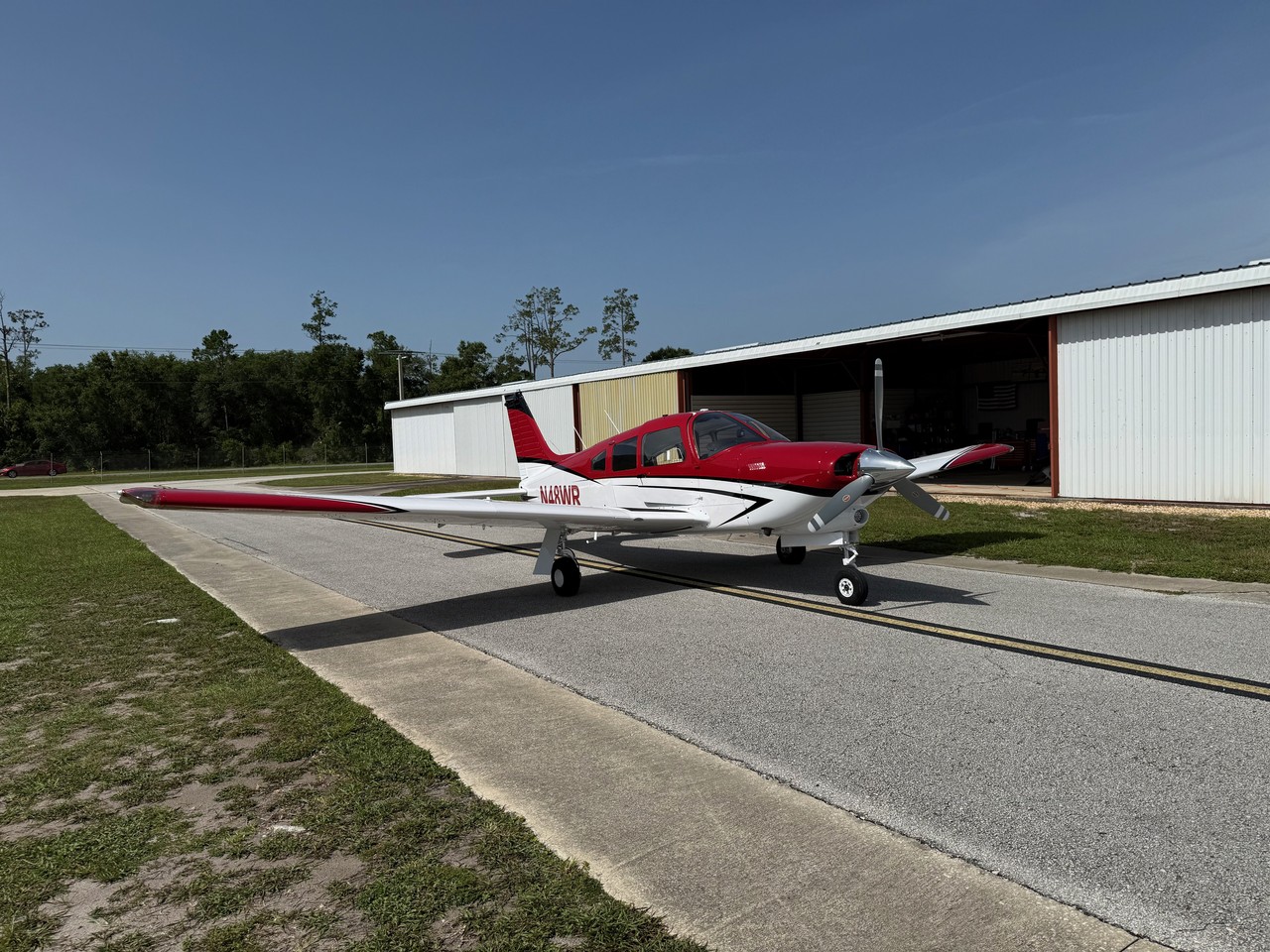
Service History in General Aviation
The Turbo Arrow III carved out a specialized niche in general aviation by offering affordable access to flight levels previously reserved for more expensive aircraft. Over 400 units were initially sold, primarily to private owners and flight schools seeking to train pilots in high-altitude operations and retractable-gear procedures. The aircraft's ability to maintain full power at 12,000 feet through its Rajay turbocharger system made it particularly valuable for operations in mountainous terrain and high-density altitude conditions that challenged naturally aspirated engines.
The aircraft served as a stepping stone for pilots transitioning from basic trainers to more complex aircraft, providing experience with retractable landing gear, constant-speed propellers, and turbocharged engine management. Flight training organizations appreciated its forgiving handling characteristics combined with the complexity needed to prepare students for advanced aircraft operations.
The Manufacturer's Legacy
Piper Aircraft Corporation, founded in 1927 by William T. Piper as Taylor Brothers Aircraft Manufacturing Company, had established itself as a dominant force in general aviation by the time the Turbo Arrow III entered production. The company's reputation was built on aircraft like the J-3 Cub, of which over 5,000 were produced by 1945 for wartime pilot training. Renamed Piper Aircraft in 1930, the company's philosophy of building affordable, reliable aircraft for the masses aligned perfectly with the Turbo Arrow's mission.
Despite filing for bankruptcy in 1991, Piper was acquired by New Piper Aircraft Inc. in 1995 and continues operations today as Piper Aircraft. The company maintains production of PA-28 variants including the Archer TX and LX models, demonstrating the enduring appeal of the basic Cherokee design that spawned the Arrow series.
Engine and Technical Innovation
The heart of the PA-28R-201T was its Continental TSIO-360-F turbocharged engine, later upgraded to the -FB and -FE variants. This six-cylinder powerplant delivered 200 horsepower at 2,575 rpm while maintaining sea-level power output up to 12,000 feet altitude. Continental Motors, now Continental Aerospace Technologies, initially specified a 1,400-hour time between overhaul for early engines, extending this to 1,800 hours by 1979 through improved connecting rod designs in the -FE variant.
The Rajay turbocharger system represented a significant technological advancement for light aircraft in 1977. Unlike larger, more expensive aircraft with sophisticated turbocharged systems, the Turbo Arrow made this technology accessible at a price point that individual owners could afford. The system enabled the aircraft to achieve a service ceiling of 20,000 feet, exceptional for a four-seat piston aircraft of its era.
Piper's engineering team built upon the proven PA-28R-180 Arrow foundation, incorporating a semi-tapered wing design that improved efficiency over the original Cherokee's constant-chord wing. The retractable landing gear system, while adding complexity, significantly enhanced cruise performance compared to fixed-gear variants.
Pilot Perspective and Performance
Pilots appreciated the Turbo Arrow III's predictable handling characteristics and robust construction, though the turbocharged engine required more careful management than naturally aspirated powerplants. The aircraft achieved maximum cruise speeds of 128 to 138 knots true airspeed while burning approximately 11.6 gallons per hour. With a maximum range extending from 522 to 695 nautical miles depending on configuration and conditions, it provided genuine cross-country capability.
The cockpit accommodated a pilot plus three passengers, though useful load considerations often limited full-seat, full-fuel operations. Pilots transitioning from the later PA-28RT-201T Turbo Arrow IV noted the conventional tail design of the III model offered more conventional handling characteristics compared to the IV's T-tail configuration, which some found challenging in certain flight regimes.
Production History and International Reach
Production of the PA-28R-201T began in 1977 at Piper's United States facilities, continuing until 1982 when the line was temporarily discontinued. Economic conditions forced a production hiatus until 1989, when manufacturing resumed for three final years before ending permanently in 1992. Beyond domestic production, Piper licensed international manufacturing to several companies, including Chincul SACAIFI in Argentina, which produced 960 PA-28 variants between 1972 and 1995, and Embraer in Brazil, which built the type as the EMB-711T Carisco Turbo.
Legacy and Current Status
Today, hundreds of Turbo Arrow IIIs remain airworthy, valued by owners for their combination of performance, reliability, and relatively affordable operating costs. The aircraft's significance extends beyond its production numbers, as it demonstrated that sophisticated performance capabilities could be packaged in accessible, maintainable aircraft for the broader general aviation community. While no specific museum examples are prominently displayed, the type's influence on subsequent Piper designs and general aviation turbocharged aircraft development remains evident in modern aircraft still in production.
The Turbo Arrow III's greatest achievement was proving that high-altitude performance previously reserved for twin-engine aircraft or expensive singles could be delivered in a package that individual owners and small flight schools could afford, fundamentally expanding the operational envelope available to general aviation pilots.