
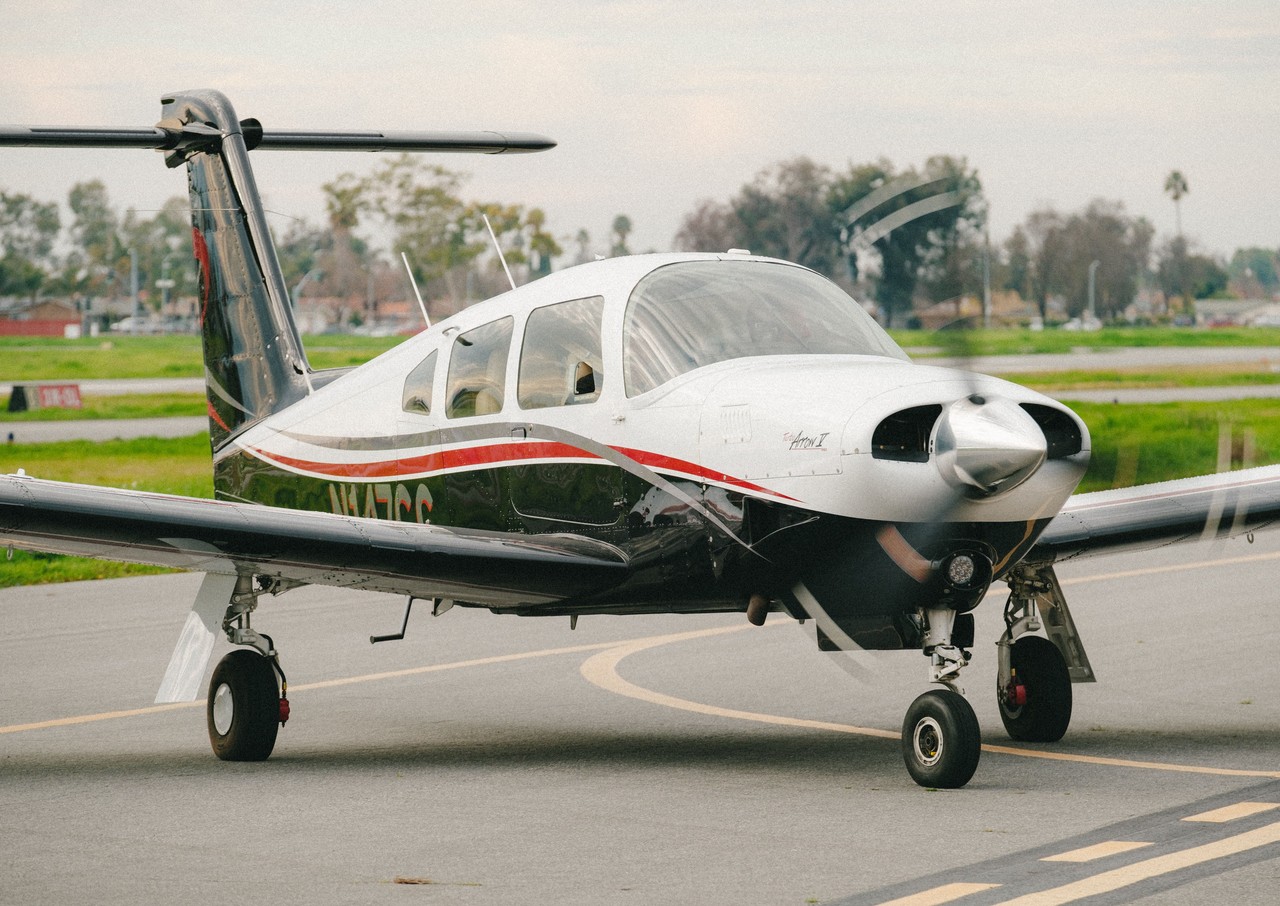
The Turbo Arrow's Development
The PA-28RT-201T emerged from Piper's engineering team as an evolutionary leap from the successful Arrow III series, incorporating lessons learned from nearly two decades of Cherokee development. The aircraft received its FAA type certification on November 13, 1978, representing Piper's ambitious attempt to combine the reliability of the PA-28 family with advanced aerodynamic features and turbocharged performance.
The most distinctive feature of the Turbo Arrow IV was its T-tail configuration, introduced in 1979 to improve aerodynamic efficiency and reduce cabin noise. This design choice, combined with semi-tapered wings that had been incorporated around 1977, was intended to enhance cruise performance and handling characteristics. However, the T-tail would later prove controversial among pilots due to pitch control issues at certain flight regimes.
Manufacturing and Production
Piper Aircraft Corporation manufactured the PA-28RT-201T at its Vero Beach, Florida facility throughout its eleven-year production run from 1979 to 1990. The aircraft was part of a broader Arrow family that had seen significant success in the late 1970s, with 676 total Arrows delivered in 1977 alone, including 404 Turbo Arrow variants. By 1979, however, deliveries had declined to 589 aircraft as the general aviation market began to soften.
The manufacturer itself underwent significant changes during the aircraft's production years. Founded in 1927 by William T. Piper as Taylor Brothers Aircraft Manufacturing Company and renamed Piper Aircraft in 1930, the company had merged with Bangor Punta in 1969. Despite these corporate changes, production continued steadily until the model's discontinuation in 1990.
Powerplant and Performance
The heart of the Turbo Arrow IV was its Continental TSIO-360-FB turbocharged engine, producing 200 horsepower and manufactured by what was then Teledyne Continental Motors. This six-cylinder powerplant represented a refinement of the earlier TSIO-360-F variant, which had debuted in Piper aircraft around 1977 with a Rajay turbocharger system. The -FB version, standardized from 1979, featured improved reliability and automatic wastegate options.
This engine configuration enabled the aircraft to achieve impressive high-altitude performance for its class. The Turbo Arrow IV could climb at 831 feet per minute and reach a service ceiling between 16,200 and 20,000 feet, depending on conditions. At 75 percent power, the aircraft consumed 11.6 gallons per hour while maintaining a best cruise speed of 138 knots indicated airspeed.
Operational Characteristics
With a maximum gross weight of 2,900 pounds and an empty weight of approximately 1,637 pounds, the PA-28RT-201T offered a practical balance between payload and performance. The aircraft's 72-gallon fuel capacity provided a range of 695 to 770 nautical miles, making it suitable for cross-country business and personal travel.
The retractable landing gear system, a hallmark of the Arrow series, contributed to the aircraft's clean aerodynamic profile and enhanced cruise performance. Takeoff distances varied from 1,025 to 1,600 feet over a 50-foot obstacle, while landing distances ranged from 615 to 1,525 feet under similar conditions. The aircraft's stall speed of 55 knots indicated airspeed provided reasonable low-speed handling characteristics.
Design Innovations and Limitations
The Turbo Arrow IV incorporated several advanced features for its era, including the controversial T-tail design intended to improve aerodynamics by positioning the horizontal stabilizer away from wing and propeller wash. The semi-tapered wings enhanced cruise efficiency compared to the straight wings of earlier Cherokee variants.
However, these innovations came with trade-offs. Pilots reported that the T-tail configuration could create handling challenges, particularly regarding pitch authority in certain flight conditions. These issues, combined with changing market conditions and increasing product liability costs, contributed to the aircraft's discontinuation in 1990.
Legacy and Current Status
As part of the PA-28 family—historically the fourth most-produced aircraft series—the Turbo Arrow IV contributed to Piper's reputation for building reliable, practical general aviation aircraft. While exact numbers of airworthy examples remain unclear, the broader PA-28 family continues to maintain a strong presence in the used aircraft market, with hundreds of variants regularly available for sale.
The PA-28RT-201T's significance lies in its role as an affordable entry point into turbocharged, high-altitude personal aviation. Despite the T-tail's ultimate market rejection, the aircraft successfully bridged the gap between Cherokee simplicity and Arrow performance, offering non-pressurized high-altitude capability that remained accessible to private owners and small businesses throughout the 1980s.