
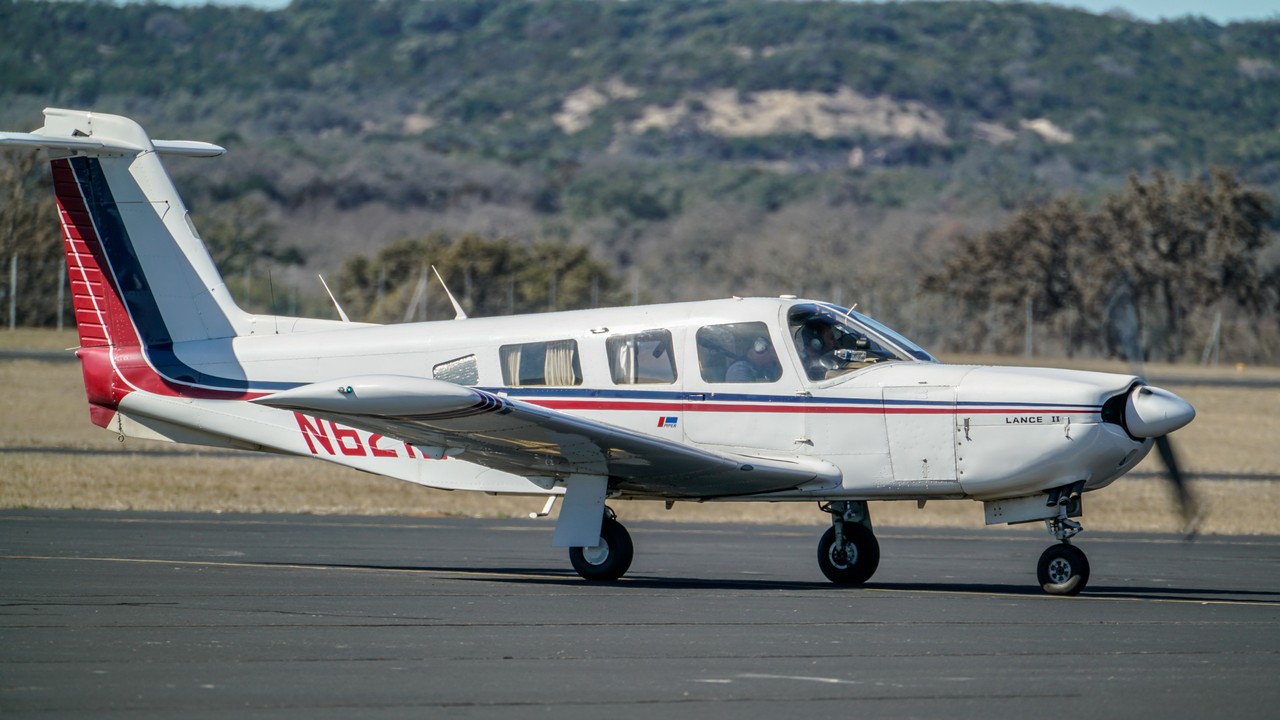
Development and Design
The PA-32RT-300 Lance II emerged from Piper's engineering efforts to fill the high-performance single-engine gap left after Comanche production halted in 1972 following the devastating Lock Haven flood. Building upon the successful Cherokee Six platform, Piper's design team transformed the fixed-gear six-seater into a retractable-gear speedster capable of carrying substantial loads while achieving significantly higher cruise speeds.
The most distinctive feature of the Lance II was its T-tail configuration, where the horizontal stabilator was mounted atop the vertical fin rather than at the fuselage. This aerodynamic innovation was intended to improve performance by placing the tail surfaces in undisturbed airflow, away from wing wash and propeller blast. The design promised better efficiency and cleaner airflow characteristics during cruise flight.
Manufacturing Heritage
Piper Aircraft Corporation produced the Lance II at its Lock Haven, Pennsylvania facilities during the brief 1978-1979 production window. The company, founded in 1927 by William T. Piper and George L. Neumann as Taylor Brothers Aircraft Manufacturing Company, had established itself as a major force in general aviation by the 1970s. After Piper acquired the company outright in 1930, it grew through decades of expansion despite facing significant challenges including the 1972 flood that disrupted operations and forced the end of Comanche production.
Throughout its history, Piper weathered multiple ownership changes. Bangor Punta Corporation acquired the company in 1969, followed by Chris-Craft Industries in 1980, and later Newco under Stuart Millard in 1983. The company filed for bankruptcy in 1991 before being acquired by Piper Investment Corporation. Today, Piper Aircraft, Inc. continues operations from Vero Beach, Florida, though PA-32 production ended in 2009.
Powerplant and Performance
The Lance II's performance centered around its Lycoming IO-540-K1G5D naturally aspirated engine, a six-cylinder horizontally opposed powerplant producing 300 horsepower. Lycoming, originally the Lycoming Division of AVCO and later part of Textron, had developed the IO-540 series beginning in the 1960s. The engine featured a 2,000-hour time between overhauls and proved reliable for the aircraft's intended cross-country mission profile.
A turbocharged variant, the Turbo Lance II, utilized the TIO-540-S1AD engine, enabling operations up to 20,000 feet service ceiling compared to the naturally aspirated version's 15,400-foot limit. Both engines consumed approximately 18 gallons per hour at 75 percent power settings, providing the fuel efficiency necessary for the aircraft's 748 to 850 nautical mile range with its 94-gallon fuel capacity.
Operational Characteristics
Pilots found the Lance II capable of achieving a best cruise speed of 156 knots indicated airspeed, representing a significant improvement over its fixed-gear Cherokee Six predecessor. The aircraft demonstrated a climb rate of 1,000 feet per minute and stalled at 61 knots indicated airspeed. Takeoff performance required 1,450 feet of runway, extending to 2,360 feet to clear a 50-foot obstacle, while landing distances measured 880 feet ground roll and 1,710 feet over a 50-foot obstacle.
However, the T-tail configuration that distinguished the Lance II also created handling challenges that ultimately contributed to its brief production run. Pilots reported reduced control authority at low speeds, a characteristic that made the aircraft less forgiving during approach and landing phases compared to conventional-tailed aircraft. This feedback from the flying community influenced Piper's decision to revert to conventional tail configurations in subsequent models.
Civil Service and Applications
The Lance II found its primary market among private owners seeking high-performance transportation and small commercial operators requiring load-hauling capability. With a gross weight of 3,600 pounds and useful load of 1,433 pounds, the aircraft could accommodate one pilot and six passengers or equivalent cargo loads. This flexibility made it attractive to flight schools, charter operators, and businesses requiring efficient point-to-point transportation.
Operators included diverse entities such as Northstar Aviation, UPS for cargo operations, Wings Express Airline, and Flyourself Holland BV. Individual operators worldwide flew registered examples including N39614, PH-SYA, and D-ENER, demonstrating the type's international appeal despite its short production run.
Legacy and Current Status
The Lance II's brief two-year production window resulted in limited numbers, making it a transitional footnote in Piper's evolution toward the Saratoga line that debuted in 1979. The aircraft served as a bridge between the earlier Lance models and the refined Saratoga series that would continue production until 2009. Despite handling criticisms, the Lance II demonstrated Piper's commitment to innovation during the competitive 1970s single-engine market.
Today, dozens of Lance II aircraft remain airworthy, supported by an active parts market and ongoing sales of used examples. Aviation accident databases and aircraft-for-sale listings document continued operations well into the 21st century, with examples like a 1978 N-registered aircraft advertised in the 2020s showing 2,346 total hours. While no specific museum examples are prominently displayed, the type represents an important chapter in general aviation's pursuit of speed and efficiency in single-engine aircraft design.