
Design and Development
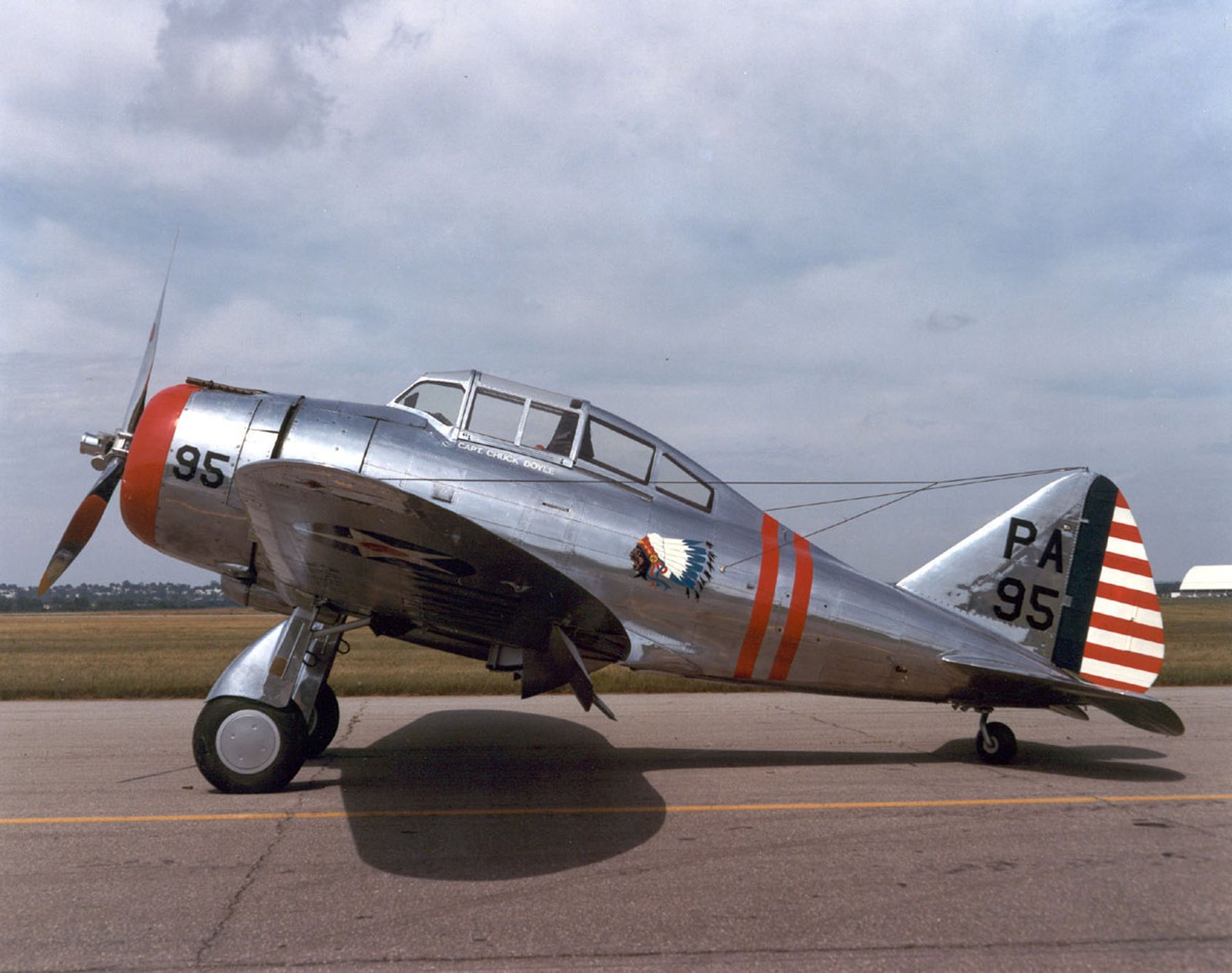
Designed under the leadership of Alexander P. de Seversky, the P-35 was a transformative aircraft for the United States Army Air Corps (USAAC). The prototype, originally designated as the SEV-1XP, performed its maiden flight on August 15, 1935, at Wilbur Wright Field in Riverside, Ohio. The aircraft represented a leap in aviation technology, being the first production single-seat fighter in the USAAC to feature all-metal stressed-skin construction, a low-wing monoplane configuration, an enclosed cockpit, and retractable landing gear.
Production and Manufacturer History
The aircraft was produced by the Seversky Aircraft Company in Farmingdale, Long Island, New York. In 1936, the USAAC ordered 77 aircraft, with deliveries occurring between May 1937 and August 1938. Of these, 76 were delivered as P-35s, while the final airframe became the XP-41 prototype. Total production for the P-35 family—including the 2PA and AT-12 variants—is estimated at 196 aircraft, with production spanning from approximately 1937 to 1941. Following internal disputes, the Seversky Aircraft Company was reorganized as the Republic Aviation Corporation in late 1939 or early 1940. Republic later produced the P-47 Thunderbolt and F-105 Thunderchief before eventually being absorbed into larger aerospace firms; the company no longer exists as an independent entity.
Technical Specifications
The P-35 was powered by a Pratt & Whitney R-1830-45 Twin Wasp, an air-cooled, 14-cylinder radial piston engine. The aircraft reached a maximum speed of 467 km/h (290 mph) and had a service ceiling of 9,144 meters (30,000 feet) with a range of 1,034 kilometers. Its dimensions included a wingspan of 10.97 meters and a length of 7.62 meters. Armament varied by version: the original P-35 featured one .50 caliber and one .30 caliber machine gun in the cowling, while the P-35A increased this to two .50 caliber guns in the cowling and two .30 caliber guns in the wings. It could also carry up to 300 lbs of bombs on under-wing racks.
Military Service
The P-35 saw service in several nations. In the Philippines, 48 P-35A aircraft were deployed in early 1941 with the 3rd and 17th Pursuit Squadrons of the Far East Air Force. During the December 1941 Japanese attacks, these aircraft were heavily outclassed by the Mitsubishi A6M Zero; lacking armor and self-sealing fuel tanks, all USAAC P-35As in the region were eventually destroyed. Sweden operated the J 9 (export version EP-106), which served in the air defense of Stockholm until 1946, with some remaining in training roles until 1952. Additionally, six P-35As formed the first combat unit of the Ecuadorian Air Force, and the Imperial Japanese Navy operated 20 two-seat 2PA-B3 variants under the designation A8V-1.
Legacy
Though rapidly rendered obsolete by the start of World War II, the P-35 served as a critical design stepping stone for the Republic P-47 Thunderbolt. Today, only three airframes are believed to survive, including a P-35A (J 9) preserved at the Swedish Air Force Museum in Malmen.