
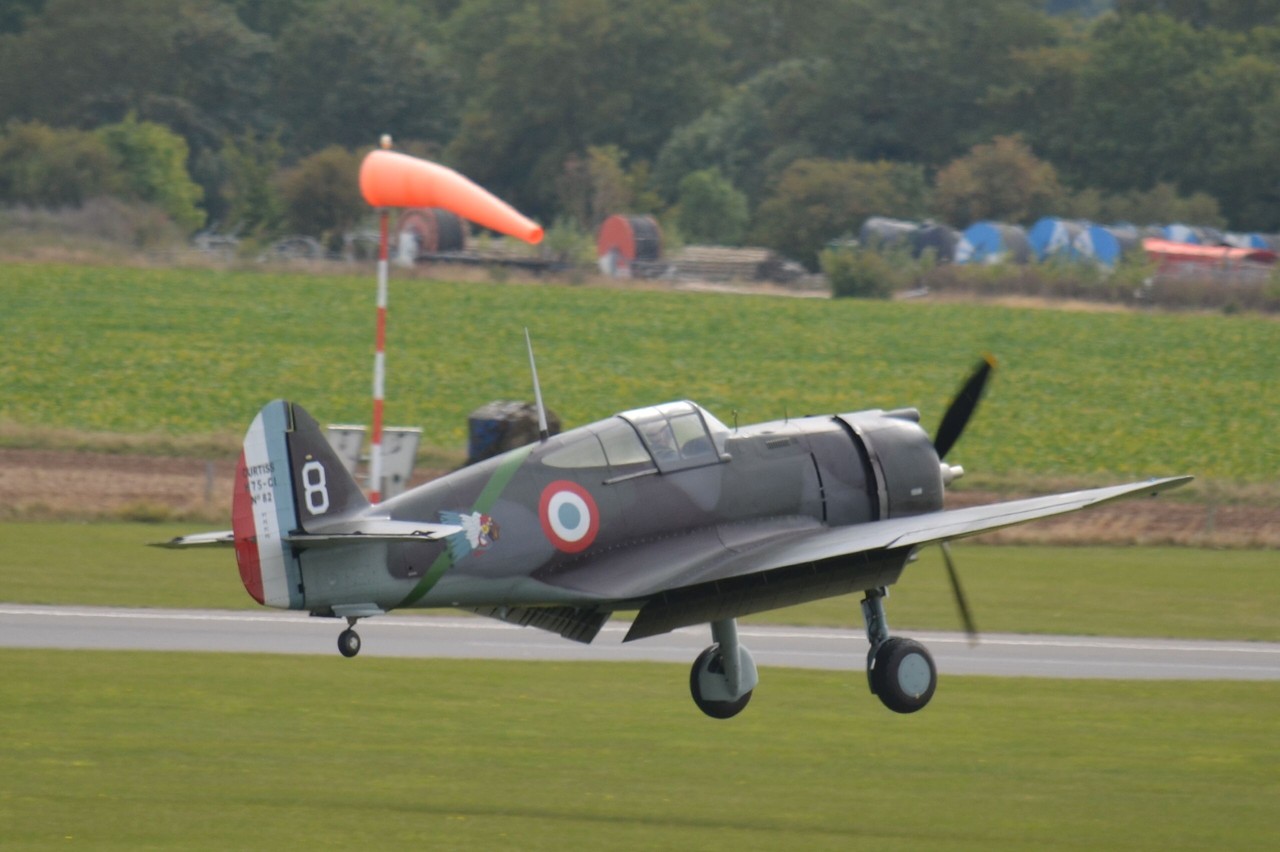
Design and Development
The P-36 Hawk emerged from the innovative mind of Don R. Berlin, a former Northrop engineer who joined Curtiss-Wright and created the Model 75 as a private venture. Berlin's design represented a bold leap forward in American fighter aviation, introducing all-metal monoplane construction when most military aircraft still employed fabric-covered biplanes. The prototype's maiden flight on May 6, 1935, showcased a sleek fighter powered by a 900-horsepower Wright XR-1670-5 radial engine.
Competitive trials in 1936 initially disappointed when the prototype's Wright XR-1820-39 Cyclone engine failed to deliver promised performance, limiting the aircraft to just 285 miles per hour. However, Curtiss engineers persevered, eventually adopting the reliable Pratt & Whitney R-1830 Twin Wasp engine, which transformed the aircraft's capabilities and secured a production contract from the United States Army Air Corps.
Service History
The first P-36As reached the 20th Pursuit Group at Barksdale Field, Louisiana, in April 1938, but the aircraft's service introduction proved problematic. Early production models suffered from engine exhaust difficulties, structural skin buckling over landing gear wells, and various airframe weaknesses that required extensive modifications. By the time these issues were resolved, rapid advances in fighter technology had already rendered the P-36 obsolescent for frontline service.
Consequently, most P-36s were relegated to training duties and overseas garrison assignments at Albrook Field in the Panama Canal Zone, Elmendorf Field in Alaska, and Wheeler Field in Hawaii. The Hawaiian deployment in February 1941 demonstrated innovative logistics when P-36 fighters were loaded aboard the aircraft carrier USS Enterprise and flown directly off the carrier deck by Army Air Corps pilots—a unprecedented procedure that saved weeks compared to traditional disassembly and shipping methods.
Combat Experience
The P-36's limited combat career reached its pinnacle during the December 7, 1941, attack on Pearl Harbor, when pilots flying the type from Wheeler Field engaged Japanese aircraft in the only combat action involving P-36s in United States Army Air Forces service. This brief encounter marked both the beginning and end of the aircraft's frontline combat role for American forces.
International Operations
France became the P-36's most significant operator, purchasing hundreds of aircraft under the Hawk 75 designation. The French ordered 100 Hawk 75A-2s equipped with six 7.5-millimeter machine guns, followed by 135 Hawk 75A-3s and 285 Hawk 75A-4s. However, Germany's rapid victory in June 1940 prevented most French aircraft from reaching their intended destination, with many diverted to British forces who designated them Mohawk III and Mohawk IV.
Argentina acquired simplified Hawk 75O variants featuring fixed landing gear for rough-field operations, receiving 30 aircraft from Curtiss plus manufacturing rights that produced an additional 20 locally-built examples. Chinese license production of the Hawk 75A-5 variant was relocated to India, where these aircraft were ultimately absorbed into Royal Air Force and Royal Indian Air Force service.
Engine Evolution
The P-36's powerplant development reflected the rapidly advancing state of radial engine technology. The original Wright XR-1670-5 gave way to the problematic Wright XR-1820-39 Cyclone, which was eventually replaced by the proven Pratt & Whitney R-1830 Twin Wasp family. Standard P-36As utilized the 1,050-horsepower R-1830 variant, achieving the type's maximum speed of 313 miles per hour, while later P-36Cs received the more powerful 1,200-horsepower R-1830-17 engine. Export variants employed different powerplants, including the Wright R-1820-G205A Cyclone producing 1,200 horsepower in the French Hawk 75A-4.
The Manufacturer
Curtiss-Wright Corporation emerged from the 1929 merger of the historic Curtiss Aeroplane and Motor Company with Wright Aeronautical Corporation, creating one of America's premier aviation manufacturers. The company's engineering expertise, demonstrated in the P-36 design, directly led to the more successful P-40 Warhawk, with 13,738 examples produced between 1939 and 1945. Curtiss-Wright continued operations through the Cold War era before eventually being absorbed into other aerospace conglomerates, with the original company name disappearing from independent operation.
Legacy and Survivors
While quickly superseded by more advanced fighters, the P-36 Hawk's historical significance extends far beyond its brief operational career. The aircraft demonstrated the viability of all-metal monoplane construction and directly influenced subsequent American fighter development, particularly the P-40 Warhawk series that became a mainstay of Allied air forces during World War II.
At least one P-36C survives in airworthy condition today. Aircraft serial number 38-210, believed to be the final P-36 completed in 1939, joined the Fighter Collection at Duxford in 2015. This particular aircraft participated in alternative camouflage trials at the 1939 Cleveland air races and served with multiple Army Air Corps squadrons before finishing its military career with Chanute Technical Training Command in 1942, representing a tangible link to this pivotal period in fighter aviation history.