
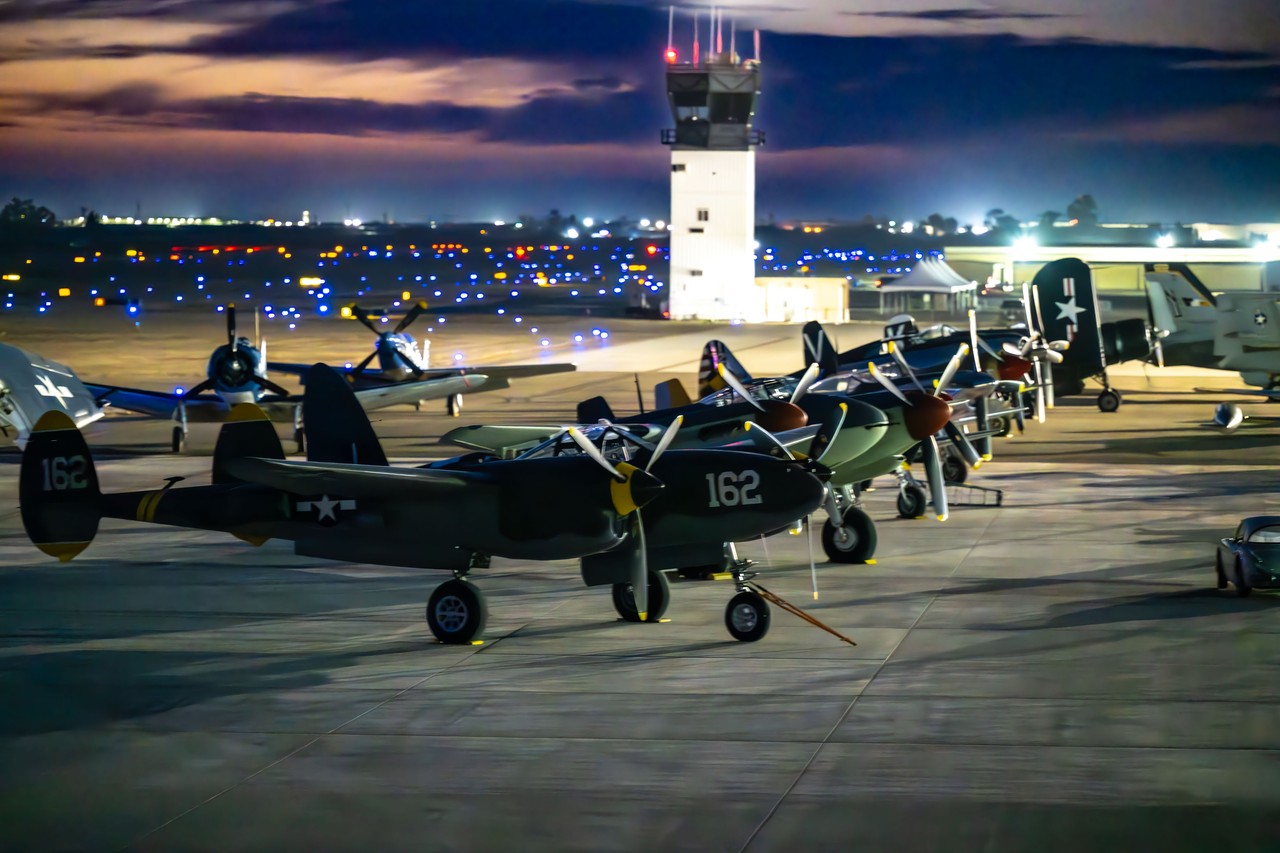
Service History
The P-38 Lightning dominated long-range fighter operations in the Pacific Theater, excelling in roles that demanded extended reach and heavy firepower. From its first delivery to operational units in mid-1941 through the end of World War II in 1945, exactly 10,038 P-38s rolled off production lines, making it uniquely significant as the sole American fighter manufactured continuously from before Pearl Harbor until Victory over Japan Day. By 1944, production reached its peak with 22 subcontractors supplying components for final assembly at Lockheed's Burbank facility.
Wartime Operations
The Lightning served primarily with the U.S. Army Air Forces, though the Royal Air Force operated it as the Lightning I and II, and the Free French Air Force also flew the type. Its versatility proved remarkable—the aircraft functioned as an interceptor, long-range escort fighter, dive bomber, and reconnaissance platform. The F-4 photographic reconnaissance variant carried four K-17 cameras, with 500 of the total production dedicated to photo-reconnaissance missions.
Notable variants included the P-38E, which entered service in September 1941 with 210 aircraft built, and the P-38L, the most numerous and capable version with 3,923 examples produced. The P-38J introduced dive flaps on its final 210 aircraft in June 1944, improving the type's effectiveness as a fighter-bomber. One specific example, P-38J-10-LO serial number 42-67762, was accepted on November 6, 1943, and underwent extensive testing in 1944 before joining operational units.
The Manufacturer
Lockheed won the U.S. Army Air Corps contract on June 23, 1937, for the XP-38 prototype at a cost of $163,000, though the company's internal development expenses reached $761,000. Founded in 1912, Lockheed transformed during World War II from a modest civilian aircraft manufacturer into a major defense contractor. The company constructed the Lightning prototype at a secure Burbank distillery site that became the first location of what would later be known as the famous Skunk Works.
Through corporate evolution, Lockheed became Lockheed Corporation and later merged with Martin Marietta in 1995 to form Lockheed Martin, which continues operations today as a leading aerospace and defense contractor.
Design Innovation
Clarence L. "Kelly" Johnson, working as assistant to chief engineer Hall L. Hibbard, led the design team that conceived the P-38 in 1936 as Lockheed's Model 22. The Army Air Corps requirement called for a twin-engine, single-pilot high-altitude interceptor, and Johnson's team delivered revolutionary innovations. The twin-boom configuration housed the engines with counter-rotating propellers to eliminate torque effects, while the central nacelle contained the pilot and concentrated armament.
Lieutenant Benjamin S. Kelsey piloted the XP-38 prototype on its maiden flight January 27, 1939. Just two weeks later, on February 11, 1939, Kelsey set a transcontinental speed record of 7 hours and 48 minutes, though the aircraft crashed on landing. During YP-38 testing, engineers solved critical high-speed compressibility and tail buffeting problems that enabled successful mass production.
Engine and Technical Specifications
Two Allison V-1710 liquid-cooled V-12 engines powered the Lightning, manufactured by the Allison Engine Company, later the Allison Division of General Motors. Later variants like the P-38H incorporated more powerful versions of these engines, while the P-38L received the most advanced powerplants with enhanced high-altitude performance through intercoolers and aftercoolers.
The single pilot operated from the central nacelle, commanding formidable firepower concentrated in the aircraft's nose: one 20mm Hispano cannon and four .50-caliber M2 Browning machine guns. External pylon racks accommodated bombs or drop tanks, with the P-38F being the first variant to introduce this capability.
Performance Characteristics
The P-38E achieved a top speed of 415 miles per hour at 20,000 feet, while later variants with drop tanks extended operational range significantly. The tricycle landing gear, innovative for its era, provided excellent ground handling characteristics compared to conventional tail-wheel fighters.
Pilots appreciated the Lightning's stability and firepower concentration, though early models suffered reliability issues in cold European climates. By mid-1944, P-51 Mustangs had largely replaced P-38s in European operations, but the type continued excelling in Pacific Theater missions where its range and twin-engine reliability proved invaluable.
Legacy and Preservation
Approximately six P-38 Lightnings remain airworthy today, including "23 Skidoo," a P-38J representing the 5,018th aircraft built and delivered in May 1944, now displayed at the Planes of Fame Air Museum. Notable static displays include a P-38L at the U.S. Air Force Museum, the historically significant P-38J-10-LO (42-67762) at the National Air and Space Museum, and another P-38L at the Museum of Flight.
The Lightning's innovative twin-boom design influenced subsequent aircraft development, and its Lockheed heritage connects directly to modern programs like the F-35 Lightning II. As the only continuously produced American World War II fighter, with over 10,000 examples built, the P-38 Lightning secured its place as one of the war's most distinctive and capable combat aircraft.