
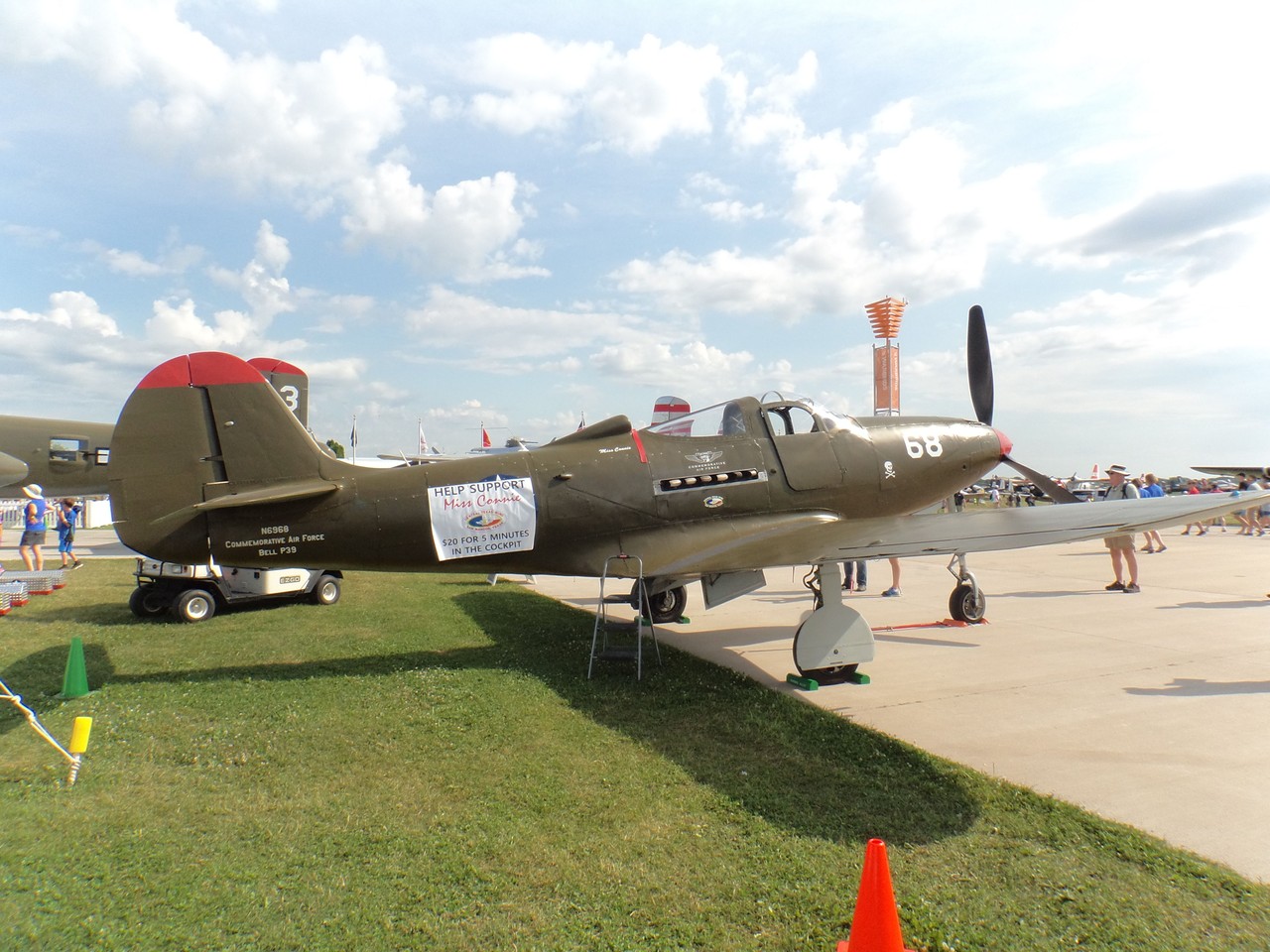
Soviet Success Story
While American pilots found the P-39 Airacobra disappointing at high altitudes, Soviet pilots embraced it as one of their most effective ground attack fighters. Through the Lend-Lease program, 4,773 Airacobras—primarily P-39N and P-39Q variants—were delivered to the Soviet Union, where they excelled in the low-altitude combat that characterized the Eastern Front. Soviet ace Alexander Pokryshkin scored 47 of his 59 victories flying P-39s, demonstrating the aircraft's lethal effectiveness when properly employed.
Design Innovation and Limitations
The P-39's most distinctive feature was its Allison V-1710 engine mounted behind the pilot, connected to the propeller via a long driveshaft. This configuration allowed engineers to install a powerful 37mm M4 cannon firing through the propeller hub—a devastating weapon for ground strafing missions. The XP-39 prototype incorporated recommendations from NACA wind tunnel testing, leading to the refined XP-39B variant that first flew on November 25, 1939, featuring a streamlined canopy and repositioned cooling intakes.
However, a critical decision during development severely compromised the aircraft's performance. The removal of the turbo-supercharger from production variants to reduce complexity and cost eliminated the P-39's high-altitude capability, relegating it to low-level operations where it faced intense anti-aircraft fire.
Production Variants and Service
Bell manufactured the P-39 in numerous variants, each reflecting evolving combat requirements. The initial P-39C production model proved inadequate for combat, lacking armor protection and self-sealing fuel tanks. These deficiencies were corrected in the P-39D series, which became the foundation for Lend-Lease deliveries.
The P-39D-1 and D-2 variants replaced the 37mm cannon with a 20mm M1 weapon, while the P-39N introduced the more powerful V-1710-85 engine producing 1,200 horsepower. Later P-39N variants reduced internal fuel capacity to improve performance, reflecting lessons learned in combat. The final P-39Q incorporated all previous improvements and became the most numerous variant delivered to Soviet forces.
Bell Aircraft Company
Bell Aircraft Company, founded by Lawrence Dale Bell in 1935, established itself as an innovative manufacturer willing to explore unconventional designs. Operating from its Wheatfield, New York facility, Bell would later pioneer helicopter development and experimental aircraft like the X-1 rocket plane. The company's willingness to challenge conventional wisdom was evident in the P-39's unique configuration, though market realities often tempered such innovation.
Combat Performance
By December 7, 1941, nearly 600 P-39s had been manufactured, with aircraft already deployed to combat zones including Australia and New Guinea. American pilots criticized the aircraft's poor high-altitude performance and tendency to enter dangerous flat spins, but Soviet pilots found these characteristics manageable in their operational environment.
The P-39's 37mm cannon proved devastating against ground targets, while its combination of .50 and .30 caliber machine guns provided additional firepower. Soviet forces appreciated the cannon's effectiveness against German aircraft and light armor, though contrary to popular belief, the P-39 was not primarily used for tank-busting missions—this misconception arose from translation errors in Russian combat reports.
Technical Specifications
The P-39N featured a 3.18-meter Aeroproducts propeller and typical armament of one nose-mounted cannon plus four machine guns. Different engine variants provided varying performance levels, with the P-39D-2's V-1710-63 producing 1,325 horsepower and representing the peak of Airacobra power output.
Pilots noted the aircraft's unusual weight distribution due to its mid-mounted engine, which required careful attention during takeoff and landing. The tricycle landing gear—advanced for its era—provided excellent ground handling characteristics that pilots appreciated.
Legacy and Preservation
Production ended in August 1944 after 9,584 aircraft had been completed, making the P-39 one of the most numerous American fighters of World War II. Today, survivors are rare but significant. The Military Aviation Museum displays P-39F serial number 41-7215, while the Yanks Air Museum houses a P-39N recovered from Tadji, New Guinea, and restored over nine years in a project completed in March 2002.
The Airacobra's story illustrates how aircraft can succeed in unexpected roles with operators who understand their capabilities. While American forces found the P-39 unsuitable for their needs, Soviet pilots transformed it into an effective ground attack weapon that contributed significantly to victory on the Eastern Front.