
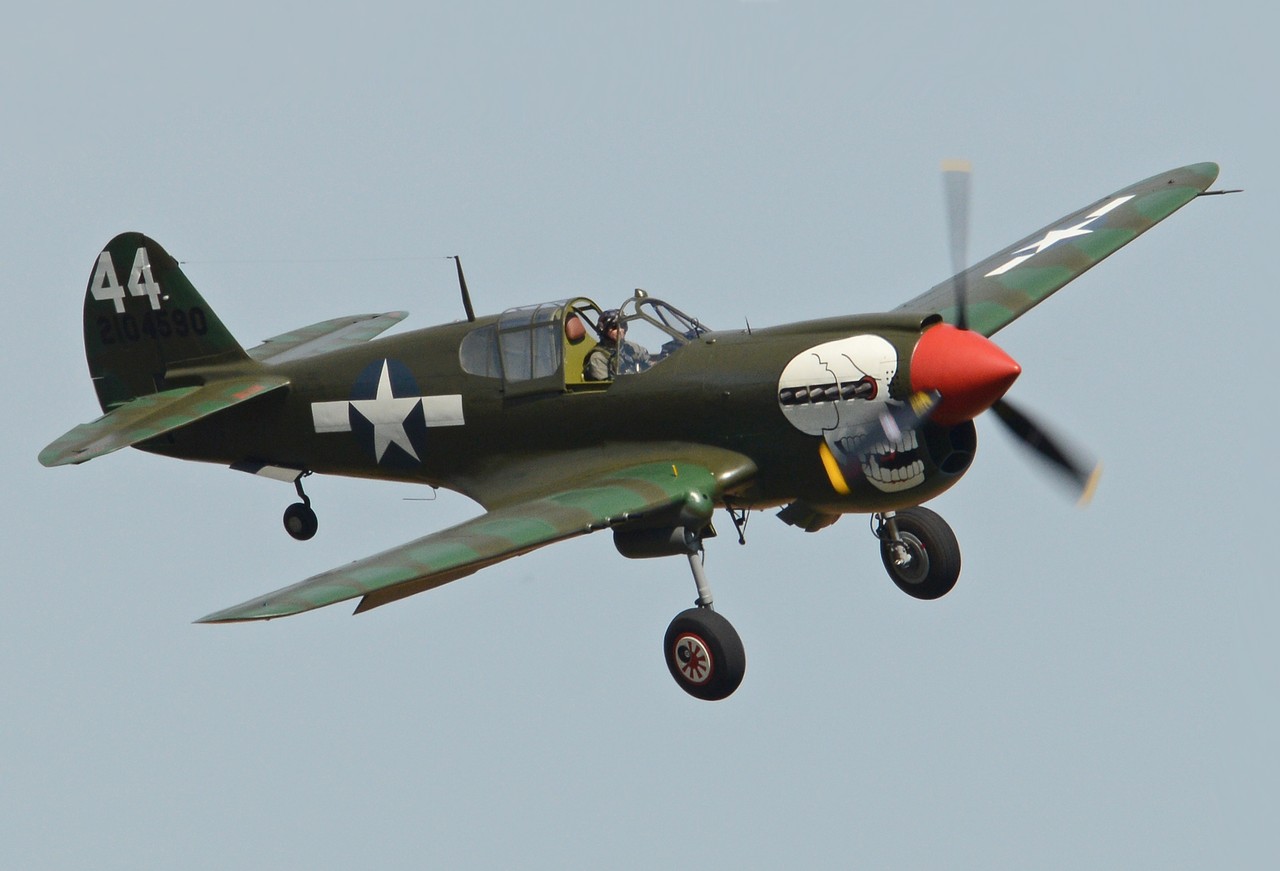
Combat Service and Global Impact
The P-40 entered United States Army Air Forces service in June 1940 with the 33rd, 35th, and 36th Pursuit Squadrons, arriving at a critical moment when America needed fighters quickly. While not the most advanced aircraft of its era, the P-40 filled an essential role during 1940-1943, serving with 28 nations including the RAF, Royal Australian Air Force, Soviet Union, and Chinese American Volunteer Group. The aircraft gained legendary status with Claire Chennault's Flying Tigers, whose shark-mouthed P-40Bs achieved remarkable success against Japanese forces in China during 1941-1942.
The Royal Australian Air Force adopted the P-40 as their primary fighter, while RAF squadrons operated it extensively in North Africa as part of the Desert Air Force. American units like the 23rd Fighter Group and 75th Fighter Squadron continued Flying Tigers traditions, with pilots such as Robert H. Smith achieving ace status with nine victories. Despite suffering heavy losses when facing more modern enemy aircraft, the P-40's availability in large numbers proved crucial during the Allies' darkest hours.
Design Evolution and Variants
Don R. Berlin led the Curtiss design team that evolved the P-40 from the earlier P-36 Hawk, creating the XP-40 prototype that first flew on October 14, 1938. The design philosophy prioritized rapid production using existing P-36 tooling, enabling quick deployment to meet urgent military requirements at a unit cost of $24,566.60. Berlin's team incorporated innovations including self-sealing fuel tanks, pilot armor beginning with the P-40B variant, and the distinctive forward-mounted radiator that enabled the famous shark-mouth nose art.
Production spawned numerous variants, beginning with 131 P-40B aircraft built between January and April 1941. The P-40D introduced the definitive shark-mouth appearance when the first example flew on May 22, 1941, followed by 2,320 P-40E models starting in April 1941. The P-40F and P-40L variants, totaling 2,011 aircraft, featured Packard-built Merlin engines producing 1,300 horsepower. The final and most numerous variant, the P-40N, saw 5,219 aircraft built and achieved the series' highest speed of 378 mph.
Manufacturing and Corporate Legacy
Curtiss-Wright Corporation produced all P-40s primarily at their Buffalo, New York facility, representing the culmination of Glenn Curtiss's aviation legacy that began with the founding of Curtiss Aeroplane and Motor Company in 1916. The company had already established itself during World War I with designs like the JN-4 Jenny trainer before merging with Wright Aeronautical in 1929 to form Curtiss-Wright. This corporate heritage brought decades of aircraft manufacturing experience to the P-40 program.
The company continued operations through the mid-20th century before undergoing various mergers and acquisitions. Kaman Corporation acquired Curtiss-Wright's aircraft division in 1999, though today the legacy continues under TransDigm Group, which maintains the Curtiss-Wright name for aerospace components rather than complete aircraft manufacturing.
Powerplant and Performance
The heart of most P-40 variants was the Allison V-1710 liquid-cooled V-12 engine, manufactured by General Motors' Allison Engine Company division. Engine variants ranged from the V-1710-33 producing 1,040-1,090 horsepower to the V-1710-81 generating 1,700 horsepower, with Allison producing over 70,000 V-1710 engines between 1937 and 1948. While reliable at low and medium altitudes, the engines suffered from inadequate supercharging for high-altitude operations.
Curtiss attempted various solutions, including experimental turbocharging for the P-40J variant, though this program was abandoned in May 1942. More successful was the incorporation of Packard-built Merlin engines in P-40F and P-40L variants, part of a September 13, 1940 licensing agreement for 9,000 engines total. These Merlin-powered aircraft demonstrated improved high-altitude performance while maintaining the P-40's excellent low-altitude characteristics.
Armament and Tactical Role
Early P-40 variants carried a mixed armament of two 0.50-caliber and two to four 0.30-caliber machine guns, though later models standardized on six wing-mounted 0.50-caliber weapons. The aircraft could also carry up to 1,500 pounds of bombs, transforming it into an effective fighter-bomber for ground attack missions. Some variants incorporated 20mm cannon options, though machine guns remained the standard armament throughout production.
The P-40 excelled in roles including air superiority fighting, ground attack, fighter-bomber missions, and reconnaissance. Its rugged construction and reliable engine made it particularly effective in harsh operating conditions across North Africa, the Pacific, and China-Burma-India theaters.
Production Legacy and Museum Preservation
Production ended on November 30, 1944, after 13,738 aircraft were completed, making the P-40 the third most-produced American fighter of World War II. Despite this massive production run, few examples remain airworthy today, though exact numbers of flying aircraft are not precisely documented. The type continues appearing at airshows worldwide, maintaining its connection to aviation enthusiasts.
Notable museum examples include the Tri-State Warbird Museum's P-40M Kittyhawk III (NZ3119/N5813) and the Smithsonian National Air and Space Museum's P-40E Warhawk (NASM A19650242000), restored in 1975 to represent the 75th Fighter Squadron. These preserved aircraft ensure that the P-40's legacy as a crucial early-war fighter continues inspiring future generations, symbolizing the period when quantity and availability mattered more than cutting-edge performance.