
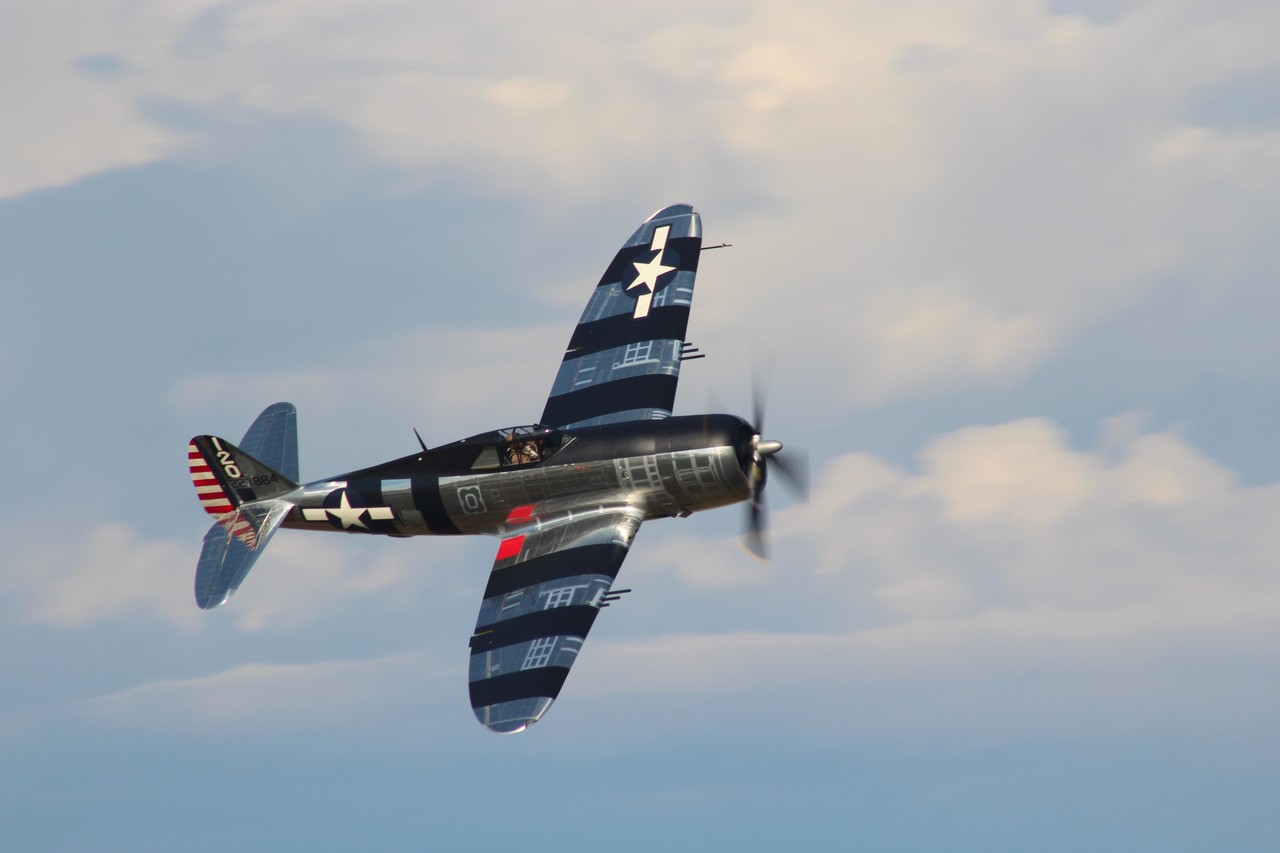
Combat Dominance
The P-47 Thunderbolt established an extraordinary combat record that few fighters could match. Flying more than 746,000 sorties of all types, Thunderbolt pilots achieved an aerial kill ratio of 4.6:1 while maintaining a remarkably low loss rate of just 0.7 percent per mission. From D-Day until VE Day, P-47 pilots claimed destruction of 86,000 railroad cars, 9,000 locomotives, 6,000 armored fighting vehicles, and 68,000 trucks, demonstrating the aircraft's devastating effectiveness in the ground-attack role.
Francis "Gabby" Gabreski became the top-scoring P-47 ace in the European Theater with 28 aerial victories, while the aircraft served with distinction in both the Pacific and European theaters. The Thunderbolt's first combat mission occurred in April 1943 during a sweep over Western Europe, marking the beginning of its legendary wartime career.
Republic Aviation's Engineering Marvel
Alexander Kartveli designed the P-47 as Republic Aviation Corporation's answer to the need for a high-performance fighter. Originally conceived as a lightweight interceptor, the design evolved into a formidable heavyweight that could absorb punishment no other single-engine fighter could survive. Luftwaffe ace Heinz Bär noted that the P-47 "could absorb an astounding amount of lead and had to be handled very carefully," a testament to its robust construction.
Republic Aviation, headquartered in Farmingdale, New York, expanded production by opening a second facility in Evansville, Indiana. Breaking ground on April 7, 1942, nine months ahead of schedule, the Evansville plant employed over 5,000 workers and produced 6,242 P-47s between 1942 and 1945. The Farmingdale facility contributed 2,547 bubble-top P-47Ds to the total production run.
Powerplant and Performance
The heart of the Thunderbolt was its massive Pratt & Whitney R-2800-59 Double Wasp, an 18-cylinder air-cooled radial engine producing 2,000 horsepower. This powerplant, coupled with a 13-foot diameter four-bladed Curtiss Electric constant-speed propeller, gave the P-47 exceptional high-altitude performance with a service ceiling of 43,000 feet and a range of 800 miles.
The P-47G variant, produced by Curtiss-Wright Corporation, featured an even more powerful R-2800-59 engine producing 2,535 horsepower. Between December 1942 and March 1944, Curtiss-Wright manufactured 354 P-47G Thunderbolts, adding to the overall production total.
Pilot Experience
Pilots nicknamed the P-47 the "Jug" due to its distinctive, stout profile, but they respected its capabilities and survivability. Armed with eight 0.50-caliber machine guns and capable of carrying two 500-pound bombs, the Thunderbolt excelled in both air-to-air combat and ground attack missions. The aircraft's sturdy construction and air-cooled radial engine allowed it to return home despite severe battle damage that would have downed other fighters.
Early production models featured metal-framed "greenhouse"-type cockpit canopies, but late D-series aircraft and all M and N series production received clear "bubble" canopies that significantly improved rearward vision for pilots during combat.
Production Legacy
Of the 15,686 P-47s built, approximately two-thirds were deployed overseas during World War II. Combat and operational losses totaled 5,222 aircraft, with 1,723 attributed to non-combat accidents and 3,499 lost to combat causes. Despite these losses, the Thunderbolt's production numbers made it the backbone of American fighter operations.
The aircraft continued serving beyond World War II, with many transferred to allied nations. Serial number 45-49167, built at the Evansville plant in 1945, exemplifies the P-47's extended service life. After serving with the Women Airforce Service Pilots program and multiple U.S. units through 1953, it was transferred to Peru where it remained operational with the Peruvian Air Force until 1963.
Surviving Aircraft
Today, the P-47 Thunderbolt remains a prized warbird, with restored examples participating in air shows and races. Serial 45-49167 was restored to flight in December 1971 and competed in the 1974 National Championship Air Races in Reno, Nevada, where pilot Lefty Gardner qualified 18th in the Unlimited Class at 289.76 mph. The aircraft's enduring appeal stems from its historical significance as the most-produced American fighter and its reputation as an indestructible warrior that helped secure Allied victory in World War II.