
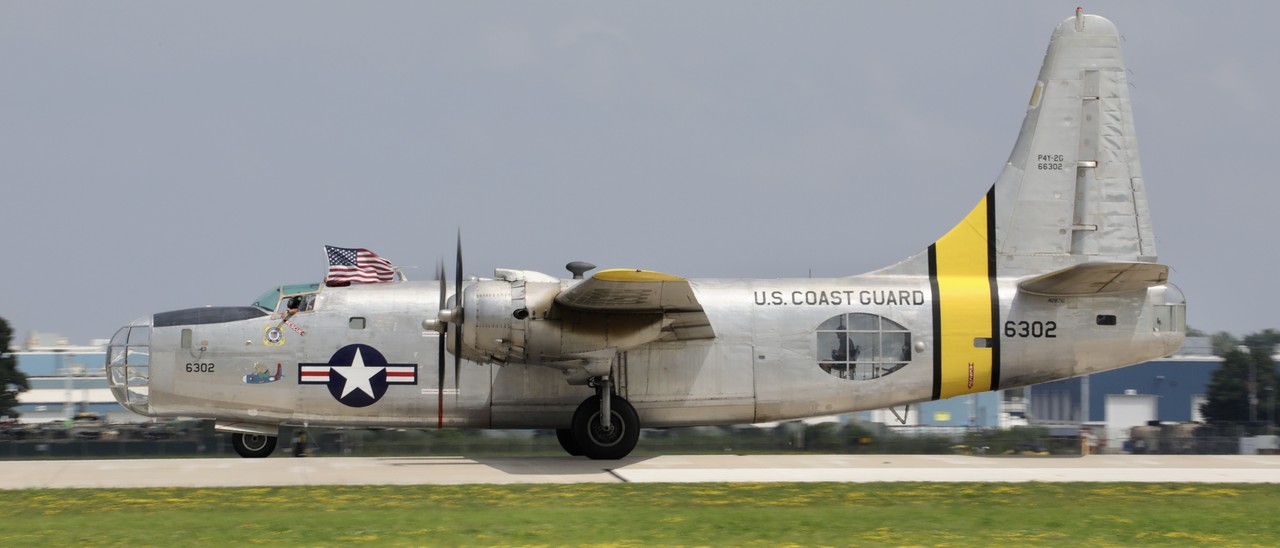
Service History
The P4Y-2 Privateer dominated U.S. Navy maritime patrol operations throughout the Pacific Theater during World War II and beyond. Fleet deliveries began in March 1944 and continued through October 1945, with the Navy purchasing 740 aircraft plus 33 transport variants. The type served exclusively in the Pacific, conducting vital long-range overwater missions against enemy shipping and submarines in support of amphibious operations. Following the 1951 designation change from patrol bomber to patrol aircraft, the PB4Y-2 became the P4Y-2, remaining in Navy squadron service until June 1954.
Design Innovation
In May 1943, Consolidated Aircraft Company received orders to convert three B-24D bombers into XPB4Y-2 prototypes, launching a comprehensive redesign program. Wind tunnel testing revealed that replacing the B-24's distinctive twin tail configuration with a single large vertical stabilizer dramatically improved stability during low-altitude patrol missions. Engineers extended the fuselage seven feet forward of the wing to accommodate additional electronic equipment and operators essential for maritime reconnaissance.
The aircraft featured non-supercharged Pratt & Whitney R-1830-94 engines specifically chosen for optimal performance at low altitudes, abandoning the turbo-superchargers that made the B-24 effective at high-altitude bombing missions. Defensive armament increased substantially to twelve .50-caliber M2 Browning machine guns mounted in strategically positioned turrets: Convair nose and tail turrets, two Martin top turrets, and two ERCO fuselage side turrets that created the distinctive "blister" appearance.
The Manufacturer
Consolidated Vultee Aircraft Corporation emerged from the 1943 merger of Consolidated Aircraft Corporation and Vultee Aircraft, eventually becoming known as Convair. The company's San Diego facility served as the exclusive production center for the Privateer, leveraging Consolidated's extensive experience with the B-24 Liberator program. Consolidated had established itself as a major manufacturer of flying boats and long-range patrol aircraft, making it the logical choice for developing the Navy's next-generation maritime patrol platform.
Engine and Technical Specifications
Four Pratt & Whitney R-1830-94 Twin Wasp engines powered the Privateer, each 14-cylinder, air-cooled, twin-row radial producing 1,350 horsepower for takeoff at 2,800 rpm and 1,200 horsepower at 10,000 feet. The decision to eliminate turbo-superchargers reflected the aircraft's specialized low-altitude mission profile, optimizing fuel efficiency and mechanical reliability for extended maritime patrols. Engineers repositioned oil cooler scoops above and below each nacelle to improve cooling during prolonged low-altitude operations.
With an empty weight of 37,405 pounds and maximum takeoff weight of 65,000 pounds, the Privateer achieved a maximum speed of 245 mph at 13,750 feet and cruised at 158 mph. Service ceiling reached 21,200 feet, though operational missions typically occurred much lower. Fuel capacity ranged from 2,840 to 4,760 gallons, enabling the impressive 2,630-mile operational range essential for Pacific Theater operations.
Coast Guard and Post-War Service
The U.S. Coast Guard acquired eleven P4Y-2G Privateers beginning in 1946, operating them from air stations at Barbers Point, Hawaii, and San Francisco, California. During the Korean War, Coast Guard Privateers deployed to air rescue detachments at Guam, Wake, and Midway Islands, conducting search and rescue missions across vast Pacific distances. By 1958, only four remained in Coast Guard service, with final disposal occurring in 1960.
Civil Aviation Legacy
Numerous Privateers found second careers in civilian aviation following military retirement. Lysdale Flying Service of St. Paul, Minnesota, purchased several aircraft for conversion to aerial sprayers, with these aircraft working farms from California to Montana throughout the 1960s. The transition to aerial firefighting proved particularly successful, with companies like Avery Aviation and Hawkins and Powers Aviation operating Privateers as forest fire water bombers from 1959 through 2002.
One notable example, Bureau Number 59876, emerged from the Convair plant in April 1945 and later served as Tanker 125, flying fire suppression contracts for the U.S. Forestry Service and Department of the Interior for over four decades.
Production and Survival
Total Privateer production reached 740 military aircraft plus the transport variants, representing a relatively modest production run compared to the B-24's massive numbers. The aircraft succeeded in its specialized role precisely because of its focused design optimization for maritime patrol rather than the multi-role compromises of its Liberator predecessor. Today, the Yankee Air Museum maintains a restoration project featuring one of the surviving examples, preserving this important chapter in naval aviation history.