
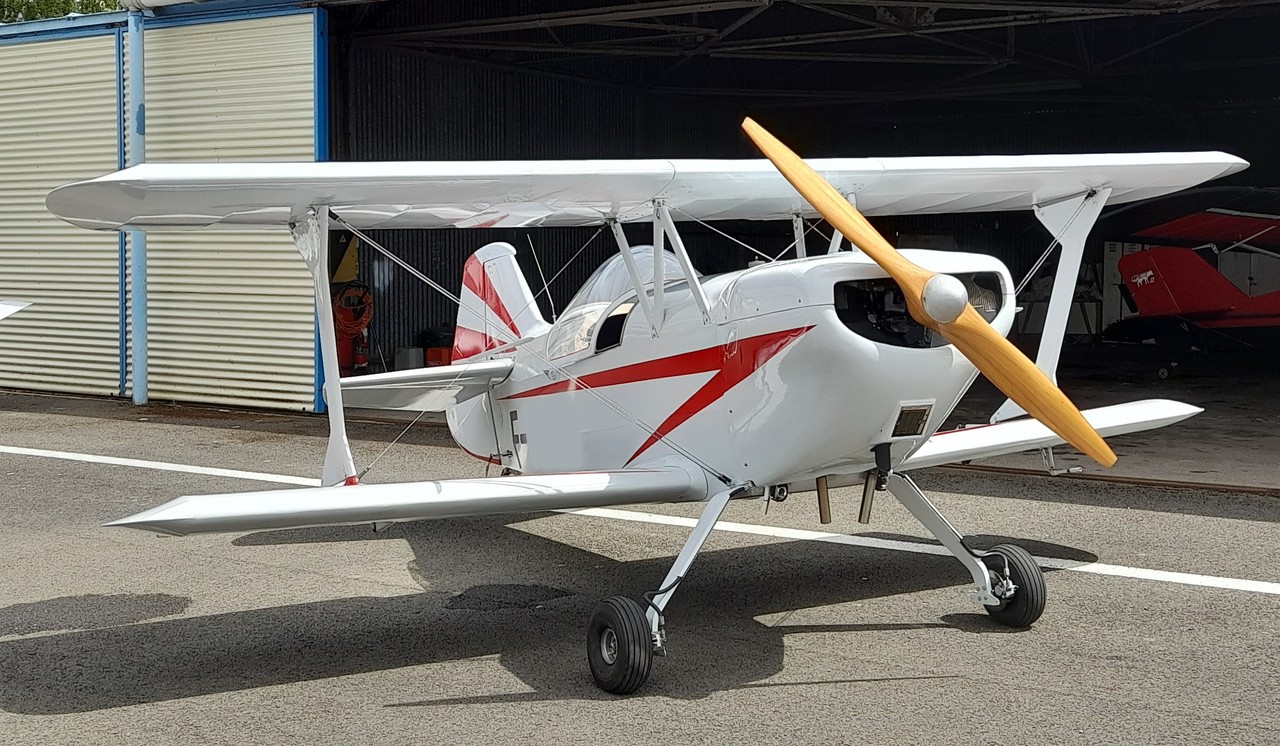
Design Origins and Development
Jean Pottier conceived the P-60 Minacro in the late 1980s as a radical departure from his established design philosophy. Unlike his previous all-metal monoplanes such as the P.40 tailless monoplane from 1975, the Minacro embraced traditional biplane construction methods using wooden framework covered in fabric. Pottier's design objectives centered on creating an affordable, single-seat aerobatic aircraft that amateur builders could construct from plans, accepting powerplants up to 125 horsepower.
The prototype emerged in Austria around 1991-1992 as OE-AGM, construction number 01, powered by a 105-horsepower Potez 4E-20A engine. This initial example validated Pottier's design concept, demonstrating the aircraft's aerobatic capabilities and construction feasibility for amateur builders.
Production and Variants
The P-60 family comprised two primary variants. The original P-60 saw limited production with at least one confirmed example, the Austrian-registered prototype OE-AGM. The improved P-60A variant achieved greater success with five documented aircraft completed by the end of 1999.
Gérard Caminade completed the third overall aircraft and first French example as F-PRIJ, construction number 03, which achieved first flight in September 1992. This aircraft utilized a 90-horsepower Continental C-90 engine, establishing the powerplant preference for subsequent P-60A variants. Additional French examples included F-PBAG, which flew in 1993, and F-PGBS bearing construction number 09.
By the end of 1999, approximately six Minacro aircraft had achieved flight status across both variants, representing a modest but successful production run for a plans-built design.
Engine Specifications and Performance
The Minacro accommodated multiple engine installations, reflecting Pottier's design flexibility. The prototype utilized the French-manufactured Potez 4E-20A, a four-cylinder inline engine producing 105 horsepower. This powerplant traced its origins to 1930s development, with limited post-World War II production primarily serving training aircraft applications.
Most P-60A variants adopted American Continental engines, particularly the reliable C-90 producing 90 horsepower and the O-200-A generating 100 horsepower. Continental Motors manufactured over 50,000 units across these engine families, with the C-90 serving from approximately 1947 through the 1980s and the O-200 spanning the 1960s through 2010s. These air-cooled, flat-four engines provided proven reliability for light aircraft applications.
The aircraft's single-seat, open-cockpit configuration emphasized the pure aerobatic flying experience, though specific performance figures including maximum speed, service ceiling, and climb rates remain undocumented in available sources.
The Pottier Legacy
Jean Pottier operated independently through Avions Jean Pottier for plans distribution, developing over 40 aircraft designs from the 1960s through 1990s. His portfolio included successful designs such as the P.70S with 52 aircraft built by 1977 and the P.220S Koala achieving 379 completions by 1997. Earlier in his career, Pottier collaborated with Robert Jacquet as technical chiefs producing designs like the JP.15/36 "Aiglon" sailplane in 1974.
The P-60 Minacro represented a unique position within Pottier's catalog as his first biplane design, demonstrating his versatility beyond the all-metal construction that characterized his earlier work. This wooden biplane proved that affordable aerobatic aircraft remained achievable for amateur builders during the post-1980s resurgence in French homebuilt aviation.
Current Status and Legacy
Pottier's death marked the end of active design development, with no company continuing under his name today. However, several Minacro aircraft persisted into the 2010s, with F-PBAG documented in photographic records as late as 2017, suggesting continued airworthiness among the small fleet.
The Smithsonian Institution's research database includes the P-60 Minacro, though specific museum examples and locations remain unspecified in available documentation. The aircraft's legacy endures within niche homebuilt aviation circles, representing successful plans-built construction and the enduring appeal of traditional aerobatic biplanes.
While production numbers remained modest compared to Pottier's more popular designs, the Minacro achieved its designer's objective of providing amateur builders access to aerobatic biplane flight through proven construction techniques and readily available powerplants.