
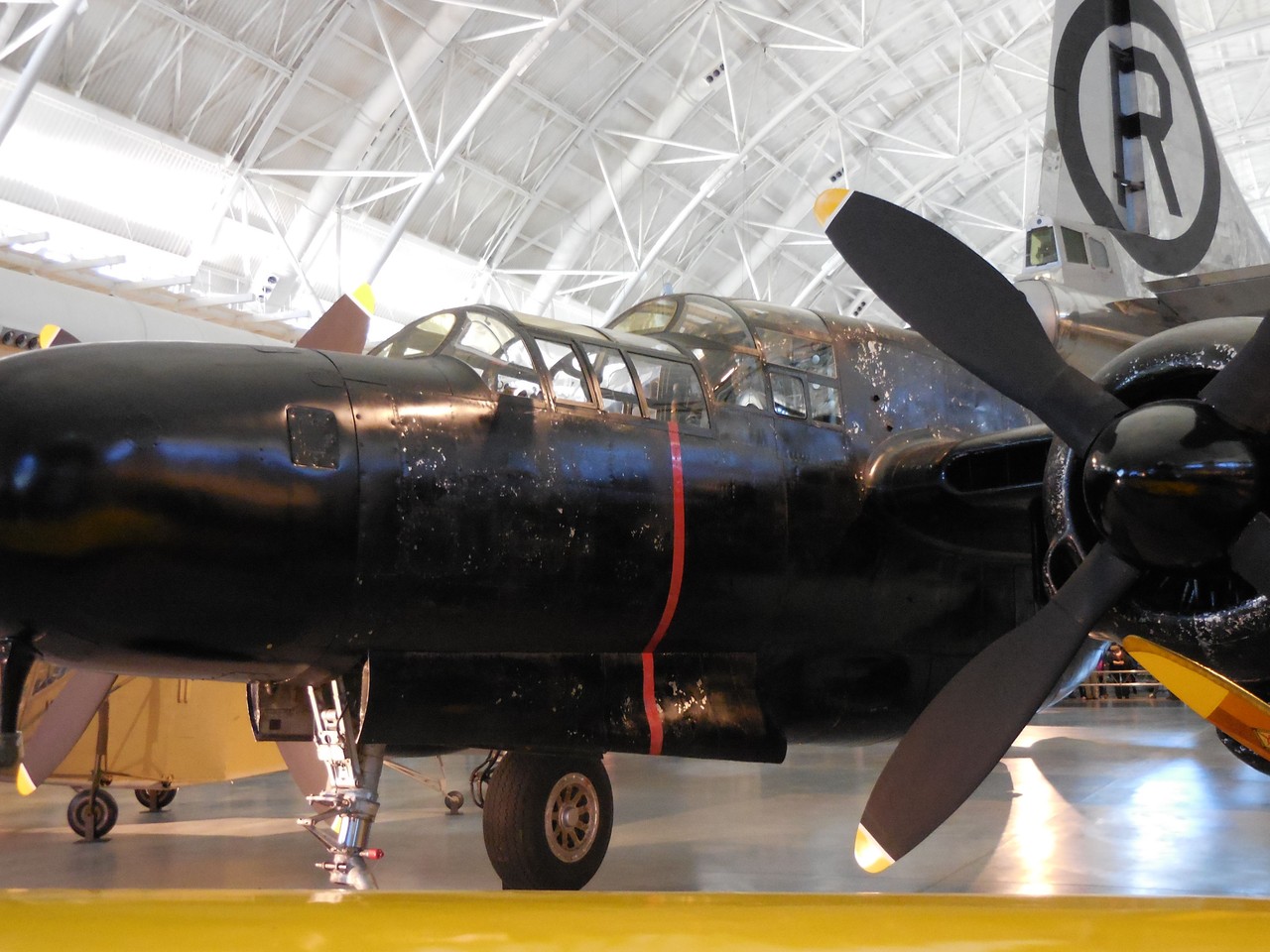
Wartime Service History
The P-61 Black Widow entered combat operations in 1944, serving exclusively with the U.S. Army Air Forces in both Pacific and European theaters. By mid-1944, three squadrons operated in the Pacific, while the 422nd and 425th Night Fighter Squadrons deployed to Europe. The aircraft achieved its first kill on June 30, 1944, when the 6th Night Fighter Squadron based at Guadalcanal downed a Mitsubishi G4M "Betty" bomber. European operations proved equally successful, with the 422nd and 425th squadrons destroying five German aircraft between February 4 and April 10, 1945.
The Black Widow's operational debut came on June 25, 1944, with its first mission following D-Day. Despite its effectiveness, spare parts shortages plagued European operations, reducing both the 422nd and 425th squadrons to ten or fewer aircraft each by late 1944. The aircraft served until war's end in 1945, quickly becoming obsolete in the post-war era.
Design Innovation and Development
Jack Northrop led the design team that formalized the concept as Northrop Specification 8A on December 5, 1940. The design objectives centered on creating an all-weather interceptor incorporating revolutionary features: nose-mounted SCR-720 AI radar, a twin-boom configuration to accommodate a remote-controlled dorsal turret, and heavy armament for devastating nocturnal attacks.
The prototype XP-61, piloted by Vance Breese, first took flight on May 26, 1942. The aircraft featured groundbreaking innovations including its all-metal twin-boom structure, integrated radar system, full-span retractable flaps, and tricycle landing gear. This three-crew configuration allowed specialized roles: the pilot focused on flying, the radar operator managed intercepts, and the gunner controlled defensive armament.
The Northrop Corporation
Northrop Corporation, founded in 1939 by aviation pioneer Jack Northrop, manufactured all 706 Black Widows at their Hawthorne, California facility between October 1943 and January 1946. The company emerged from Northrop's earlier venture, Northrop Aircraft Corporation (1928-1939), which had gained recognition for innovative designs including the N-1M "Jeep" flying wing prototype in 1940.
Northrop operated as an independent entity until 1994, when it merged with Grumman to form Northrop Grumman Corporation. Today, Northrop Grumman continues as a major aerospace and defense contractor, carrying forward Jack Northrop's legacy of innovative aircraft design.
Powerplant and Technical Specifications
Twin Pratt & Whitney R-2800 Double Wasp engines powered the Black Widow, each producing 2,000 horsepower. These 18-cylinder air-cooled radial engines, manufactured by Pratt & Whitney from 1939 to 1960, proved exceptionally reliable throughout the war. Over 125,000 R-2800 engines were produced, powering iconic aircraft including the P-47 Thunderbolt and F4U Corsair.
Early P-61A and B models used R-2800-10 engines, while the later P-61C variant employed turbocharged R-2800-73 engines for enhanced high-altitude performance, achieving 430 mph at 30,000 feet compared to the standard 375 mph at 20,000 feet.
Combat Capabilities and Armament
The Black Widow's formidable armament consisted of four 20mm Hispano M2 cannons mounted in the belly and four .50-caliber M2 Browning machine guns in the dorsal turret. Wing racks could carry up to four 1,600-pound bombs or drop tanks, extending the aircraft's range to 1,000 miles. With a service ceiling of 33,400 feet and climb rate of 2,000 feet per minute, the P-61 could intercept high-altitude raiders effectively.
The aircraft's 66-foot wingspan and 51-foot, 7-inch length housed sophisticated radar equipment that gave it unparalleled night-fighting capabilities. This combination of radar, firepower, and performance made the Black Widow a feared nocturnal predator.
Production Variants and Legacy
Northrop produced several variants during the war: two XP-61 prototypes, 13 YP-61 pre-production aircraft, standard P-61A and improved P-61B models, and 41 P-61C aircraft with turbocharged engines built between July 1945 and January 1946. Additionally, 36 aircraft were converted to F-15A Reporter photo-reconnaissance variants in 1945.
Today, only four P-61s survive, with none remaining airworthy. Notable examples include P-61B-15-NO (42-39715) displayed at Beijing Air and Space Museum at Beihang University, China, and P-61C-1-NO (43-8330) at the Smithsonian National Air and Space Museum's Udvar-Hazy Center. As America's first production night fighter, the Black Widow pioneered radar-equipped interception techniques that influenced post-war all-weather fighter development, securing its place in aviation history despite its brief operational career.