
Service History
The P-166A carved out a specialized niche in commercial aviation by enabling airline service to previously inaccessible airstrips across challenging terrain. Exactly 29 P-166AL1 aircraft were constructed, with approximately 15 operating in Australia during the early 1960s as commuter airliners. Patair of New Guinea became the first commercial operator when their VH-PAP entered service on October 8, 1959, after placing their order on May 8, 1959. The aircraft proved invaluable on high-altitude and short-field routes, effectively replacing aging Avro Ansons with significantly improved payload capacity.
Other notable operators included Alitalia for executive transport duties, Macrobertson Miller Airlines, Ansett Transport Industries, and Tasman Airlines throughout Australia. The Australian Department of Civil Aviation also operated one example, demonstrating the type's versatility in government service roles.
The Manufacturer
Piaggio's aviation heritage stretches back to 1884 when Rinaldo Piaggio established the company, making it one of the world's oldest aircraft manufacturers upon entering aviation in 1915 with their first aircraft production. The company survived World War II disruptions and diversified into motor scooters, including the famous Vespa line, while maintaining aerospace operations through various corporate restructurings.
Manufacturing of the P-166A occurred at Piaggio's Finale Ligure facilities in Italy, with assembly operations also connected to Meccaniche Rinaldo Piaggio S.p.A. in Genoa. The company later became Piaggio Aero Industries in 1998, continuing aircraft production until bankruptcy in 2018 ended independent aviation operations. Today, Piaggio continues as Piaggio & C. SpA, focusing primarily on motorcycles and scooters rather than aircraft.
Engine & Technical Innovation
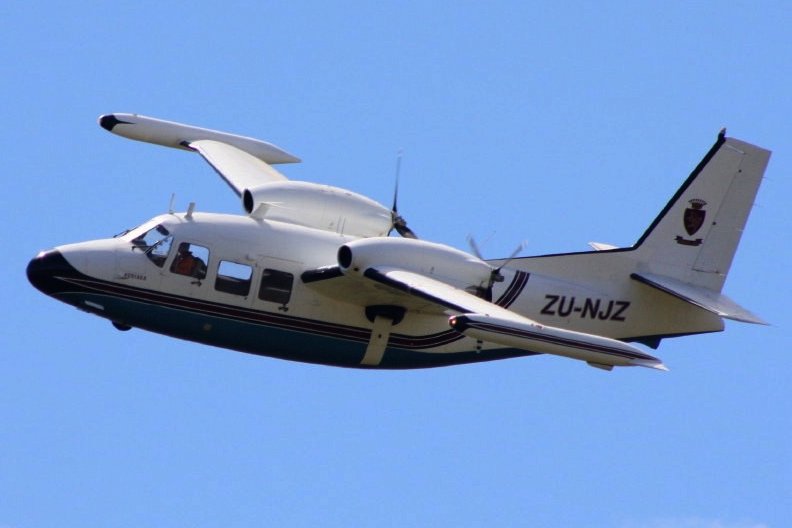
The P-166A's distinctive character stemmed from its powerplant configuration featuring two 340-horsepower Lycoming GSO-480-B1C6 engines. These six-cylinder, horizontally-opposed, air-cooled engines incorporated geared supercharging for enhanced high-altitude performance. The pusher arrangement, inherited from the P.136 amphibian design lineage, provided exceptional propeller ground clearance and unobstructed cabin space.
Lead designer Giovanni Casiraghi achieved this innovative layout by mating the wing and empennage from the proven P.136 amphibian with an entirely new fuselage and tail unit. The retained gull-wing design became a signature feature, contributing to the aircraft's distinctive appearance while providing structural benefits for the pusher engine installation.
Development and Testing
Prototype I-RAIF, carrying serial number 341, completed its maiden flight on November 26, 1957, at Villanova d'Albenga airfield near Genoa under the command of test pilot Aldo Gasperi. The development program proceeded smoothly, leading to ENAC certification on October 28, 1958, for the base model. Production commenced immediately afterward in 1958, representing rapid progression from prototype to certified aircraft.
The design objectives specifically targeted six-to-eight-seat light utility transport requirements for commercial executive use, feeder airline operations, and rough airstrip capability. Later variants expanded capacity to accommodate up to twelve passengers, demonstrating the basic design's scalability.
Military Applications
While the P-166A itself served primarily in civilian roles, the broader P.166 family found extensive military application. The Italian Air Force operated 51 P.166M variants for utility transport and maritime patrol missions. The South African Air Force acquired P.166S Albatros variants, while Italian services included the Coast Guard and Guardia di Finanza operating specialized versions.
One notable military example, P.166-DL3 MM.25165, first flew on September 22, 1989, serving with the Italian Coast Guard under callsign Orca 7. The Guardia di Finanza acquired two ex-Alitalia P.166-DL3 aircraft in 1990, followed by ten new P.166-DL3/SEM variants delivered between 1991 and 1995.
Production Legacy
Total P.166 family production exceeded 150 aircraft across all variants, with piston-engine versions like the P-166A representing approximately 110-113 airframes before production shifted to turboprop variants. The P-166A specifically ended production after 29 examples, succeeded by the more powerful P.166B Portofino, which first flew on March 27, 1962, with upgraded 380-horsepower Lycoming IGSO-540-A1C engines.
Fewer than ten P.166 aircraft remain airworthy worldwide today. Notable preserved examples include I-FENI, a P-166C restored in November 2010 in Italy, and VH-FSC at Essendon, Victoria, Australia. The HARS Aviation Museum at Shellharbour Airport displays c/n 365, a P.166 Portofino retired in 2002 and acquired in 2008, while MM.25165 is preserved at Volandia Parco e Museo del Volo in Italy.