
Design and Development
Jean Pottier conceived the P-70 as his second production aircraft design, following his experimental P-40 model that began development in 1967. His design philosophy centered on creating simple, affordable sport aircraft that amateur builders could construct using readily available materials and powerplants. The P-70 embodied this approach with its all-metal construction, straightforward assembly techniques, and adaptation of mass-produced Volkswagen automotive engines for aviation use.
The prototype P-70B, designated S.70 VS and later registered as F-PVQG, was constructed by Alain Besneux beginning around 1974. This initial variant incorporated a 50-horsepower Volkswagen conversion and served as the proof-of-concept for the design. The success of this prototype led directly to the refined P-70S production version, with construction of the first example (F-PYEF, serial number 02) beginning in January 1974.
Production History
The P-70S achieved its maiden flight in 1977 and entered regular production that same year. Unlike traditional aircraft manufacturing, Avions Jean Pottier distributed construction plans to individual builders rather than operating a centralized factory. This approach kept costs low while allowing customization to suit local regulations and builder preferences.
Production numbers remained modest but respectable for the homebuilt market. The P-70B remained a one-off prototype, while the P-70S achieved a production run of 52 aircraft. Notable examples included F-PYII, F-PRPC, and F-PYOM (serial number 40), indicating steady construction throughout the late 1970s. The design's success spawned the improved P-80S variant beginning in 1977, which incorporated refinements and eventually saw 80 examples built.
Technical Innovation
The P-70's most significant innovation lay in its powerplant selection. Rather than expensive purpose-built aircraft engines, Pottier specified modified Volkswagen flat-four automotive engines, typically 1,500cc or 2,000cc variants producing 30 to 40 horsepower. This choice dramatically reduced operating costs while maintaining reliability, as replacement parts remained widely available through automotive suppliers.
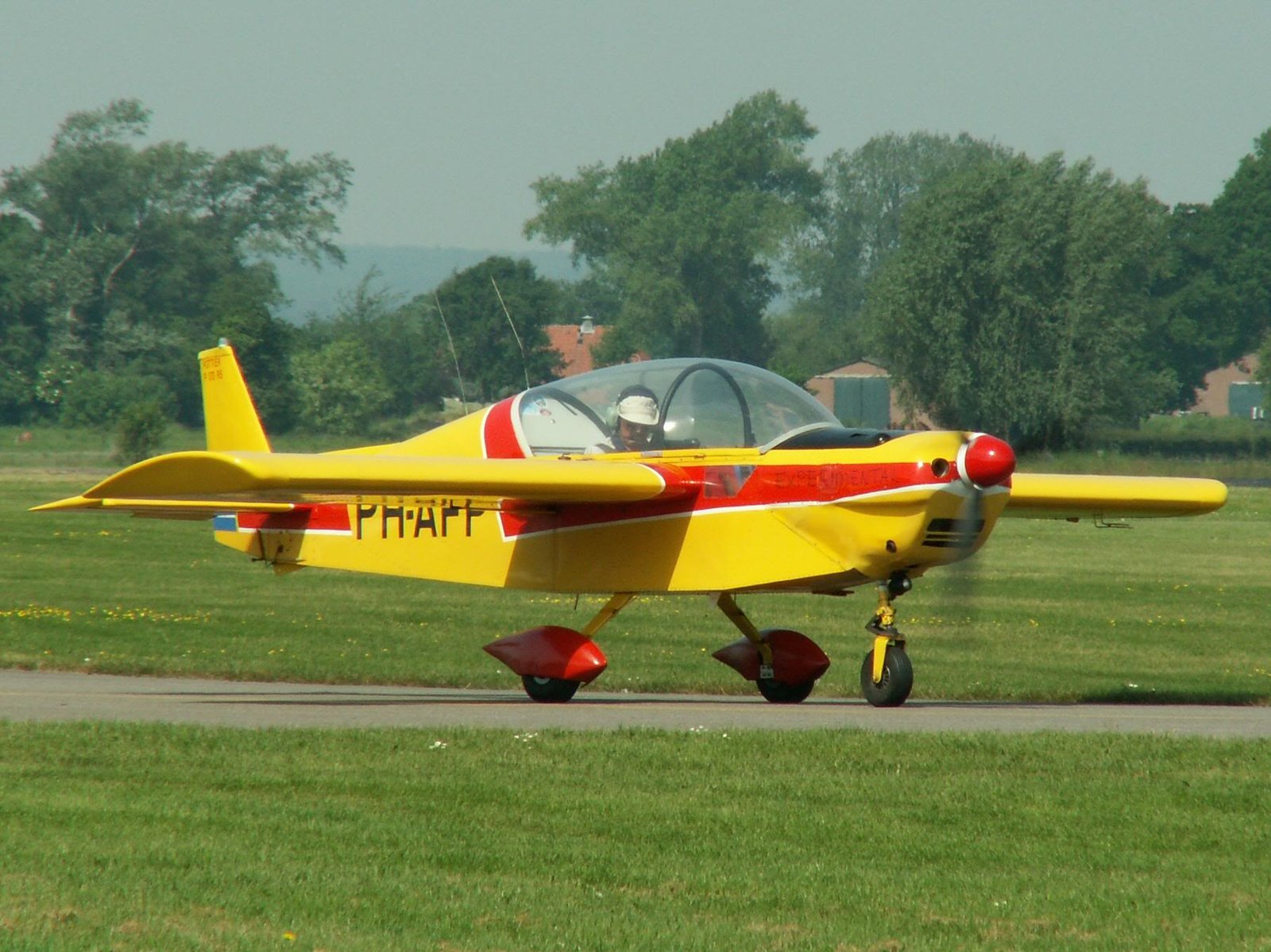
The aircraft's structure employed conventional aluminum construction with a cantilever mid-wing configuration. Builders could choose between fixed tricycle or conventional tailwheel landing gear, depending on their intended operating environment. The enclosed cockpit provided weather protection while maintaining excellent visibility for the single occupant.
With an empty weight of just 215 kilograms (474 pounds) and a maximum takeoff weight of 325 kilograms (716 pounds), the P-70 achieved impressive weight efficiency. Its compact dimensions - 5.15 meters (16 feet 11 inches) long with a 5.85-meter (19 feet 2 inches) wingspan - made it suitable for small airfields while providing 7.2 square meters (78 square feet) of wing area for adequate lift.
Operational Service
The P-70 found its niche among European sport pilots and homebuilding enthusiasts. French examples like F-PYEF operated from various airfields, with documented appearances at Rotterdam in 1978 demonstrating the type's cross-border mobility. The aircraft also appeared on registers in Belgium and Switzerland, indicating modest international appeal within the European homebuilt community.
As a single-seat aircraft, the P-70 remained strictly in the recreational flying category. Its performance, while not spectacular, proved adequate for local sport flying and served as an excellent introduction to homebuilt aviation for many builders. The straightforward construction and forgiving flight characteristics made it particularly suitable for first-time aircraft builders.
The Pottier Legacy
Avions Jean Pottier continued operations from the late 1960s into the 2000s, ultimately producing plans for over 20 different aircraft types. The P-70's success provided a foundation for more ambitious designs, including the P-170S (approximately 5 built from 1979) and eventually the highly successful P-220S "Koala" which achieved 379 completions by 1997.
Jean Pottier's design philosophy emphasized practical, buildable aircraft over cutting-edge performance, an approach that resonated with the growing European homebuilt movement. The P-70 demonstrated that metal construction could be accessible to amateur builders, influencing subsequent homebuilt designs throughout Europe.
Current Status
With production ending in the late 1970s and no central manufacturer support, few P-70s likely remain airworthy today. The aircraft's homebuilt nature means maintenance and parts availability depend entirely on individual owner initiative. However, the design's influence persists in the broader homebuilt aviation community, where Pottier's emphasis on simple, practical construction continues to inspire new designs.
The P-70 represents an important chapter in European homebuilt aviation, bridging the gap between one-off experimental aircraft and the sophisticated kit planes that would dominate the market in later decades.