
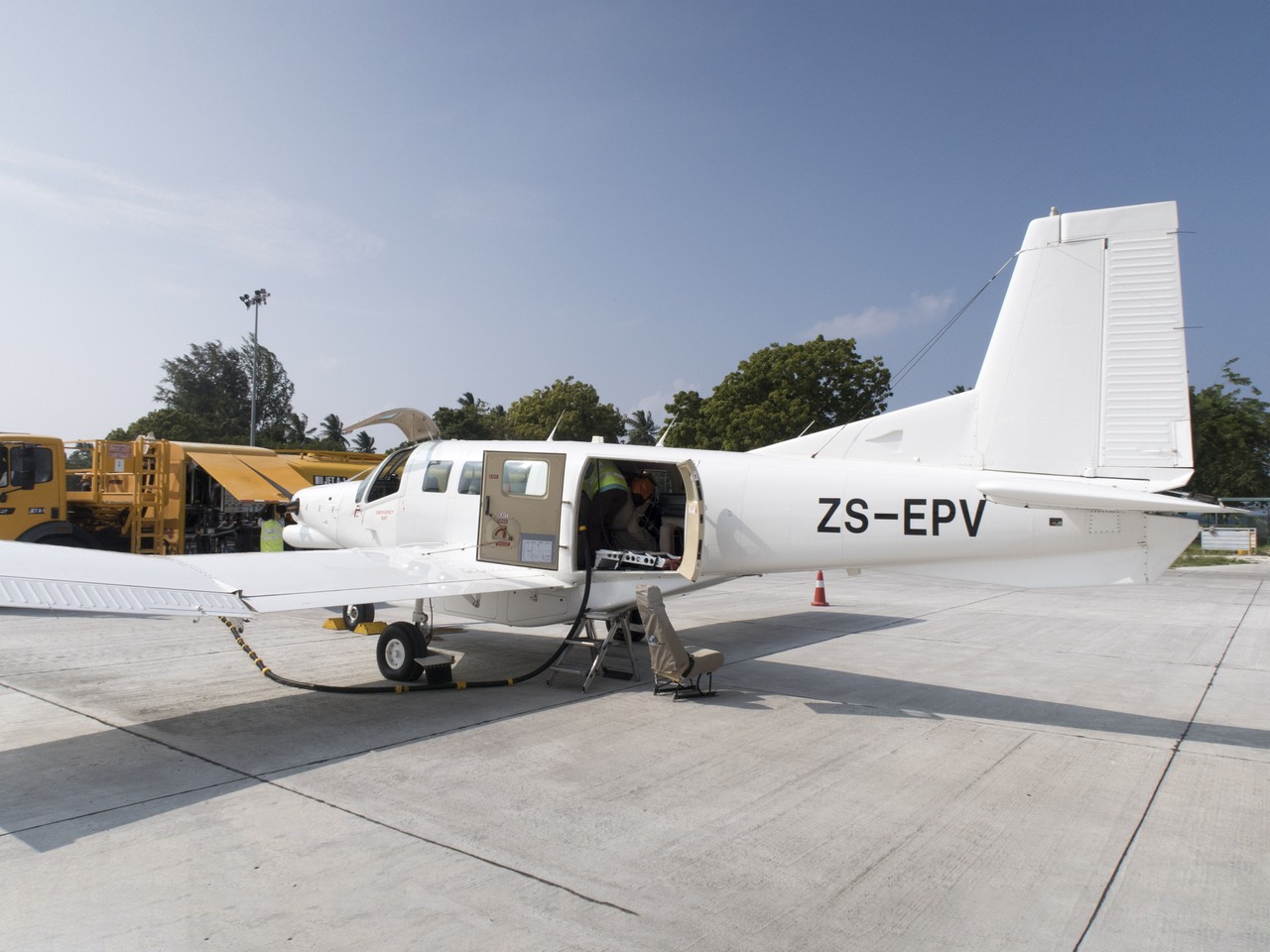
Development Origins
The P-750 XSTOL emerged from a specific market request in 1999 when representatives from the United States skydiving industry approached Pacific Aerospace Corporation seeking an enlarged version of their existing Cresco aircraft. The skydiving operators required an aircraft capable of carrying 17 skydivers to altitude and returning to the departure point within 15 to 16 minutes, while maintaining rugged construction, ease of operation, and low maintenance costs.
Pacific Aerospace expanded the design objectives beyond the initial skydiving mission to encompass freight transport, passenger operations, agricultural spraying, firefighting, aerial photography, and surveying roles. The development team substantially modified the original Cresco design, replacing or upgrading the wings, ailerons, flaps, and fuel systems to meet the demanding performance requirements.
Certification Achievement
The aircraft completed its maiden flight in 2001 and achieved FAA certification on March 10, 2004, after a development program lasting 52 months from initial drawings to certification—considered remarkable in aircraft certification timelines. This rapid development reflected Pacific Aerospace's five decades of design experience, building upon their established reputation in utility aircraft manufacturing.
In 2012, the P-750 XSTOL gained certification against ICAO Annex 6 for Single Engine IFR Passenger Transport Operations, qualifying it for commercial passenger service under instrument flight conditions—a significant achievement for a single-engine aircraft.
The Manufacturer
Pacific Aerospace Limited has operated continuously since 1954 from its Hamilton, New Zealand manufacturing facility. Over its operational history, the company has produced more than 600 aircraft, establishing itself as a leading manufacturer of specialized utility aircraft. The company remains active today, continuing P-750 XSTOL production alongside other aircraft models.
The P-750 XSTOL represents the culmination of Pacific Aerospace's design philosophy evolution, incorporating lessons learned from decades of utility aircraft development and operation in demanding environments worldwide.
Powerplant and Performance
The aircraft's exceptional short-field performance stems from its Pratt & Whitney Canada PT6A-34 turboprop engine producing 750 horsepower. This powerplant drives a three-bladed Hartzell constant-speed propeller with full feathering and reversible pitch capability, rotating at 2,200 rpm. The 2.43-meter diameter propeller maintains 0.48-meter ground clearance.
The PT6A-34 incorporates an epicyclic reduction gearbox to minimize propeller noise, combined with multistage axial and single-stage centrifugal compressors, reverse-flow combustor, and single-stage compressor turbine. This configuration delivers reliable power across the aircraft's operational envelope while maintaining fuel consumption at 50 gallons per hour.
Operational Capabilities
With a maximum speed of 315 kilometers per hour and cruise speed of 259 kilometers per hour, the P-750 XSTOL achieves a service ceiling of 6,096 meters and range of 1,179 nautical miles with 45-minute fuel reserves. The aircraft's 5.4 meters per second rate of climb enables rapid altitude gains essential for skydiving operations.
The 240-cubic-foot cabin accommodates rapid reconfiguration between passenger, cargo, and specialized mission configurations. When equipped for agricultural spraying, the aircraft carries a 2,272-kilogram chemical hopper, while passenger configuration seats up to 10 occupants including the pilot.
Global Market Penetration
By May 2010, approximately 66 P-750 XSTOL aircraft had entered service worldwide. The 2008 order book included 50 aircraft distributed across New Zealand (13), North and South America (16), Europe (9), Africa (9), Southeast Asia (12), and Central Asia (2). The United States imported 12 aircraft specifically for skydiving operations by July 2009.
In April 2010, Pacific Aerospace signed an exclusive distribution agreement with InterGlobe General Aviation covering India, Sri Lanka, Bangladesh, and the Maldives, expanding market presence in South Asia's growing aviation sector.
Operational Versatility
The P-750 XSTOL's XSTOL capabilities enable operations from grass strips, dirt runways, and semi-prepared airfields where conventional aircraft cannot operate safely. This versatility makes it valuable for remote area operations including medical evacuation, supply missions, and resource exploration support.
Notable operators include GoJump America for skydiving services, while numerous operators worldwide employ the aircraft for cargo transport, passenger service, and specialized missions. The aircraft's extended 150-hour inspection intervals reflect robust design and reliable operation in demanding environments.
Current Status
The P-750 XSTOL remains in active production and continues serving diverse markets worldwide. Its unique combination of short-field performance, payload capacity, and operational flexibility has established it as the definitive XSTOL utility aircraft, unmatched by competing production aircraft in its performance category.