
Combat Legacy
The P-82 Twin Mustang arrived too late for World War II but proved its worth during the Korean War, where USAF Twin Mustangs claimed 20 North Korean aircraft destroyed between 1950 and 1953. Operating primarily as night and all-weather fighters, F-82Es replaced aging P-61 Black Widows in frontline service. The aircraft served with distinction until November 12, 1953, when the last operational Twin Mustangs were retired in favor of jet-powered F-94 Starfires.
Strategic Air Command Service
From 1948 to 1953, the P-82 served as a long-range escort fighter with Strategic Air Command during the early Cold War period. The aircraft's exceptional range capability made it ideal for protecting B-29 Superfortress bombers on extended missions across the Pacific. F-82E variants entered operational service in May 1948, with 118 aircraft accepted by the Air Force through 1949.
North American Aviation Heritage
North American Aviation produced all 272 Twin Mustangs at their Inglewood, California facility between 1945 and 1949. Founded in 1929, NAA had already established itself as a premier military aircraft manufacturer through production of the legendary P-51 Mustang during World War II. The company continued operations until 1967, when Rockwell International acquired it. Today, North American Aviation's legacy lives on under Boeing, which absorbed Rockwell's aerospace operations in 1996.
Revolutionary Design Philosophy
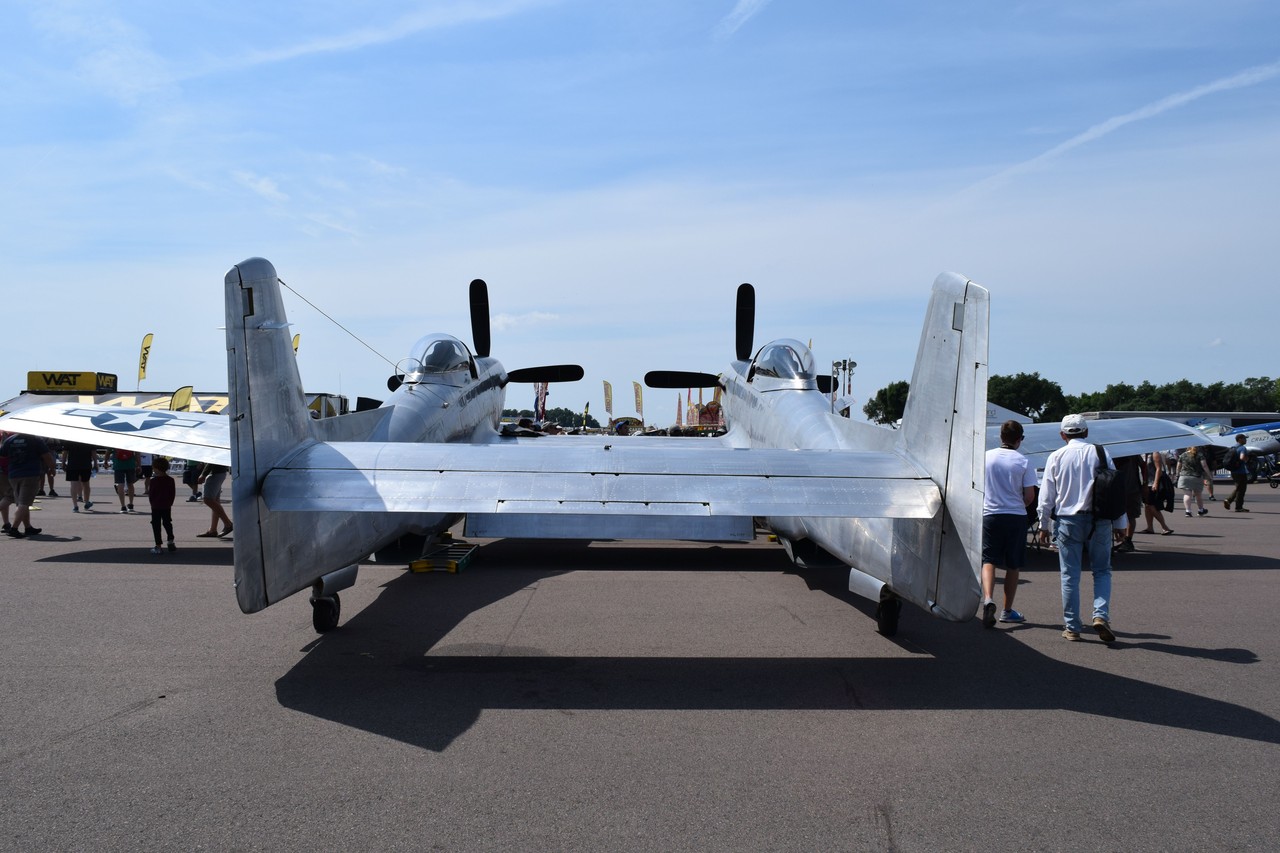
Design Chief Edgar Schmued conceived the twin-fuselage configuration in November 1943 to meet the Army Air Forces' requirement for an ultra-long-range escort fighter. The innovative design essentially joined two modified P-51 airframes with a central wing section and horizontal stabilizer, creating an aircraft with more than twice the range of a standard Mustang. Dual cockpits allowed pilots to alternate flying duties during missions exceeding 14 hours, addressing crew fatigue on transpacific flights.
Powerplant Evolution
Early P-82 variants utilized twin Packard V-1650 Merlin engines, each producing 1,650 horsepower. These license-built Rolls-Royce Merlin V-12 engines provided exceptional reliability and performance for long-range operations. However, later F-82E production models switched to Allison V-1710-100 engines due to post-war procurement decisions, though these powerplants delivered inferior performance compared to the Packard-built Merlins.
Record-Breaking Performance
On February 27, 1947, P-82B "Betty Jo" (serial number 44-65168) established a remarkable long-distance record by flying non-stop from New York to Hawaii. Pilots Lieutenant Colonel Paul "Bud" Evans and Lieutenant John Ard completed the 5,051-mile journey in 14 hours and 32 minutes, demonstrating the Twin Mustang's extraordinary range capability. This flight showcased the aircraft's potential for transpacific operations that originally drove its development.
Production Variants
North American built multiple P-82 variants, beginning with three XP-82/XP-82A prototypes in 1945. Production continued with 20 P-82B aircraft, followed by the definitive F-82E model that comprised the majority of Twin Mustang production. The EF-82B designation applied to aircraft modified for NACA research duties, including the record-setting "Betty Jo" which served as a flying testbed after its famous transpacific flight.
Museum Preservation
Today, surviving P-82 Twin Mustangs remain extremely rare, with most examples residing in museums rather than active flight status. The EF-82B "Betty Jo" is preserved at NASA's John H. Glenn Research Center in Cleveland, Ohio, honoring both its record-breaking flight and subsequent research contributions. One XF-82 prototype recently returned to flight after a 70-year restoration, representing a remarkable achievement in warbird preservation efforts.
Historical Significance
The P-82 Twin Mustang represents a unique chapter in aviation history as the final piston-powered fighter to serve operationally with the United States Air Force. Its innovative twin-fuselage design solved the specific challenge of very long-range escort missions while maintaining fighter performance characteristics. Though overshadowed by the rapid transition to jet aircraft, the Twin Mustang successfully bridged the gap between World War II-era piston fighters and the jet age that followed.