
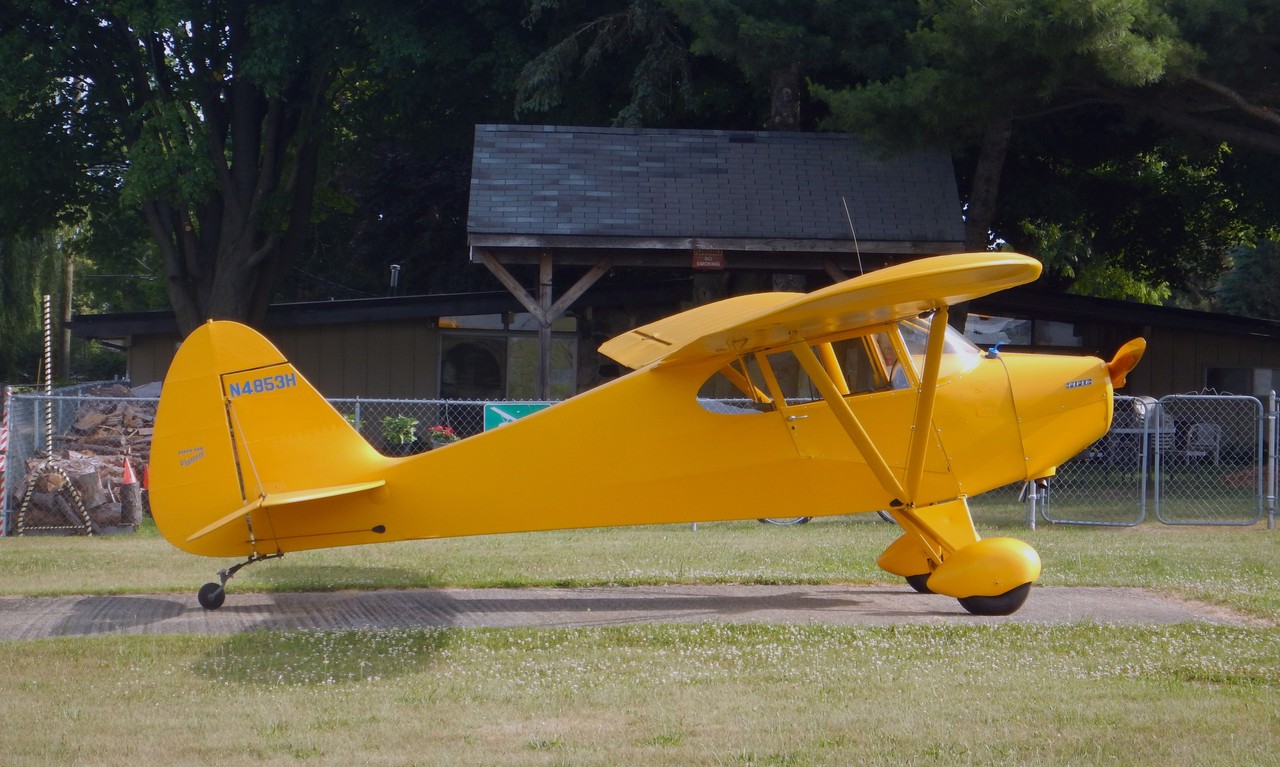
Post-War Revival
The PA-15 Vagabond emerged from desperate circumstances that nearly ended Piper Aircraft's existence. Following World War II, the company faced severe financial difficulties that temporarily suspended operations. William T. Piper's son Howard led a skeletal engineering team of just four people who conceived the Vagabond design between September 12-15, 1947. Their mandate was clear: create an aircraft that could be built quickly and cheaply using existing Piper Cub tooling to generate immediate revenue.
The engineering team froze the design within the first week, and remarkably, the prototype took to the skies just 45 days after conception on November 3, 1947. This unprecedented development speed reflected both the urgency of Piper's financial situation and the practical approach of maximizing existing components. The Federal Aviation Administration issued a Temporary Certificate on February 4, 1948, with the first production aircraft rolling out on February 20, 1948.
Design Philosophy
Howard Piper's team prioritized economy over performance, creating an aircraft that shared the Cub's tail assembly, landing gear, and most wing components while introducing a completely new fuselage configuration. Instead of the Cub's traditional tandem seating, the Vagabond featured side-by-side accommodation, making it more appealing to couples and flight training operations.
The design team reduced the wingspan from the Cub's 36 feet to 29 feet by eliminating one wing bay, cutting material costs while creating a more compact aircraft. At 18 feet 8 inches in length with 147 square feet of wing area compared to the Cub's 178.5 square feet, the Vagabond represented a study in efficient engineering. The aircraft utilized the USA 35B airfoil and maintained the high-wing configuration that made Piper famous.
Powerplant and Performance
Lycoming's O-145 engine powered the PA-15, a four-cylinder air-cooled horizontally-opposed powerplant producing 65 horsepower through a fixed-pitch two-bladed propeller. This engine, manufactured by Lycoming Engines from the early 1940s through the 1950s, was selected specifically for its low cost, light weight, and economical operation.
Despite its modest power output, the Vagabond delivered respectable performance for its era. Maximum cruise speed reached 87 knots with a range of 220 nautical miles from its 12-gallon fuel capacity. The aircraft could climb at 510 feet per minute to a service ceiling of 10,000 feet, with an absolute ceiling of 11,500 feet. Most impressively for a budget aircraft, it required only 900 feet for takeoff and just 300 feet for landing, with an approach speed of 39 knots.
The Manufacturer's Journey
Piper Aircraft originated in 1927 as Taylor Brothers Aircraft Manufacturing Company, founded by William T. Piper and George L. Taylor before becoming Piper Aircraft in 1930. The Vagabond's success proved crucial to the company's survival, generating enough revenue to prevent bankruptcy through the intelligent reuse of existing tooling and components.
The company has endured multiple ownership changes throughout its history, including acquisition by Bangor Punta in 1969, a 1987 buyout that led to bankruptcy in 1991, and subsequent revival under new ownership. Today operating as Piper Aircraft Inc., the company remains active in aircraft manufacturing, holding over 150 type certificates and having produced more than 140,000 aircraft throughout its history.
Production and Variants
Piper manufactured exactly 387 PA-15 Vagabonds at its Lock Haven, Pennsylvania facility, plus one aircraft converted from a PA-17. The related PA-17 variant, powered by a Continental A-65-8 engine and featuring dual controls with bungee landing gear, saw 214 examples built. Production ran from January 1948 through 1949, with both variants manufactured simultaneously.
The PA-15's specifications included an empty weight of 630 pounds and a gross weight of 1,100 pounds, resulting in a wing loading of 7.5 pounds per square foot. The power-to-weight ratio of 0.06 horsepower per pound reflected the aircraft's emphasis on economy rather than performance.
Legacy and Survivors
The Vagabond launched Piper's Short Wing family, which included the PA-20 Pacer, PA-22 Tri-Pacer, and PA-22-108 Colt. This lineage established Piper as a dominant force in post-war general aviation, proving that affordable, practical aircraft could succeed in the civilian market.
As of March 2018, 167 PA-15s remained registered in the United States with 101 PA-17s, while Canada recorded 13 PA-15s and 12 PA-17s still on the registry. Notable surviving examples include airshow performer Lowell White's restored Vagabond and various aircraft featured in aviation publications, demonstrating the type's enduring appeal among vintage aircraft enthusiasts.
The PA-15 Vagabond stands as more than just another light aircraft; it represents successful crisis management, innovative engineering under constraints, and the foundation of modern general aviation's emphasis on affordable flying.