
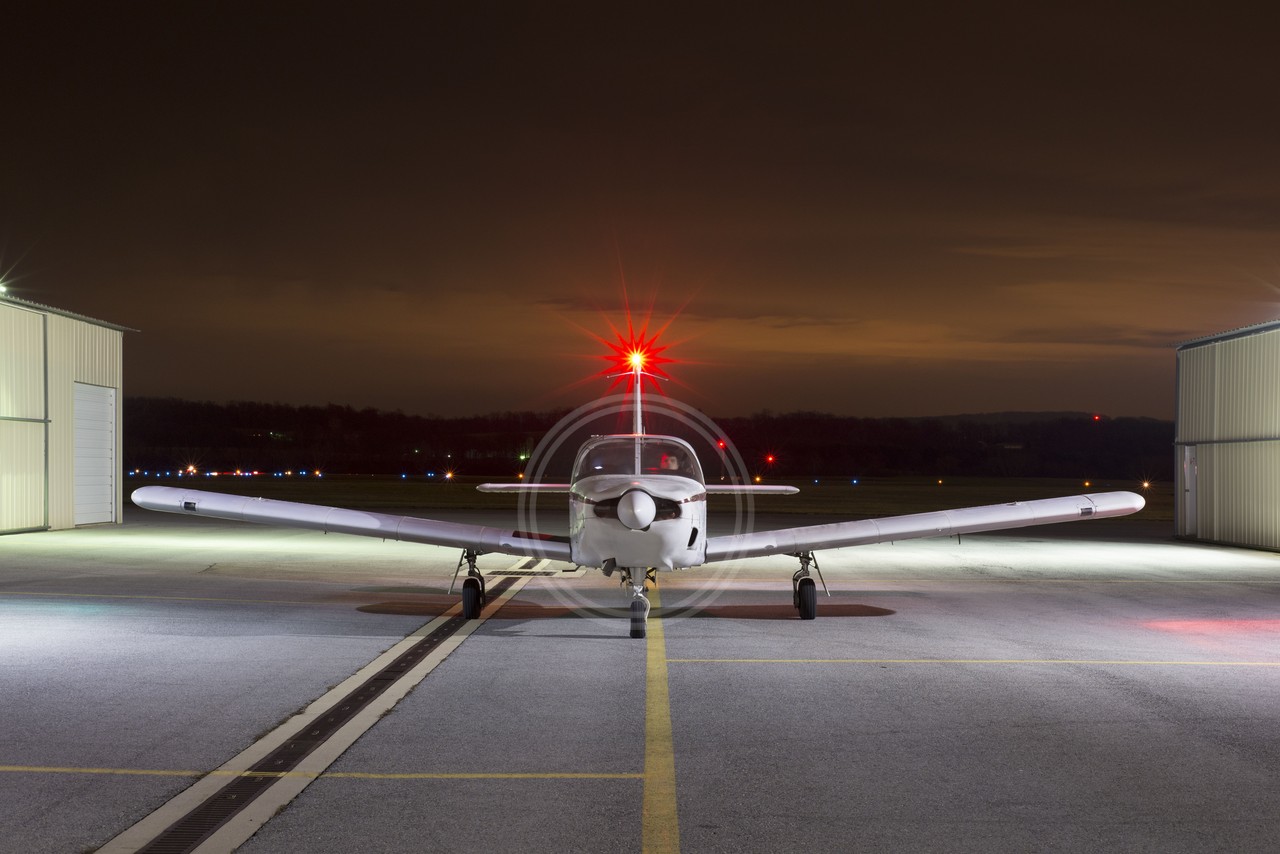
Design Origins and Development
The Saratoga's lineage traces back to 1957 when renowned aircraft designer John Thorp conducted preliminary design studies for what would become the PA-32 series. Piper Aircraft sought to create a larger, all-metal aircraft to replace the aging Tri-Pacer and meet growing market demand for six-seat single-engine aircraft. The first PA-32 prototype took flight on December 6, 1963, with FAA type certification following on March 4, 1965.
By 1980, Piper had refined the design into the Saratoga, introducing significant aerodynamic improvements. The most notable change was the adoption of a longer, semi-tapered wing derived from the "Warrior Wing" first used on the PA-28-161. This new wing design dramatically simplified fuel management by reducing the complex multi-tank system to just two wing tanks holding 107 gallons total capacity with 102 gallons usable.
Market Position and Competition
The Saratoga entered a fiercely competitive segment dominated by the Beechcraft Bonanza, directly challenging established players including the Mooney M20 series and Cessna 210. Piper positioned the aircraft as their premium single-engine offering, featuring club seating with two rows of passenger seats facing each other behind the pilot and copilot positions. This configuration became a distinctive selling point, offering a more social cabin environment than traditional forward-facing arrangements.
Three variants launched simultaneously in 1980: the fixed-gear PA-32-301 Saratoga, the retractable PA-32R-301 Saratoga SP, and the turbocharged PA-32R-301T Saratoga TC. The turbocharged model introduced a distinctive large oval air intake positioned below the propeller hub, becoming an instantly recognizable design feature.
Engine Technology and Performance
All Saratoga variants relied on Lycoming powerplants, with the naturally aspirated models using the 300-horsepower IO-540-K1G5 fuel-injected engine. The turbocharged Saratoga TC initially featured the TIO-540-S1AD engine, but Piper upgraded to the more reliable TIO-540-AH1A starting with the 1997 model year, addressing earlier reliability concerns.
The PA-32RT-300T turbocharged variant delivered impressive high-altitude performance, achieving a service ceiling of 20,000 feet with a climb rate of 1,050 feet per minute. At 10,000 feet and 75 percent power, the aircraft cruised at 175 knots true airspeed while consuming 20 gallons per hour, making it competitive with other high-performance singles of the era.
Production Evolution and Variants
Piper continuously refined the Saratoga throughout its production run. The fixed-gear version was discontinued in 1983 due to poor sales but was later revived as the 6X model. In 1993, the retractable Saratoga SP was redesignated as the Saratoga II HP, reflecting ongoing improvements to systems and interior appointments.
The aircraft's design philosophy emphasized simplicity and reliability over cutting-edge technology. Unlike the earlier Lance series which featured a T-tail configuration, the Saratoga returned to a conventional tail design, which Piper marketed as providing better handling characteristics and simplified maintenance.
Pilot Experience and Handling
Pilots appreciated the Saratoga's stable handling characteristics and spacious cabin, though the aircraft demanded respect during landing due to its relatively high wing loading. The simplified fuel system eliminated the complex fuel management procedures that plagued earlier PA-32 variants, reducing pilot workload and the potential for fuel-related incidents.
The club seating arrangement, while popular with passengers, did impact center-of-gravity management, requiring careful attention to weight and balance calculations. The large cabin doors and low wing design made passenger loading straightforward, contributing to the aircraft's popularity in charter service.
Market Decline and Discontinuation
By the mid-2000s, the Saratoga faced increasing pressure from newer competitors, particularly the Cirrus SR22 with its revolutionary ballistic parachute system. The SR22's modern avionics, composite construction, and safety innovations attracted buyers who might have previously chosen the Saratoga.
Piper made the strategic decision to discontinue Saratoga production in 2009 after 29 years, focusing resources on the more profitable PA-46 series including the pressurized Mirage and unpressurized Matrix. These larger, more capable aircraft offered better performance and higher profit margins in an increasingly challenging market.
Legacy and Current Status
While exact production numbers remain unavailable, hundreds of Saratogas continue serving in private hands and charter operations worldwide. The aircraft's reputation for solid construction and reliable systems has maintained strong resale values compared to some contemporaries. Many examples have been upgraded with modern avionics packages, extending their service life in an era of increasingly sophisticated airspace requirements.
The Saratoga represented the final evolution of Piper's PA-32 concept, embodying nearly two decades of refinement from the original Cherokee Six design. Though production has ended, the aircraft remains a testament to the era when single-engine aircraft could successfully compete on comfort and capability rather than advanced technology alone.